Arcus Hospital Partners with Stryker to Launch Robotic Hip Replacement Centre of Excellence in Pune
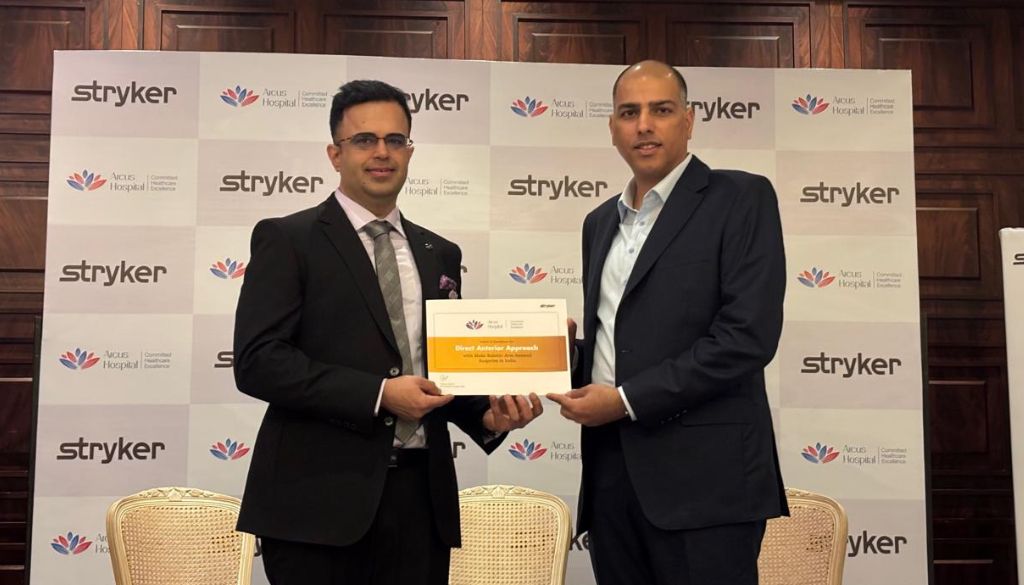
Pune, 26th February 2026: Arcus Hospital, a leading center for orthopedic care, and Stryker, a global leader in medical technologies, have announced a strategic partnership to advance robotic arm-assisted surgery in India. This collaboration designates Arcus Hospital as a Centre of Excellence for training surgeons from across India and the international medical community, with a special focus on the Direct Anterior Approach (DAA) for robotic-arm assisted hip replacement—a muscle-sparing technique that accelerates patient recovery.
Aman Rishi, Vice President and General Manager – India, Stryker, said, “Stryker’s partnership with Arcus Hospital marks an important milestone in our shared mission to improve healthcare and create lasting impact for both patients and clinicians. By introducing best-in-class robotic-arm assisted technology and advancing clinical evidence and education, we aim to empower clinicians with advanced tools, global best practices, and research-driven insights that will continue to shape the future of joint replacement.”
Dr. Rohit Luthra, Director of Arcus Hospital, first introduced the muscle-sparing Direct Anterior Approach (DAA) to India in 2018. A TED speaker with a vision, Dr. Luthra’s mission to provide pain-free mobility is built on unmatched expertise and a commitment to accessibility. His signature TruRobotics™ and MAC Precision™ techniques combine advanced robotics with surgical mastery, ensuring patients can begin moving within hours of surgery.
As one of India’s highest-volume centers for robotic hip arthroplasty, Arcus Hospital plays a pivotal role in setting new clinical benchmarks. The partnership with Stryker aims to bridge the gap between advanced technology and surgical expertise, ensuring robotic precision becomes the standard of care across the country.
Dr. Luthra said, “With Stryker as our partner, we are expanding our mission of standardized healthcare across India and globally. We are proving that the highest precision in medicine need not be a privilege for a few, but a standard available to many.”
Direct Anterior Approach Provides Faster Recovery and Greater Accuracy
Dr. Luthra explained that the Direct Anterior Approach, also called the “Front” approach, is minimally invasive and muscle-sparing. Unlike traditional methods, the incision is made at the front, and damaged bones or cartilage are removed without detaching muscles or tendons. Muscles are gently pushed aside, not cut, to place the implant. This minimizes muscle damage, allowing patients to bear weight and begin walking much sooner.
The robotic system enhances precision, ensuring the implant is positioned accurately. It allows for exact alignment based on the patient’s native hip anatomy, significantly reducing the risk of implant malposition and dislocation.
Preoperative planning is a crucial element of robotic-assisted procedures. Using CT scans, surgeons generate a 3D virtual model of the patient’s hip to determine the optimal implant size and plan the surgery. The robotic system then executes this plan with high precision. Additionally, because the patient lies supine (flat on their back), limb length can be accurately assessed during the procedure, further improving outcomes.