Can Pune Bring Workplaces Closer to Home? Kothrud and Western Pune Emerge as Potential Office Hubs
Reported by Mubarak Ansari
Pune, 19th October 2026: As Pune’s commercial real estate market expands, established residential neighbourhoods in western and central Pune could offer opportunities to develop modern office spaces closer to where professionals live. Improved metro connectivity, access to skilled talent and the availability of established social infrastructure are emerging as important considerations for companies choosing office locations.
According to CBRE’s 2026 India Office Occupier Survey, 70% of occupiers prioritise commute infrastructure when selecting office locations. Long and unpredictable commutes can affect punctuality, attendance, employee experience and companies’ ability to attract and retain talent.
Pune’s growing office market provides a backdrop for exploring additional employment hubs beyond established commercial districts such as Hinjawadi, Kharadi, Baner and Balewadi.
Colliers reported 3.2 million square feet of Grade A office absorption in Pune during the third quarter of 2026. This took the total for January to September to 6.9 million square feet, marking a 6% increase compared with the corresponding period last year.
Cushman & Wakefield, meanwhile, recorded gross office leasing of 1.99 million square feet in Pune during Q3 2026. Global capability centres (GCCs) accounted for approximately 65% of leasing activity. Banking, financial services and insurance (BFSI) was the largest contributing sector, followed by engineering and manufacturing, IT-BPM and flexible workspaces.
Companies Explore Locations Beyond Traditional Office Hubs
Industry assessments suggest that companies are increasingly considering locations beyond established commercial micro-markets as the availability of quality office buildings becomes constrained in some areas and new supply emerges elsewhere.
CBRE’s Q3 2026 India Office Figures noted a shift in transactions towards non-core corridors amid limited availability in core micro-markets and fresh supply in emerging locations. Around 51% of GCCs establishing new offices during the quarter selected secondary micro-markets, while Grade A+ buildings accounted for approximately 60% of GCC leasing.
These trends indicate that building quality, connectivity and access to talent are becoming important alongside a location’s established commercial identity. The shift could have implications for companies in technology, BFSI, engineering, consulting and professional services.
Western Pune Offers Scope for Additional Office Development
Cushman & Wakefield includes Erandwane, Karve Nagar, Paud Road and Kothrud in its SBD West office submarket, along with Aundh, Baner and Pashan.
At the end of Q3 2026, vacancy in this submarket stood at 3.9%, compared with a citywide vacancy rate of 13.88%. The planned and under-construction Grade A office supply in the submarket through 2028 was approximately 11.77 million square feet.
While large commercial developments have concentrated in areas such as Hinjawadi, Kharadi, Baner and Balewadi, several established neighbourhoods across western and central Pune have substantial residential populations and mature urban infrastructure but comparatively limited modern, institutional-quality office space.
This presents an opportunity to examine whether some future demand for commercial space can be accommodated closer to existing residential and employment catchments.
Kothrud Could Benefit From Modern Office Spaces
Kothrud, traditionally known for its residential and educational institutions, is one of the neighbourhoods that could be considered for institutional-quality office development.
The area already has housing, colleges, healthcare facilities, retail outlets, restaurants and other everyday amenities. Unlike peripheral locations where supporting infrastructure may develop alongside commercial projects, Kothrud offers the possibility of integrating modern workplaces into an established urban environment.
Its residential catchment could also help companies access local talent and potentially improve recruitment and employee retention by reducing commuting distances for some workers.
However, the extent to which Kothrud can accommodate additional office development would depend on the availability of suitable properties, planning regulations, building specifications and transport capacity.
Metro Connectivity Strengthens the Case for Western Pune
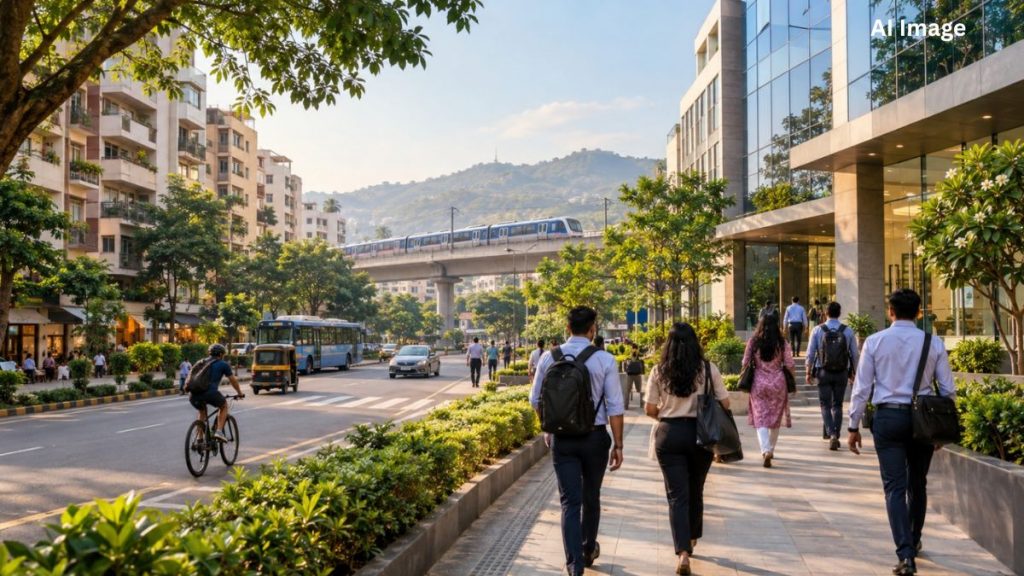
Metro connectivity is another factor supporting the wider western catchment. Stations including Vanaz, Anand Nagar, Ideal Colony and Nal Stop are part of the Vanaz–Ramwadi corridor, linking western Pune with Deccan, central Pune and the eastern corridor.
These connections can improve access for employees living nearby and those travelling from other parts of the city. The proposed Line 4A extension from Nal Stop towards Warje and Manik Baug could further strengthen connectivity across western and south-western Pune, subject to project implementation.
Better public transport, bus services, multimodal interchange facilities and reliable last-mile connectivity will remain important to making workplaces accessible.
Balancing Commercial Growth With Commuting Needs
Pune’s established commercial districts are expected to remain major employment centres. However, additional office hubs in other parts of the city could complement these locations by serving residential communities and talent pools that are currently farther from major workplaces.
Developing quality offices within established neighbourhoods could help reduce the need for some long daily journeys, while transport infrastructure improvements could make longer commutes more manageable.
As Pune plans its next phase of urban and commercial growth, the relationship between housing, workplaces and transport is likely to become increasingly significant. A broader distribution of modern office spaces, supported by public transport and suitable urban infrastructure, could bring employment opportunities closer to where more of the city’s professionals live.