IITM Pune Scientists Develop Breakthrough Method to Decode How Long Soil ‘Remembers’ Rainfall
Reported by Akshata Pawar
Pune, 10th November 2025: How long does the soil remember a burst of rain—and can that memory influence the next drought, flood, or even the monsoon? In a breakthrough, scientists at the Indian Institute of Tropical Meteorology (IITM), Pune, have decoded the actual “memory” of soil moisture using a cutting-edge information-theory framework.
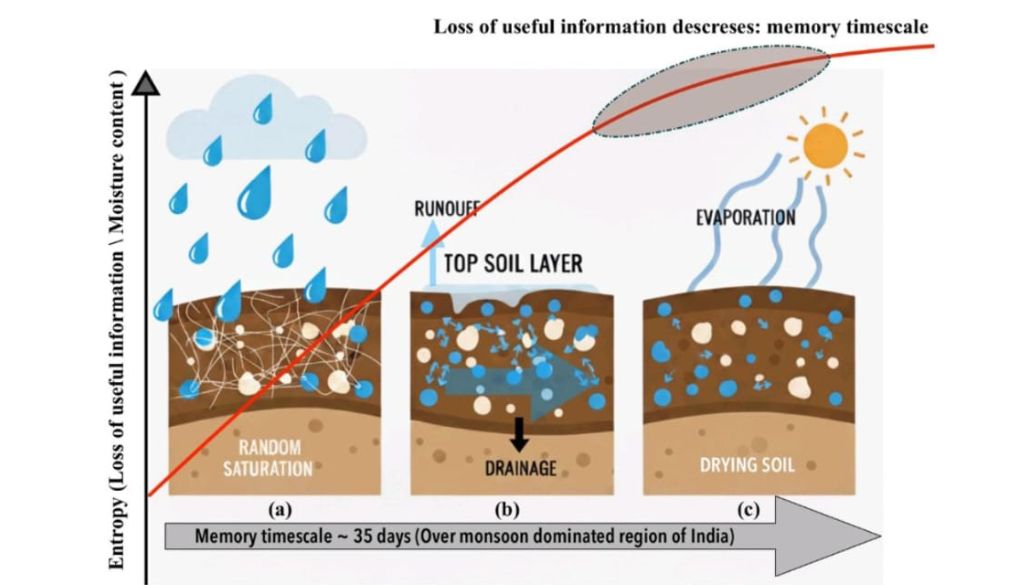
Their study reveals that soil in India’s monsoon belt retains the imprint of past rainfall for roughly 21 to 35 days, a time window far more realistic than what traditional climate models estimated for decades.
The study, authored by Madhusudan Ingale, Bhupendra Bahadur Singh, Milind Mujumdar, Mangesh Goswami, Naresh Ganeshi, C. D. Aju, R. Krishnan, and M. Ravichandran, underscores IITM Pune’s leadership in climate dynamics research under the Ministry of Earth Sciences (MoES).
The findings have been published in Physical Review Letters, one of the world’s most prestigious physics journals.
The research, titled “Persistence in Physical Systems: An Application to Soil Moisture Memory,” was led by Dr. Madhusudan Ingale under the guidance of Dr. Bhupendra Bahadur Singh from IITM’s Water, Weather, and Climate Research Lab.
The team developed a non-parametric, model-free approach based on block Shannon entropy—a mathematical tool from information theory that measures how information changes as natural systems evolve.
Traditional tools, especially autocorrelation-based methods, often assume linear behaviour and tend to overestimate soil memory, especially at daily or weekly scales where extreme weather events occur. The IITM framework overcomes these limitations, accurately identifying how quickly the soil loses information after a rainfall event and returns to its equilibrium state.
What the Study Found
Using a combination of:
modelled/reanalysis datasets, and
direct soil observations from IITM’s COSMOS site,
The researchers discovered:
Soil memory over India’s core monsoon zone is ~35 days.
At the COSMOS observational site in Pune, soil memory is ~21 days.
These durations are shorter than earlier estimates but also physically more consistent, capturing the true speed at which land systems recover from rainfall or drought.
The study also concludes:
-Soil memory is a key factor in drought development, monsoon variability, and agricultural water needs.
-A more accurate estimate helps improve land-atmosphere feedback modelling, reducing uncertainty in monsoon forecasts.
-The new approach is general enough to apply to ecological, hydrological, and socio-economic systems that exhibit persistence.
Why Soil Moisture Memory Matters
Soil moisture is the invisible bridge between land and atmosphere. Its memory influences:
-how fast or slow the land responds to rainfall,
-how droughts intensify or ease,
-how floods propagate,
-how monsoon rainfall interacts with land, and
-how much irrigation farmers will need in the coming weeks.
A small change in soil memory estimates can drastically alter predictions of water availability and weather behavior—making precise measurement crucial for both scientists and farmers.
Dr. Bhupendra Bahadur Singh, who heads the lab, said the findings correct long-standing inaccuracies, “These timescales are shorter but more physically consistent than earlier methods, which typically overstated memory. This memory plays an important role in how soil conditions influence weather, climate, and even agricultural planning.”
Lead author Dr. Madhusudan Ingale emphasized the value of using information theory, “Our framework is built on rigorous principles of information theory and offers a more realistic way to quantify memory. It captures the transition from short-term fluctuations to long-term stability—a feature traditional tools often miss.”
The team notes that improving soil moisture observations across India could further sharpen future forecasts.
The Broader Impact
The new method:
reduces uncertainty in hydroclimatic modeling,
sharpens short-term and seasonal monsoon predictions,
offers insights for irrigation and drought management, and
opens doors for analysing persistence in other natural and social systems.
For a country where both the monsoon and the soil are crucial for survival, understanding this hidden memory could help predict crises—and prevent them.