
PMC Commissioner Seeks IITM Support to Tackle Rising Air Pollution in Pune
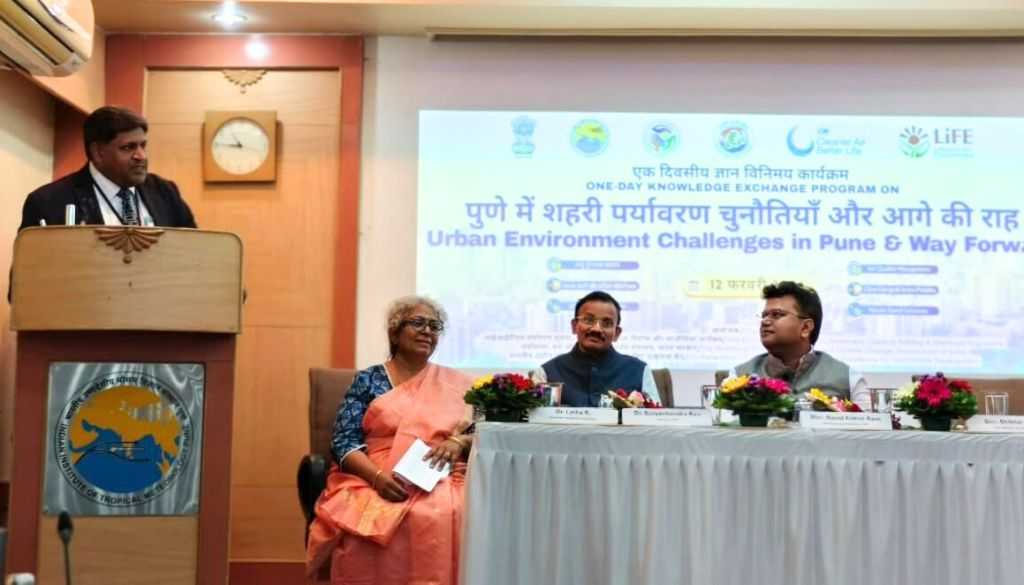
Pune, 13th February 2026: Experts, policymakers and industry leaders called for urgent, coordinated action to address rising urban environmental challenges in Pune at a one-day knowledge exchange programme held at the Indian Institute of Tropical Meteorology (IITM).
The workshop titled “Urban Environment Challenges in Pune & Way Forward” was jointly organised by the EIACP Environmental Information Awareness and Capacity Building Programme Centre at IITM and the Confederation of Indian Industry – Centre of Excellence for Sustainable Development.
In her welcome address, Dr Latha, Coordinator of the EIACP Centre and Principal Investigator of the Cleaner Air Better Life project at IITM, stressed the need for high-resolution mapping of air pollutants to capture the spatial and temporal variability of pollution across the city. She said identifying pollution hotspots is crucial for effective mitigation and underlined the importance of public awareness and collective efforts in controlling air pollution.
Dr Shikhar Jain, Executive Director of CII, emphasised collaboration between domain experts, government agencies and citizens for the effective implementation of environmental policies.
Highlighting IITM’s early initiatives in air quality monitoring, Dr Surya Chandra Rao, Director of IITM, said the institute had recognised the importance of air quality measurement at an early stage. He assured that IITM would extend research support to the Pune Municipal Corporation (PMC) in planning mitigation measures and called for coordinated action among all stakeholders.
Chief Guest Naval Kishore Ram, Commissioner of the Pune Municipal Corporation, said sustainable development must be pursued through dialogue between proponents of sustainability and development. He pointed to the low percentage of road area in Pune and inadequate public transport buses, including last-mile connectivity, as major hurdles in making the metro system more popular.
Ram observed that Pune is expanding in all directions in a largely unplanned manner. He noted that the Floor Space Index (FSI), which was around 1.5 a few years ago, has now increased to 4.5, accelerating construction activity. He also underlined the need for waterfront development on the lines of projects undertaken in Gujarat and sought stronger collaboration with IITM for actionable plans to curb air pollution. He added that urban issues are interlinked and addressing one challenge can help resolve several others.
Data presented during the air quality management session showed that between 2013 and 2022, average PM10 levels in Pune declined, while PM2.5 levels increased. However, from 2022 onwards, a shift in the dominant particulate pollutant was observed, with PM10 levels rising again, possibly due to rapid development and redevelopment activities.
Experts from Respire, IITM, the Automotive Research Association of India (ARAI) and CII discussed emission trends, clean mobility and technological interventions. During the clean energy and active mobility session, speakers from Bajaj Auto, ARAI and ITDP India addressed fuel transitions and emission contributions. They clarified that concerns over the impact of 20 percent ethanol blending on engine performance are largely unfounded, citing evidence to the contrary.
The nature-based solutions session, featuring experts from Savitribai Phule Pune University (SPPU), Gokhale Institute of Politics and Economics (GIPE) and CII, focused on integrating green infrastructure into urban planning. Speakers advocated rooftop and terrace gardens, diverse urban plantations and tree belts around hill slopes to mitigate heat, air pollution and urban flooding. They also called for clearly defined citizen responsibilities and the involvement of local bodies in maintaining green spaces.
A panel discussion with representatives from RTO Pune, ARAI and GIPE saw active participation from students and other attendees. The RTO outlined steps taken by the Motor Vehicles Department, including measures to reduce vehicular emissions. ARAI experts highlighted that a single old vehicle can negate the environmental benefits of five to six BS-VI compliant vehicles and warned that even BS-VI vehicles can emit significantly when operating at low speeds of 5–10 kmph due to congestion.
The panel also discussed the push to transition heavy vehicles above 3.5 tonnes to hybrid technologies, the likely impact of electric vehicles on power consumption and life cycle assessments of EVs. On the issue of proposed infrastructure such as tunnels through hillocks, experts said connectivity is important but should minimise ecological disturbance.
Poster presentations covered diverse themes, including the use of additives in water cannons for dust suppression, assessment of metro rail’s impact on air pollution, and the application of AI and machine learning models to SAFAR data for generating high-resolution PM2.5 maps in the Pune Metropolitan Region to identify pollution hotspots. Another study highlighted the presence of toxic metals in road dust through chemical analysis.
Three best poster presentations were awarded at the conclusion of the workshop. The programme ended with a vote of thanks and the National Anthem.