PNG vs LPG Explained: Which Cooking Gas Is Better for Homes in India?
By Radhika Sharma
New Delhi, 27 March 2026: As India faces rising fuel costs and an uncertain global energy market, more families are recognising the difference between Liquefied Petroleum Gas (LPG) and Piped Natural Gas (PNG), the country’s two main cooking fuels.
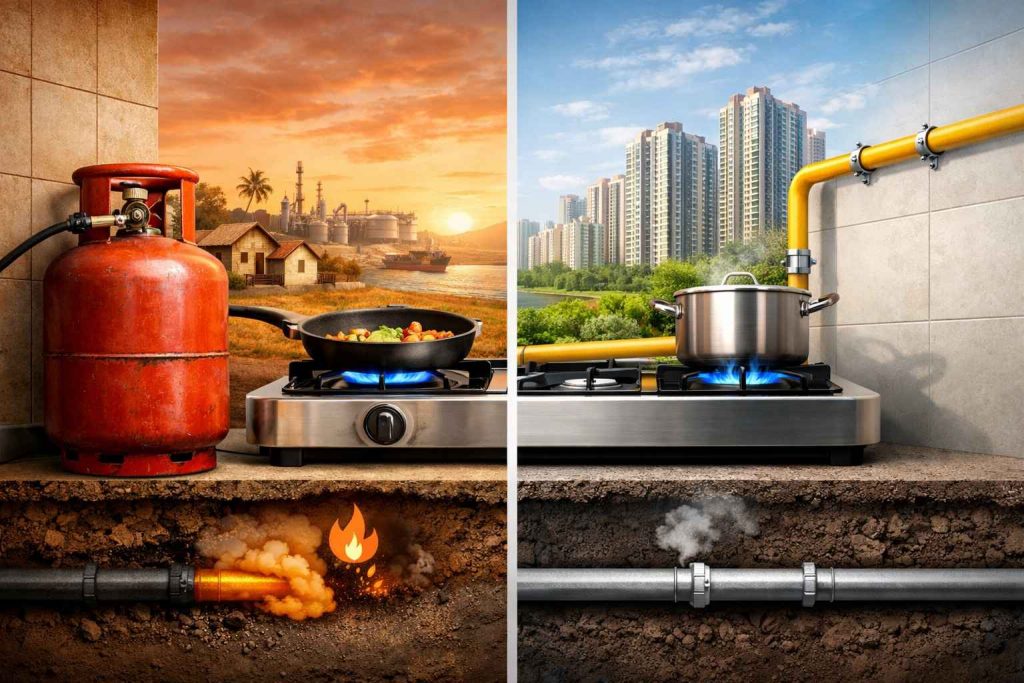
LPG, which most Indian homes are familiar with, is a fuel made by compressing gases like propane and butane into liquid form. It is stored in cylinders and delivered to homes. Its biggest advantage is that it can be used almost anywhere, which is why it remains common in both cities and rural areas. However, LPG prices often change because India imports a large portion of it, making it dependent on international crude oil rates.
PNG, on the other hand, is a form of natural gas mainly made up of methane. Instead of being stored in cylinders, it is supplied directly to homes through underground pipelines, much like water. This means users do not have to worry about booking or replacing cylinders, as the supply is continuous.
One of the key differences between the two fuels lies in safety and behaviour. LPG is heavier than air, so if there is a leak, it can settle in enclosed spaces and increase the risk of fire. PNG is lighter than air and tends to disperse quickly, which reduces the chances of accumulation.
When it comes to cost, LPG and PNG work differently. LPG is usually paid for per cylinder, and its price can go up or down depending on global markets. PNG, in contrast, is billed based on usage, similar to electricity or water. While setting up a PNG connection may involve an initial cost, it often turns out to be more stable in pricing over time.
There is also some confusion around similar-sounding fuels like Compressed Natural Gas (CNG) and Liquefied Natural Gas (LNG). CNG is mainly used as a fuel for vehicles, while LNG is natural gas that has been cooled into a liquid form for easier storage and transport. LNG is often imported and then converted back into gas before being supplied as PNG or as an industrial and power generation tool, or in railways and ships.
In recent months, there has been a noticeable push towards expanding PNG connections in cities. The government is investing in pipeline networks to reduce dependence on imported fuels and to provide a more reliable supply to urban households. In some areas where PNG is available, it is increasingly being encouraged as the primary option for cooking gas.
Given the current situation, where global fuel prices remain unpredictable, PNG is being noted as a more stable and convenient choice for the future, especially in urban India. It burns cleaner, is easier to manage on a daily basis, and fits well into plans for a more secure and efficient energy system.

That said, LPG is unlikely to disappear anytime soon. Its portability and wide reach mean it will continue to be important, particularly in areas where pipeline infrastructure has not yet reached. However, as cities expand and gas networks grow, PNG is expected to play a much bigger role in how Indian households cook in the years ahead.