Pune: After Civic Outcry, NIBM Annexe–Mohammadwadi’s SM Ghule Circle Reinstalled on Trial Basis
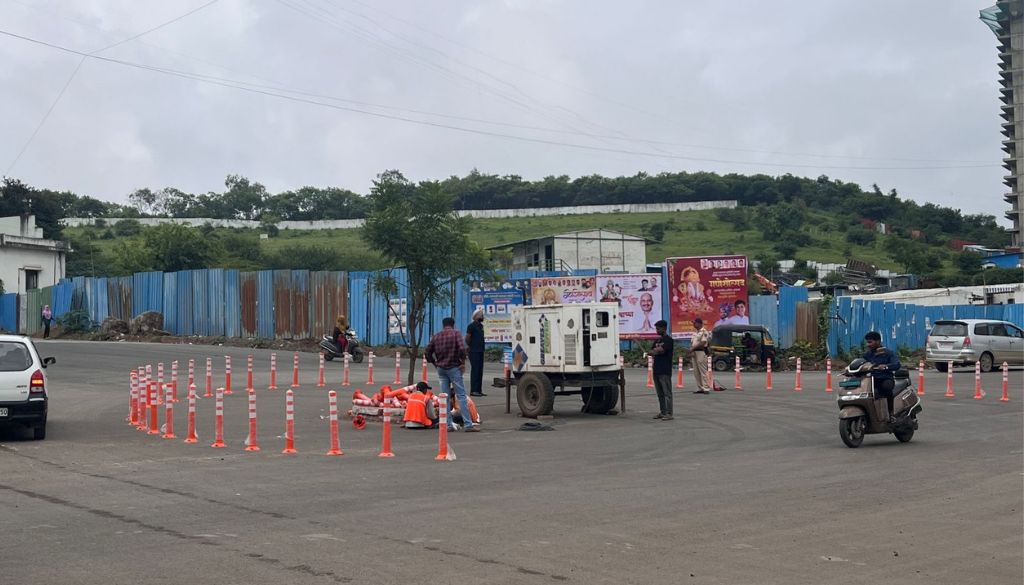
Pune, 3rd September 2025: Following sustained public outrage and allegations of unlawful civic planning, the Pune Municipal Corporation (PMC) has reinstalled the SM Ghule traffic circle at NIBM Annexe on a temporary basis on Tuesday afternoon ( Sept 2 ). The move comes weeks after the PMC dismantled an earlier oversized and unauthorized version of the circle that had triggered widespread condemnation and calls for legal action.
The original structure was taken down after a civic exposé led by activists Jaymala Dhankikar and Ashok Mehendale on August 14, which revealed that the circle had been illegally installed without obtaining requisite approvals in violation of Indian Roads Congress (IRC) engineering guidelines and without any consultation with the city’s traffic police department. Citizens claimed the design was not only flawed but illegal, and they demanded that a formal FIR (First Information Report) be filed against PMC officials responsible for the construction.
A dangerous oversight unfolds
Local residents described the initial installation as arbitrary, haphazard, and hazardous, accusing the PMC of bypassing basic planning protocols. They pointed out that no traffic feasibility study had been conducted, and that the location, size, and height of the original circle caused severe confusion for commuters—increasing the risk of accidents in an already congested junction.
“The earlier circle endangered lives. It was built with complete disregard for traffic safety norms and legal procedure,” said Jaymala Dhankikar, who has been actively leading the campaign for accountability.
PMC’s response: A trial With no notice
In a public statement, the PMC Road Engineering Department claimed that a letter had since been sent to the Traffic Police Department, requesting a survey and expert recommendation on the proper dimensions and design of the circle. PMC officials stated that the current installation is “temporary and on a three-month trial”, during which citizen suggestions and objections would be considered before finalizing the structure.
However, no public notice or advertisement was issued to inform citizens of this reinstallation—prompting further anger. Residents argue that this lack of transparency and public participation violates principles of good governance and constitutional accountability.
“When civic bodies act behind closed doors, public trust collapses,” said local resident Anjali Karnik, who filed a written objection at the PMC’s Ward Office.
Encroachments, political banners, and legal violations
Adding to public frustration, the newly reinstalled circle is now surrounded by hawkers, unauthorised food stalls, and political banners, many of which were put up by aspiring party workers. Citizens say this has turned the area into a political flashpoint, with visual pollution and traffic obstruction becoming routine.
Residents have demanded enforcement of Section 244 of the Bombay Provincial Municipal Corporations (BPMC) Act, which prohibits defacement of public property and mandates that no installation on a public road obstructs visibility or endangers commuters.
“The chowk has been taken over by illegal banners and goons claiming political affiliation. It’s disgusting and dangerous,” said Raj Singh, a resident of NIBM Annexe area . “The circle must be made safe for all citizens. It should comply with the highest legal and engineering standards—no shortcuts, no corruption.”
Legal pressure mounts
In a sharply worded statement, Advocate Aniruddha Joshi, who represents a group of residents, warned that legal action was imminent if the PMC failed to follow due process.
“We will not hesitate to approach the courts if PMC continues to violate procedure,” said Joshi. “There must be full compliance with IRC engineering standards, especially in terms of the banking angle, surface slope, and safety buffer zones. Moreover, anti-social elements backed by corrupt politicians are trying to capture and misuse the chowk. We have already submitted complaints to the police, and if the situation escalates, we will pursue prosecution.”
Joshi added that any future accidents due to non-compliance would invite legal liability on the municipal body and its officers.
Citizens call for structural clean-up
Residents are demanding that all encroachments be removed, that the circle’s final design be subject to public review, and that both the traffic police and PMC issue transparent reports detailing the structural specifications and approval process. A formal citizens’ monitoring committee has also been proposed to ensure accountability.
“This isn’t just about a traffic circle,” said Ashok Mehendale. “It’s about whether urban governance in Pune is driven by science and law—or by arbitrary decisions and political pressure.”
The Bigger picture: A litmus test for urban accountability
As the three-month trial period gets underway, residents and urban planners alike are watching closely to see whether PMC will uphold its commitment to public safety, legal compliance, and civic transparency—or revert to a pattern of opaque decision-making and political appeasement.
The SM Ghule Circle saga has become emblematic of a deeper tension in Indian cities: how to balance rapid urban expansion with legal, democratic, and safety obligations.