Pune: Experts Advocate Greater Fiscal Autonomy for Urban and Rural Local Bodies
Pune, 24th March 2025: Urban and rural local governments (ULGs/RLGs) should be seen as the first tier of governance due to their direct engagement with citizens, noted Dr. Vijay Kelkar, ex-bureaucrat and Vice President, PIC.
Proposing this shift from the perception of local governments as the 3rd Tier of governance and underscoring the significance of local governance in India, he highlighted the need for inclusive policies tailored to local issues. He also advocated for greater collaboration between think tanks to guide policy-making, echoing sentiments from a similar conference held in May 2024.
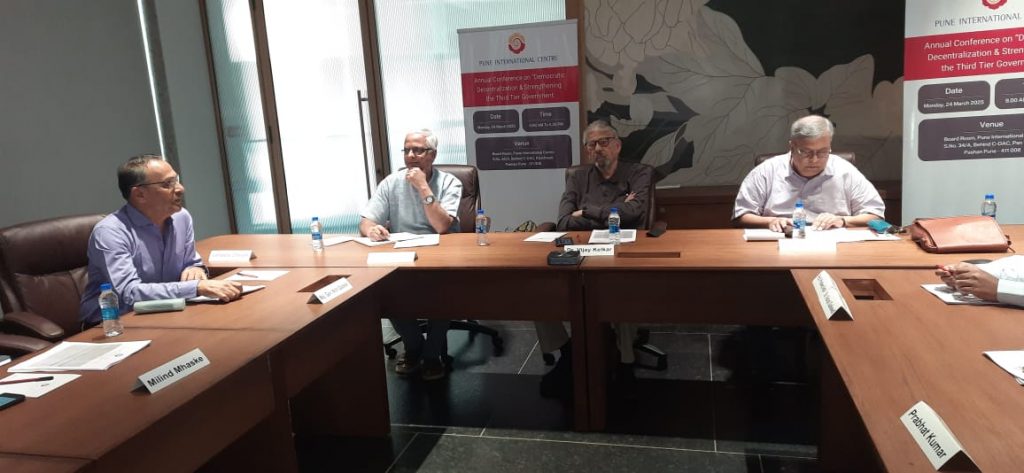
Dr. Kelkar was delivering the opening remarks at PIC’s Annual Conference on ‘Democratic Decentralisation and Strengthening the 3rd Tier Government’ at the PIC Campus in Pashan on March 24, 2025.
Experts underscored the need to empower urban and rural local governments, ensure financial sustainability, and foster citizen participation, and presented insights on the governance framework, challenges in municipal and rural finance, and the need for systemic reforms to unlock India’s urban growth potential.
The conference made key recommendations, including the introduction of independent evaluation frameworks, enhanced fiscal devolution, and reforms to empower local governments, and the urgent need to strengthen municipal and rural finances and improve service delivery to create a more participatory and efficient local governance system.
Experts also proposed integrating technology, such as digital financial management tools, to ensure better accountability and resource allocation at the local level.
The conference saw participation by experts, planners, policy makers, and ex-bureaucrats including Prof. Abhay Pethe, Senior Fellow, PIC; Sunil Kumar, former Secretary, Ministry of Panchayati Raj, Member, PIC; Jitendra Pandit, Associate Director (Governance), Transform Rural India, Dr. Chandrashekhar Pran, Founder, Teesri Sarkar Abhiyan; Prabhat Kumar, Head, Municipal Finance, Janaagraha; and Dr. Ramanath Jha, Distinguished Fellow, Observer Research Foundation; Dr. Ravikant Joshi, former World Bank Consultant; Dr. Ajit Ranade, former Vice Chancellor, Gokhale Institute of Politics and Economics; and Milind Mhaske, CEO, of Praja Foundation.
Sunil Kumar, former Secretary, Ministry of Panchayati Raj, Member, PIC, outlined the key legislative challenges in local governance, including gaps in current laws and the lack of financial autonomy for local bodies. He underscored the importance of citizens’ active participation in ensuring accountability and suggested reforms in local governance to address issues such as underutilised revenue sources and overlapping policies between urban and rural governance. Kumar stressed that local governments must explore alternative revenue generation strategies, such as property tax reforms and public-private partnerships.
Panel discussions underscored the need for comprehensive reforms to improve governance and service delivery. Prof. Abhay Pethe, Senior Fellow, PIC, emphasised the importance of capacity building and independent evaluation to enhance transparency and reduce bureaucratic inefficiencies. Dr. Ajit Ranade, former Vice Chancellor, Gokhale Institute of Politics and Economics, discussed rural-urban funding imbalances, highlighting the need for greater local autonomy and decentralised decision-making.
Dr. Chandrashekhar Pran, Founder, Teesri Sarkar Abhiyan, shared insights on local governments from the perspective of a social worker. He distinguished between governance and autonomy in government administration, highlighting the balance between administrative control and decentralised decision-making. He encouraged open discussions in villages to enhance public participation and democratic processes. He said limited financial autonomy restricts decision-making at the local level, also noting that varying spending permissions across states affects the efficiency of fund utilisation.