Pune Launches Metropolitan Region Growth Hub; Fadnavis Says City Has Power to Lead in New Frontiers
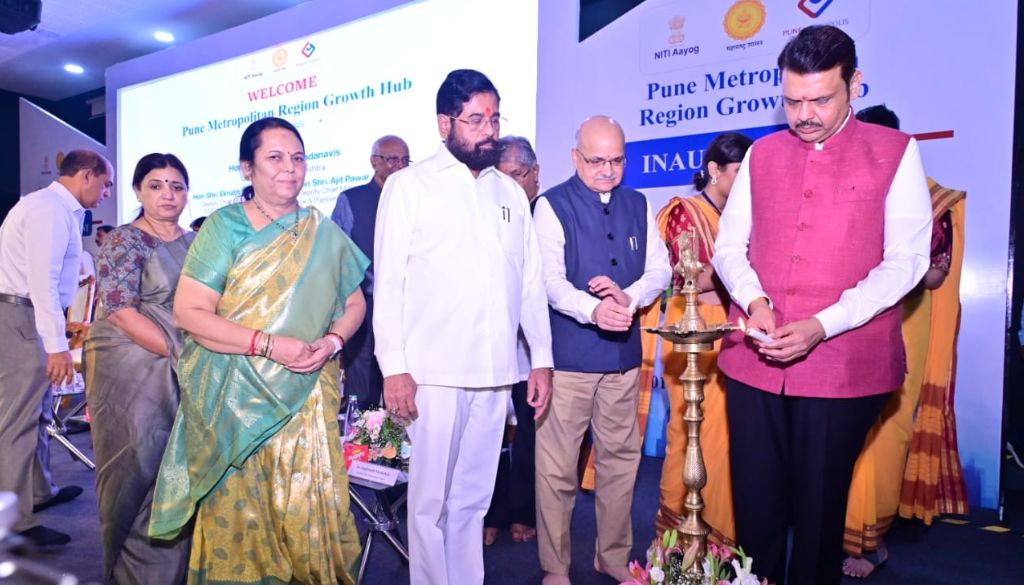
Pune, 1st August 2025: Maharashtra Chief Minister Devendra Fadnavis launched the ‘Pune Metropolitan Region Growth Hub’ at Yashwantrao Chavan Academy of Development Administration (YASHADA) on Thursday, stating that Pune has the potential to emerge as a leading force in new and emerging sectors. The initiative is a collaboration between NITI Aayog, the Maharashtra government, and Pune International Centre (PIC).
“Today, no single city dominates any one sector. Pune, with its strong foundation in innovation and progress, has the strength to lead in new domains. The Growth Hub will play a key role in shaping Pune’s development roadmap,” Fadnavis said, emphasizing planned growth for improved lifestyles and accelerated economic output.
The circuit will be developed with NITI Aayog as the accelerator, PMRDA as the planning body, and PIC providing support. Fadnavis added that 65% of India’s GDP comes from urban areas, and structured development will further speed up this growth. He highlighted that upcoming projects like the Pune Ring Road and new airport alone would contribute ₹3 lakh crore to the regional economy.
Fadnavis also highlighted efforts to make Maharashtra a hub for global education. “With central clearance for foreign universities to set up campuses in India, the state has launched ‘EduCity’ in Navi Mumbai. Top five global universities have signed MoUs, and 50,000 students are expected to study there in the next few years, generating ₹2,000 crore in GST revenue and producing high-quality AI-ready manpower.”
Deputy Chief Minister Eknath Shinde called the launch a turning point in Pune’s development, stressing the need to align tradition, environment, and progress. He said the Pune Growth Hub will strengthen both urban and rural development, making Pune a global industrial and educational powerhouse.
“Pune is already a leader in technology, manufacturing, education, and healthcare. With the right infrastructure and industrial ecosystem, it can become an international city,” he said. Shinde emphasized the need to remove bureaucratic hurdles to attract investment and ensure implementation-focused governance.
B.V.R. Subrahmanyam, CEO of NITI Aayog, presented a roadmap aiming to double Pune’s economy from $58 billion to $120 billion and ultimately reach $600 billion. The plan prioritizes manufacturing, IT, engineering, agriculture-based industries, and MSMEs. Pune’s per capita income and GDP growth rate are key targets.
Rajgopal Devara, Additional Chief Secretary (Planning), said after MMR, Pune is the second region to get a Growth Hub. Nagpur, Chhatrapati Sambhajinagar, and Nashik will follow. He added that Pune’s skilled workforce and infrastructure make it ideal for export-led development. Local industries and institutions will be consulted in the master plan process.
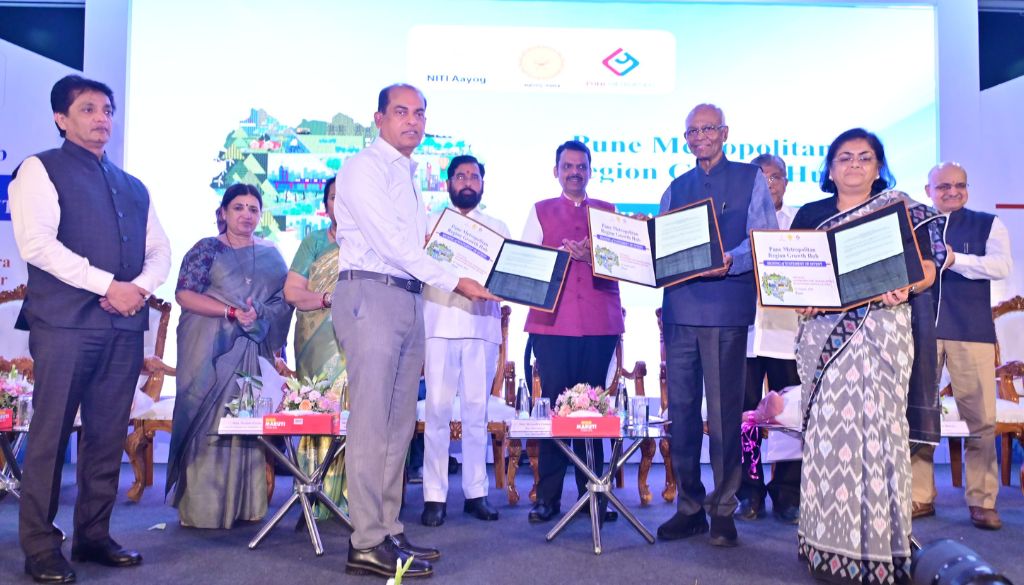
A Memorandum of Understanding was signed among the Maharashtra government, NITI Aayog, and Pune International Centre during the event.
Launched by NITI Aayog in 2023, the ‘Developing City Regions as Growth Hubs’ initiative aims to transform city regions into engines of economic dynamism. It currently covers Mumbai, Surat, Varanasi, Visakhapatnam—and now includes Pune. The mission aligns with the India@2047 vision, aiming for integrated, future-ready urban development with a strong focus on sustainable practices, improved quality of life, and rapid economic expansion.