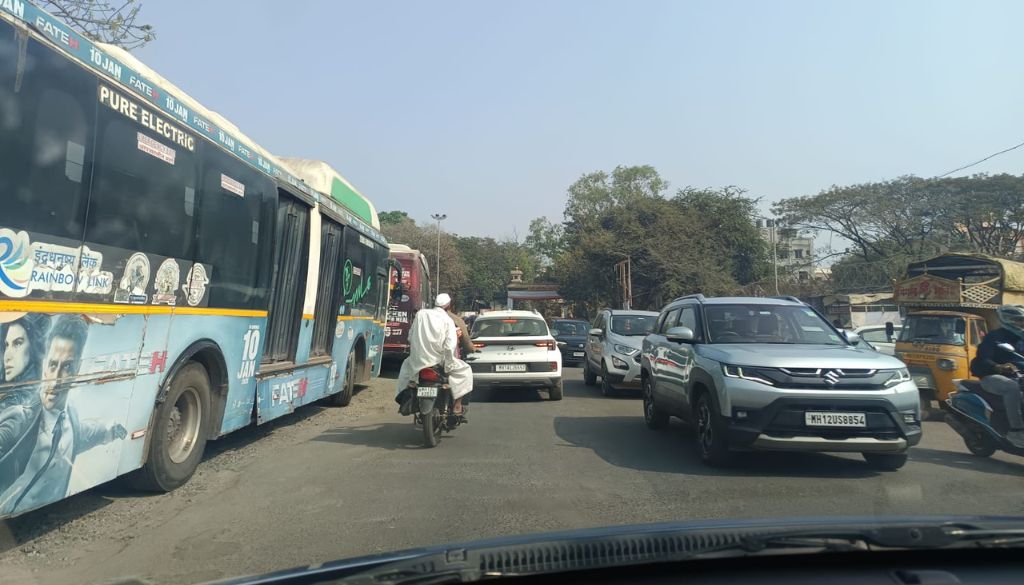
Pune Traffic Crisis: 1,300 New Vehicles Added Daily as City Ranks 5th Worst Globally for Congestion; Police Unveil Strategic Mobility Plan
Reported by Mubarak Ansari
Pune, 17th February 2026: The staggering scale of Pune’s urban mobility crisis was laid bare today at the “Workshop on Urban Mobility & Transportation Plan,” organized by the Pune Municipal Corporation (PMC) and Global Designing Cities Initiative.
Addressing a gathering of city planners, law enforcement, and civic stakeholders, Manoj Patil (IPS), Additional Commissioner of Police, Pune, presented a comprehensive, data-driven analysis of the city’s gridlock, revealing that Pune now ranks as the 5th worst city globally for traffic congestion.
The Numbers: A City Choking on Growth
The data presented painted a concerning picture of a city whose infrastructure has failed to keep pace with rapid expansion. While Pune has grown geographically by 332% since 1995—making the PMC the largest municipal corporation in the state—public transport usage has plummeted.
Currently, private vehicles account for a massive share of the roads, with 1,300 new vehicles added every single day. In stark contrast, the mode share of public transport has declined to a mere 11%.
“The imbalance is critical,” the presentation highlighted. “Private vehicles number approximately 78 lakh, while traffic volume has surged from 52 lakh in 2018 to 72 lakh in 2024.” The human cost of this congestion is severe: it is estimated that a daily commute of just 150 km consumes nearly 2 years of an individual’s lifetime due to delays, alongside significant exposure to pollution.
The Singapore Comparison: A Tale of Two Cities
The workshop drew a sharp comparison between Pune and Singapore. Despite having similar administrative areas (roughly 500-700 sq. km) and comparable population densities, the outcomes differ drastically.
While Singapore boasts a 67% public transport share, Pune lags at 11%. The difference was attributed to policy tools effectively used in Singapore, such as high public transport investment, strict Certificates of Entitlement, and electronic congestion pricing—measures that Pune is currently lacking or struggling to implement.
Enforcement and Technology: The ‘PTP’ Effect
To combat the chaos, Pune Police have ramped up enforcement using technology. The department reported a 600% increase in actions against priority violations in 2023. Consequently, road fatalities have seen a reduction, dropping to between 300 and 350 deaths per year.
A key highlight was the success of the PTP (Pune Traffic Police) App. Between June and December 2025, the app garnered over 1 lakh users, generating ₹3.75 crore in collected fines from citizen-reported violations.
Top Violations Reported: Footpath parking (39,124 cases) and Wrong-side driving (32,361 cases).
Target: The police aim to reach 5 lakh app users within the next five months to further democratize traffic management.
The Way Forward: Collaboration Over Construction
The roadmap for 2026 and beyond focuses on “Evidence-Based Urban Transport Planning.” This includes:
Infrastructure: Prioritizing the most congested corridors and focusing on “Safety First” designs for pedestrians and cyclists (VRUs).
Public Transport: A goal to increase bus load factors to 45-50% and rationalize routes to avoid overlapping.
Corporate & School Responsibility: The plan explicitly calls on IT parks and corporates to implement staggered office timings, encourage carpooling, and mandate 100% clearance of employees’ e-challans. Similarly, schools are urged to enforce the use of buses over private drops to reduce peak-hour pressure.
“Cities improve when citizens participate, not just when authorities enforce,” the presentation concluded. “Traffic discipline is city-building, not just obedience.”