Pune Traffic Crisis: Plan Now for the Next 50 Years, Says Union Minister Murlidhar Mohol
Reported by Mubarak Ansari
Pune, 18th August 2026: Pune’s worsening traffic congestion requires immediate action as well as long-term planning that takes into account the city’s needs for the next 50 years, Union Minister of State Murlidhar Mohol said on Tuesday.
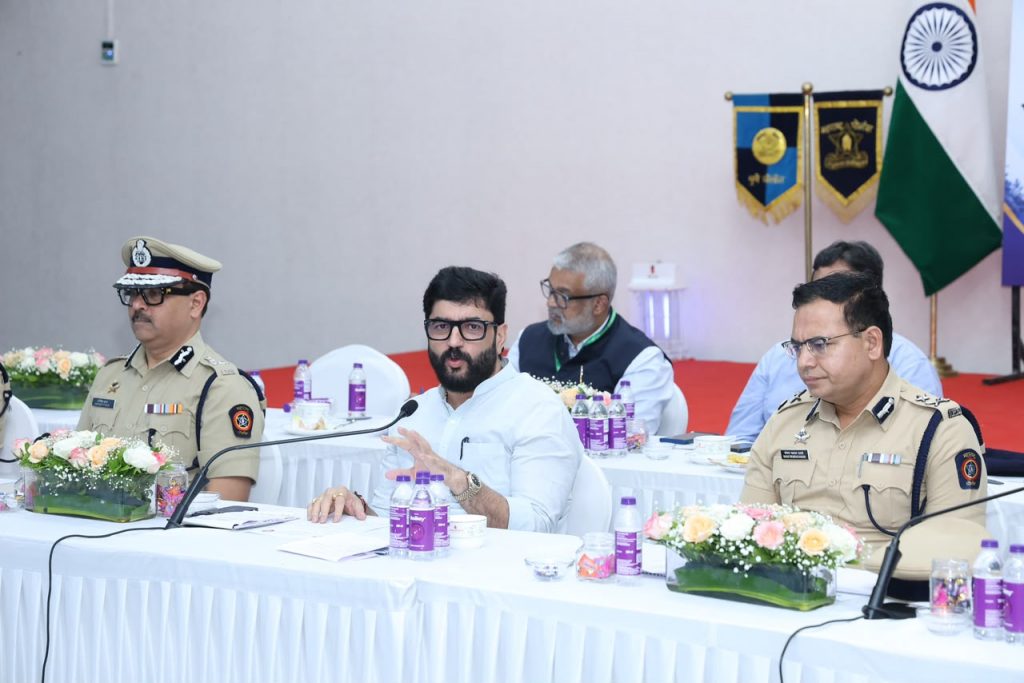
Mohol was speaking at a meeting of the Pune City Traffic Advisory Committee held at the Police Commissioner’s Office. He said the rapid expansion of the city, rising population and inadequate growth of public transport infrastructure had placed considerable pressure on Pune’s roads.
He stressed the need to clear the backlog of pending infrastructure works while simultaneously developing a long-term transport strategy based on projected population growth, vehicle numbers and urban expansion.
The meeting was attended by former mayors Ankush Kakade and Vandana Chavan, senior Congress leader Mohan Joshi, Shiv Sena (UBT) leader Gajanan Tharkude, Pune Police Commissioner Amitesh Kumar, Joint Commissioner of Police Sanjay Darade, Additional Commissioners of Police Rajendra Bansode and Manoj Patil, Resident Deputy Collector Jyoti Kadam, Regional Transport Officer Archana Gaikwad and representatives of various social organisations.
Public transport expansion seen as key
Mohol said Pune’s population had grown rapidly in recent years and was estimated to be in the range of 6-7 million. However, the expansion of roads and public transport had not kept pace with the city’s growth.
He said public transport currently accounts for only around 11% of travel in the city, highlighting the need to strengthen the system and reduce dependence on private vehicles.
Pune currently has around 1,970 buses operating on its roads. Efforts are underway to increase the fleet substantially over the next three years, with a target of adding 3,000 to 4,000 buses, he said. The Centre’s schemes are also being explored to procure electric buses.
Mohol said increasing the number of buses alone would not be sufficient and that last-mile connectivity between homes and bus stops, Metro stations and other public transport services also needed improvement.
The city’s Metro network has received a positive response from commuters and is expanding, but the bus network also needs to be strengthened, he said. Better integration between buses, Metro and other modes of public transport could encourage more people to shift away from private vehicles.
Focus on missing links and major corridors
Authorities are working on measures to address traffic problems along major corridors, including Nagar Road, Solapur Road and Nashik Road.
Mohol said efforts were also underway to address missing links between different parts of the city and provide the infrastructure needed to improve connectivity.
He stressed that traffic management should not rely solely on short-term measures or major infrastructure projects. Planning should be based on scientific assessment of current and future requirements, including projected population, vehicle growth and urban expansion.
“Future generations will not forgive us”
Mohol called for greater coordination among the Pune Municipal Corporation, police, Pune Mahanagar Parivahan Mahamandal Limited (PMPML), Metro authorities, transport officials, elected representatives, voluntary organisations and citizens.
He said the traffic problem could not be solved by government agencies alone and that each stakeholder needed to fulfil its responsibility effectively.
“Everyone needs to think about the future of the city with the idea of ‘My Pune’. If we fail to take the right decisions today, future generations will not forgive us,” he said.
He also said elected representatives should address smaller, local traffic problems instead of focusing only on large infrastructure projects. Pending works should be accelerated while planning for the requirements of future generations.
Mohol said protecting Pune’s reputation and quality of life required all stakeholders to work together to address congestion.
Local traffic committees to be formed
Pune Police Commissioner Amitesh Kumar said the police would involve citizens and elected representatives in identifying and addressing local traffic problems.
The city currently has 35 traffic police outposts. Local committees will be formed for each outpost to study traffic conditions within its jurisdiction and recommend solutions.
Each committee is expected to have around 40 to 45 members, including representatives of citizens, elected representatives and the police.
The committees will examine issues such as narrow roads, rising vehicle numbers, congestion-prone locations and other local traffic challenges. The process of forming the committees is expected to begin within the next week.
Kumar said the initiative was aimed at developing solutions based on ground-level traffic conditions and increasing citizen participation in traffic management.