Should Real Estate and Petroleum Come Under GST? Experts Debate at Pune Conclave
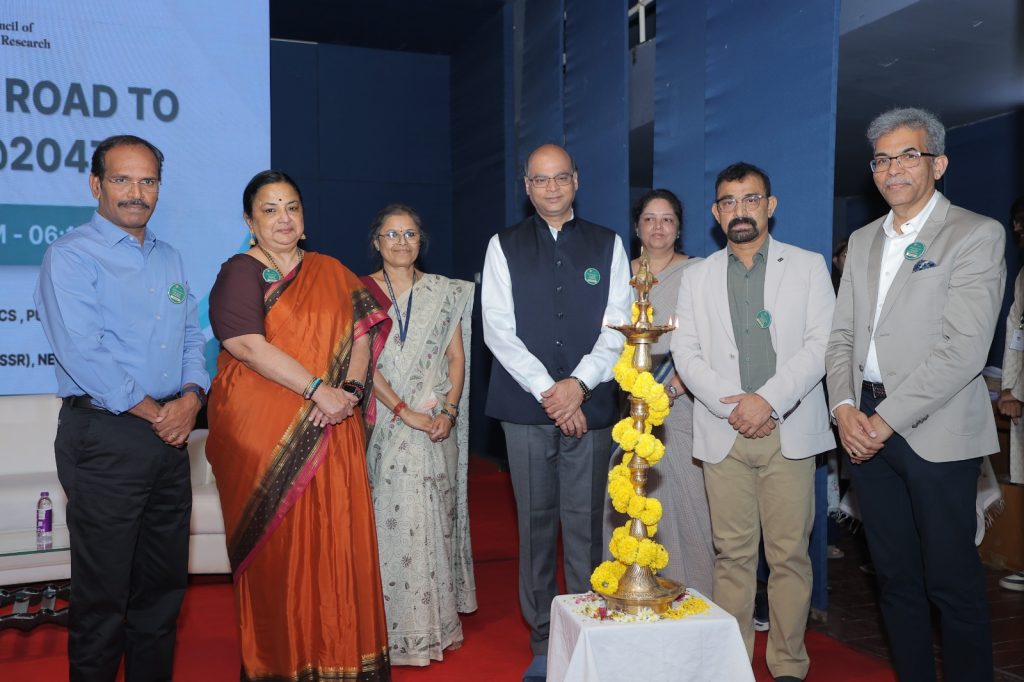
Pune, 13th March 2026: The Gokhale Institute of Politics and Economics (GIPE), Pune, in collaboration with the Indian Council of Social Science Research (ICSSR), hosted a National Conclave on “Next-Gen GST and the Road to Viksit Bharat @ 2047” at Kale Hall, Gokhale Institute.
The ICSSR-sponsored conclave brought together policymakers, academicians, researchers, industry leaders and practitioners from across the country to deliberate on the future trajectory of the Goods and Services Tax (GST) and its role in achieving the vision of Viksit Bharat @ 2047. The conclave was inaugurated by Prof. Umakant Dash, Vice Chancellor of Gokhale Institute, who also delivered the opening address outlining the objectives of the event.
Vivek Johri, former Chairman of the Central Board of Indirect Taxes and Customs (CBIC) and Senior Advisor for Indirect Taxes at KPMG India, set the context by sharing his perspective on the journey towards GST 2.0. He highlighted that the implementation of GST demonstrated strong collaboration between the Centre and 28 state governments. Addressing the question of whether GST 2.0 reforms are compliant and capable of supporting the Viksit Bharat @ 2047 vision, Johri explained the concept, design and management principles guiding the next phase of GST reforms.
While comparing India’s GST framework with international practices, he referred to models adopted by European countries, Canada and Australia. He pointed out that India has a unique advantage due to its digital transformation, technology adoption and institutional mechanisms such as the GST Council. Johri also spoke about the future direction of reforms, suggesting that sectors such as real estate and petroleum products should eventually be brought under the GST regime. He emphasised the need to further improve the Input Tax Credit (ITC) process through technology-driven compliance systems and urged academicians and researchers to undertake more studies on GST reforms to support equitable economic growth.
Prof. Santishree Pandit, Vice Chancellor of Jawaharlal Nehru University (JNU), New Delhi, offered a perspective from the political economy standpoint, stressing its relevance in the current geopolitical context. She said tax reforms are a key pillar of economic growth in the journey towards Viksit Bharat. A stable and predictable tax system, she noted, would strengthen the economy and should ultimately benefit society, particularly the middle class. She added that efficient tax reforms should lead to outcomes such as affordable medicines and improved healthcare systems. Prof. Pandit also remarked that the Gokhale Institute represents a unique ecosystem where economists working with numbers and statistics collaborate with policymakers to address ground-level implementation challenges.
Dr. Nitin Kareer, Chairman of the Maharashtra State Finance Commission and former Chief Secretary of the Government of Maharashtra, said that a robust tax system is essential for national development. He clarified that the primary objective of GST reforms was not merely to increase government revenue but to unify multiple tax systems across states and the Centre, thereby harmonising tax collection. As part of the reform process, 12 different tax structures were abolished and consolidated under GST.
Addressing the effectiveness of the current system, Dr. Kareer said the ideal tax structure should be simple, predictable, cost-efficient in terms of collection, and should avoid cascading taxes while maintaining minimal compliance requirements. He added that such a system should have a broad base with minimal exemptions and should not distort economic activity. According to him, with a cost of collection of just 0.6 percent and a two-tier tax system, GST 2.0 meets several of these criteria and has significantly improved tax collection across the country.
Looking ahead, he suggested that the next phase, GST 3.0, should aim for a single tax rate across the country with minimal exemptions. He also emphasised the need for sectoral expansion, simplified return filing and stronger integration with India’s digital platforms to detect fraud and improve compliance. In conclusion, he said that considering India’s complex federal structure, GST implementation has been among the most significant tax reforms globally. He cautioned against direct comparisons with countries such as New Zealand and Singapore, which have smaller economies, or Canada, which has been refining its GST framework for over 25 years.
Prof. Ramesh Salian from the Centre for Economic Studies and Planning at JNU highlighted the importance of adopting a consumer-first approach in future GST reforms. Prof. L. C. Malliah from the School of Economics at the University of Hyderabad discussed the impact of GST on the agriculture sector and emphasised that the principle of equity should guide policy decisions.
The plenary session concluded with insights from Prasant Mohanty, former IRS officer and GST expert, who shared ground-level observations following GST implementation. He noted that breaks in the ITC chain can create operational challenges and need to be addressed in future reforms.
Following the inaugural plenary session, three panel discussions were held with eminent academicians, industry leaders and practitioners to explore different dimensions of GST 2.0 reforms and expectations from the next generation of GST.
The first panel discussion focused on “Next-Gen GST: Sectoral Impacts and Socio-Economic Implications.” Moderated by Prof. Pradeep Apte, economist and council member of ICSSR, the session featured Prof. M. Suresh Babu, Director of the Madras Institute of Development Studies (MIDS), Dr. Vidhu Shekhar from S. P. Jain Institute of Management and Research, Mumbai, and Dharanidhar Tripathy from the Bank Correspondence Resource Council. The panel examined sectoral and distributional impacts of GST reforms as well as broader socio-economic implications. Dr. Vidhu Shekhar noted that the GST system implemented in 2017 played an important role in helping the country manage inflation during the COVID-19 period.
The second panel discussion, titled “GST 2.0: Simplifying Compliances for Businesses, MSMEs and Start-ups,” was moderated by independent researcher and consultant Bhushana Karandikar. The panel included Ram Iyer, Founder and CEO of Vayana Network, Sanjali Dias, Joint Commissioner of State Tax (GST) in the Government of Maharashtra, and Nirupama Soundararajan, CEO and Co-founder of the Policy Consensus Centre. The discussion focused on challenges faced by the MSME sector, which accounts for nearly 7.83 crore Udyam registrations across small and micro enterprises. The panel noted that taxpayers with a turnover of less than ₹5 crore constitute about 92 percent of the MSME sector, and emphasised the need for simplified compliance systems to address capacity and bandwidth constraints faced by smaller businesses.
The third panel discussion on “GST 2.0: Institutional Reform and Implementation Efficiency” was moderated by Chartered Accountant and GST consultant Swapnil Munot. The panel included Prasant Mohanty, former IRS officer and GST expert; Dhruva Seshadri, former IRS officer and GST specialist; CMA Sanjay Bhargave; and CA Yogesh Dixit. The panel discussed implementation challenges such as tax inversion and cascading taxes. At the same time, the participants acknowledged the significant progress made over the past seven years, with tax collections rising from ₹7 lakh crore to ₹22 lakh crore and the taxpayer base expanding from 60 lakh to around 1.6 crore.
The panel also pointed out that in certain sectors the benefits of GST rate reductions are not always passed on to consumers. As an example, it was noted that despite the reduction of GST on cement from 28 percent to 18 percent, real estate prices have not seen a corresponding decline.
The conclave concluded with a vote of thanks delivered by Lalitagauri Kulkarni, Associate Dean of Research and Publications at the Gokhale Institute.