Symbiosis Law School, Pune, Commemorates the 76th Constitution Day with Panel Discussion on Inclusive Development
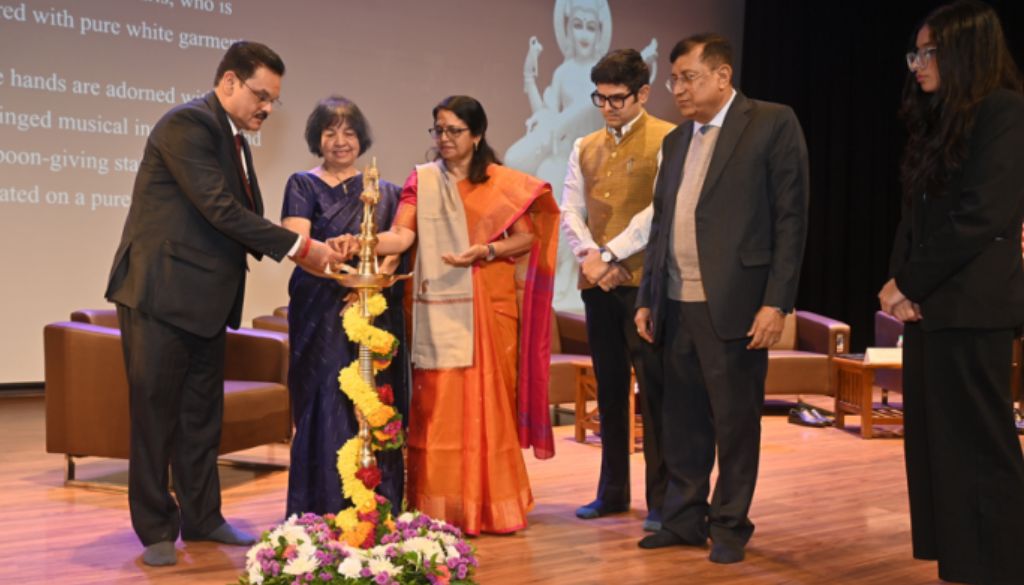
Pune, 17 December 2025: Symbiosis Law School, Pune, a constituent of Symbiosis International (Deemed University), commemorated the 76th Constitution Day on Tuesday, 16 December 2025, with a panel discussion on the theme “The Constitution and India’s Journey Towards Inclusive Development” at the Symbiosis Ishanya Auditorium. The programme commenced with the arrival of dignitaries, followed by the lighting of the ceremonial lamp, marking the formal opening of the event.
The introduction and opening address were delivered by Prof. (Dr.) Shashikala Gurpur, Fulbright Scholar, Director of Symbiosis Law School, Pune, Dean, Faculty of Law, SIU, JM Chair Professor, and Principal Investigator, SPARC Project. In her address, Dr. Gurpur spoke on the genesis of Symbiosis, underscoring its foundational philosophy rooted in care, collaboration, and inclusivity. She reflected on how the theme of the panel discussion resonates with the Constitution and concerns for society, humanity, and the rule of law, and how these values reverberate through the idea of inclusive development.
Dr. Gurpur emphasized that the judiciary has historically served as a vital platform to discover and rediscover the Constitution, especially in addressing the gaps between the written text of the Constitution and lived realities. She stressed that the law must remain responsive to human suffering, and proposed that if human suffering is recognized as vulnerability and development is envisioned as hope for tomorrow, society would benefit significantly. She further observed that inclusive development is not a finished project but an ongoing constitutional agenda. Following her address, she felicitated the distinguished guests.
This was followed by the reading of the Preamble, led by Hon’ble Justice Shalini Phansalkar Joshi, Former Judge of the Bombay High Court, with the audience joining in collective recitation, reaffirming their constitutional commitment.
The panel discussion began with Justice Joshi’s address. She highlighted that the Constitution begins with the word “We”, reflecting its profoundly inclusive spirit. She cited certain landmark cases of intersectional vulnerability, where the judiciary engaged in an elaborate and sensitive interpretation of lived injustice. Justice Joshi observed that with every progressive judgment, the judiciary moves one step closer to inclusivity and towards realizing the vision enshrined in the Preamble.
Prof. (Dr.) N. K. Chakraborty, Former Vice-Chancellor of the West Bengal National University of Juridical Sciences, Kolkata, spoke on the importance of interdisciplinary education in constitutional learning. Drawing from the philosophies of Dr. Sarvepalli Radhakrishnan and Swami Vivekananda, he argued that education must cultivate empathy and ethical responsibility. He emphasized that introducing contemporary cases into classroom debates enables students to engage meaningfully with constitutional values and nurtures the capacity to think for others, which he described as the true purpose of education and a pathway to inclusivity.
Dr. Vijay Pratap Tiwari, Professor of Law, Maharashtra National Law University, Nagpur, focused on the challenges of implementing constitutional guarantees in everyday litigation, particularly the ideals embedded in the Preamble and fundamental rights. Referring to the ancient ethical ideal of “Sarve Jana Sukhino Bhavantu”, he questioned whether such values have meaningfully translated into present-day realities. He pointed to the contradiction between political equality and the absence of social and economic equality, noting increasing societal insensitivity. He observed that although Article 32 remains a cornerstone of constitutional remedies, its potential has not been fully realized. Emphasizing the need to refocus attention on the Daridra Narayana, he also highlighted the systemic challenge of courts being overburdened while struggling to keep pace with mounting litigation.
Dr. Swapnil Tripathi, Lead at Charkha (Centre for Constitutional Law), Vidhi Centre for Legal Policy, spoke on the adaptive nature of the Indian Constitution and the strength of India’s judicial system. He discussed the challenge of designing inclusive policies within a democratic framework and emphasized that the three branches of democracy—legislature, executive, and judiciary—are not adversaries but collaborators. He explained the idea of cooperation combined with constitutional control, cautioning that the blurring of institutional boundaries creates ripple effects. He stressed that each organ must remain committed to its
constitutional role. Dr. Tripathi also argued that meaningful contextualisation of constitutional law requires decolonising legal thought and critically assessing what works best within India’s socio-cultural realities.
During the Question and Answer session, stakeholders and participants engaged in a rich discussion. It was noted that gross generalisations pose a serious threat to inclusive constitutional interpretation. Speakers emphasized the need for swadeshi interpretations of law and advocated a more consultative, stakeholder-based approach to law-making and legal reform.
The discussion was moderated and concluded with Concluding Remarks by Prof. (Dr.) Shashikala Gurpur, followed by the Vote of Thanks proposed by Dr. Aparajita Mohanty, Deputy Director, Symbiosis Law School, Pune. The event concluded with the National Anthem, marking a solemn and reflective end to the Constitution Day commemoration.