The Union that Taught a Civilisation to Love: A Cultural Reflection for Vivah Panchami
By Rhythm Wagholikar
Pune, 25th November 2025: What is Vivah Panchami? Why does it matter, and why Ram Sita’s union continues to guide India’s emotional and ethical imagination?
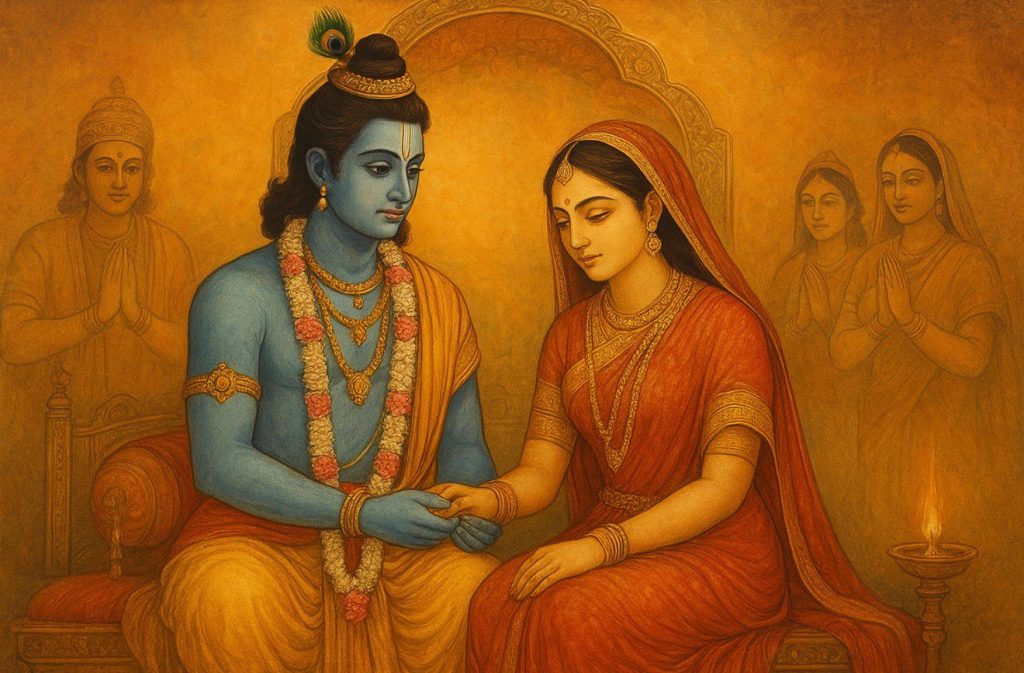
There are stories that do not simply belong to history. They belong to the soul of a civilisation. The union of Prabhu Ram and Mata Sita is one such story, an ancestral blueprint of love that continues to shape the emotional grammar of India even today. As Vivah Panchami arrives, we are reminded that their marriage was not only a divine moment in the land of Mithila but also a timeless lesson in clarity, dignity, and purpose. In a world that often confuses convenience with commitment, their union remains a compass that teaches us what it means to walk beside someone with integrity and strength.
Vivah Panchami celebrates the sacred wedding of Ram and Sita, commemorated on the fifth day of the bright fortnight of Margashirsha. Yet its significance extends far beyond the lunar calendar. It marks the moment when two individuals completely aligned in values and dharma came together in a bond that would inspire generations. When Ram lifted the bow of Shiva in King Janaka’s court, it symbolised much more than physical might. It reflected inner readiness. It carried the truth that relationships are not accidents. We attract what we are prepared for. The right person arrives when our character rises to the level of what we seek.
Their wedding is remembered not for grandeur but for the purity of intention that shaped it. Sita stepped into the marriage with courage and grace. Ram stepped into it with clarity and responsibility. Together, they demonstrated that relationships become sacred when both people choose to bring their highest selves into the bond. The essence of Vivah Panchami lies in this deeper understanding. Marriage is not merely the joining of two lives. It is the alignment of two paths, two disciplines, and two sets of values. It is a vow that must be lived through patience, compassion, restraint, and purpose. Ram and Sita lived these principles with sincerity. Their journey was not free of trials. They faced exile, separation, public scrutiny, and moments that would have crushed ordinary hearts. Yet their character held firm. Their dignity never faltered.
Their commitment did not weaken. It is this strength that shaped the emotional foundation of Indian relationships for centuries to come. When we speak of the Indian way of loving, we speak of tenderness carrying discipline, loyalty carrying responsibility, and companionship carrying an element of sacrifice. These qualities were not created overnight. They were inherited from stories such as the union of Ram and Sita, which taught that love is elevated by the inner work one is willing to do. Even those who may not actively reflect upon the Ramayana still carry traces of this emotional heritage. Our cultural understanding of trust, devotion, and mutual respect is woven from the lessons embedded in their lives. Vivah Panchami gently reminds us that love becomes divine when it strengthens the individual from within. It calls us to grow into the relationships we desire. It urges us to cultivate steadiness, clarity, and truth so that our commitments become anchors rather than burdens. Ram and Sita lived this truth quietly yet powerfully. They responded to separation with dignity. They faced criticism with grace. Their love endured because it rested on values stronger than circumstance. Across the landscapes of Mithila and the collective memory of India, the resonance of their union has endured because it offers a model of emotional maturity. It teaches that love is sustained not by excitement but by courage. Not by chance but by intention. Not by possession but by respect. These lessons feel even more relevant today. At a time when relationships often falter due to haste, impatience, or misunderstandings, the story of Ram and Sita stands as a reminder that true companionship requires awareness, patience, and the willingness to rise above ego. Their union also teaches us that a partner is not someone who completes you but someone who elevates you. Ram lived with purpose and moral clarity. Sita embodied inner strength and luminous compassion. Together they expanded each other’s capacities. This is the emotional blueprint they left behind. A relationship grows when both partners grow. When one becomes a shelter of truth, and the other becomes a source of grace, the bond becomes unshakeable. Vivah Panchami, therefore, becomes an invitation to elevate ourselves. It encourages us to examine not only the relationships we build but the individuals we are within them. Are we bringing patience into our disagreements? Are we choosing words that heal rather than inflame? Are we growing in compassion and understanding? Are we cultivating the qualities that give love depth and steadiness? These are the questions their story inspires us to ask, and the answers shape the emotional integrity with which we walk through life. When the lamps of Vivah Panchami glow in homes and temples, they illuminate more than a divine memory. They illuminate a path. They remind us that love is a journey of becoming. They encourage us to hold our relationships with reverence. They inspire us to embody the virtues that turn companionship into a sacred shared experience. The festival becomes a moment to honour not only the divine union but the values that allowed it to endure. Values that continue to live in the Indian heart. The reason Ram and Sita’s marriage still shapes our emotional grammar is simple. It represents a form of love that strengthens rather than weakens.
It shows that commitment is a conscious choice, not a convenient arrangement. It reminds us that dignity in love is eternal. It is not old-fashioned but foundational. Their story offers a blueprint for relationships that uplift the mind, steady the heart, and align the soul. On this Vivah Panchami, as we remember their union, we are invited to bring its spirit into our own lives. To choose with clarity. To love with sincerity. To protect the sacredness of the bonds we form. To build relationships that reflect purity of intention and steadiness of character. To understand that love, when lived with truth and grace, becomes a force that shapes families, futures, and entire generations. This is one of the ancestral blueprints of love that India holds close. A blueprint woven through centuries. A blueprint that continues to guide hearts seeking meaning in companionship. A blueprint that tells us true love is not merely discovered but consciously built, patiently nurtured, and honourably lived, which is why the union of Ram and Sita continues to remain the moral and emotional anchor of our civilisation.