‘This Is the Future We Are Creating’: Pune Activist’s Costume Sends Strong Environmental Message
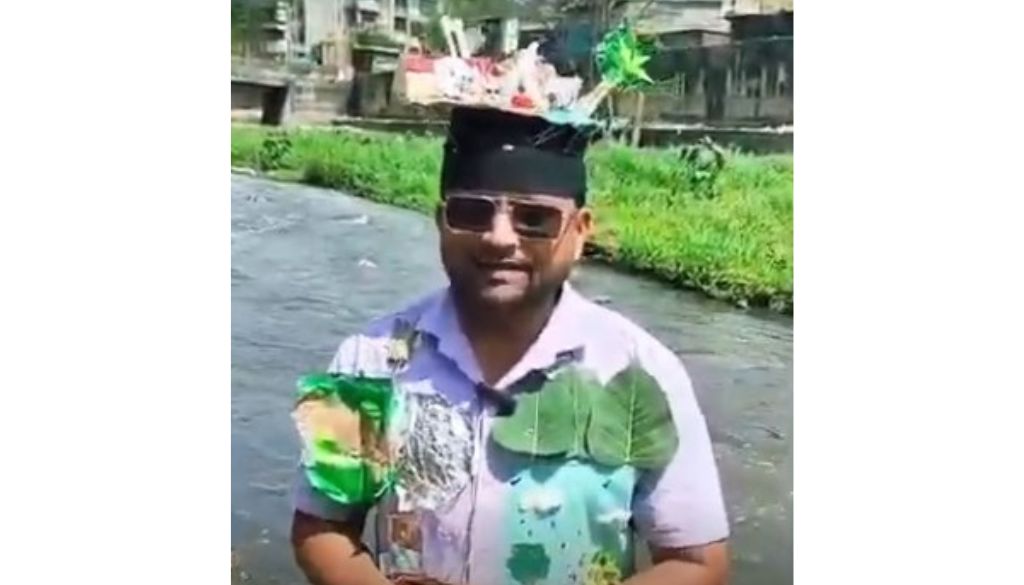
Pune, 4th June 2026: Marking World Environment Day, Pune Panther Sena Chairperson Sachin Bhosale launched a unique environmental awareness campaign aimed at drawing attention to the city’s growing pollution challenges, including garbage dumping, waste burning, shrinking green cover, deteriorating air quality, and the rising health risks faced by residents.
Departing from conventional Environment Day activities such as speeches and symbolic plantation drives, Bhosale donned a specially designed costume depicting two contrasting realities. One side represented nature and ecological balance, featuring greenery, rivers, birds, biodiversity, and a healthy environment. The other side portrayed environmental degradation through industrial smoke, plastic waste, garbage dumping, dead aquatic life, plastic bottle caps, milk packets, plastic straws, aluminium foil, cardboard waste, and other forms of unmanaged urban waste commonly found across Pune.
The visually striking display attracted significant public attention and served as a symbolic representation of the environmental challenges confronting the city.
“This Is Not Just a Costume, It Is the Future We Are Creating”
Speaking during the campaign, Bhosale said the initiative was intended to highlight the gap between environmental awareness and environmental action.
“Environment Day cannot remain a one-day event while pollution continues every day. This costume reflects the reality around us—one side shows the nature we inherited, while the other shows the destruction caused by negligence, irresponsible waste disposal, and weak enforcement,” he said.
He warned that without immediate intervention, future generations could inherit polluted rivers, toxic air, disappearing green spaces, and increasingly unlivable urban environments.
Pollution Emerging as a Public Health Concern
Bhosale emphasized that environmental degradation is no longer merely an ecological issue but has evolved into a significant public health challenge.
He pointed to increasing concerns among medical professionals regarding respiratory illnesses associated with air pollution, construction dust, vehicular emissions, industrial smoke, and garbage burning. According to medical observations, conditions such as asthma, bronchitis, allergic rhinitis, chronic obstructive pulmonary disease (COPD), persistent cough, breathlessness, sinus infections, and pneumonia have become increasingly common in polluted urban environments.
He also cited studies linking elevated PM2.5 levels in Pune to a higher demand for respiratory medications.
Medical experts have repeatedly cautioned that prolonged exposure to polluted air and toxic emissions can contribute to cardiovascular diseases, stroke, hypertension, reduced lung function, eye irritation, skin disorders, weakened immunity, and other long-term health complications.
Children, senior citizens, traffic police personnel, construction workers, street vendors, and other outdoor workers are among the most vulnerable groups.
Bhosale further highlighted the compounded health risks posed by tobacco consumption, including cigarettes, beedis, gutka, paan masala, and other smokeless tobacco products. He noted that tobacco use, when combined with prolonged exposure to polluted environments, significantly increases the risk of respiratory illnesses, oral cancer, lung cancer, heart disease, and other serious medical conditions.
Key Environmental Concerns Highlighted
During the campaign, the following environmental issues were highlighted:
Rising air pollution caused by industrial emissions, vehicle exhaust, construction dust, and waste burning.
Open garbage burning and the release of toxic smoke into residential areas.
Plastic waste and garbage dumping in rivers, public spaces, and open land.
Shrinking green cover due to rapid urbanisation and tree felling.
Water pollution affecting rivers and lakes due to sewage contamination and improper waste disposal.
Increasing cases of pollution-related respiratory and health disorders.
Demands Raised Before Authorities
Bhosale urged the Pune Municipal Corporation (PMC), Maharashtra Pollution Control Board (MPCB), Health Department, and district administration to move beyond symbolic environmental observances and implement visible, measurable action.
The key demands raised included:
Strict enforcement against open garbage burning.
Continuous Air Quality Index (AQI) monitoring across major city locations.
Action against illegal dumping of plastic waste, construction debris, and mixed waste.
Protection and expansion of urban green cover.
Immediate cleaning and conservation of rivers and water bodies.
Public disclosure of pollution data and environmental violations.
Scientific waste management and stricter enforcement of waste segregation rules.
Health monitoring programmes for pollution-related diseases.
Public awareness campaigns on the health impacts of pollution and tobacco consumption.
According to Bhosale, the costume symbolised the environmental contradiction Pune faces today—rapid urban development on one side and environmental degradation on the other.
Call for Immediate Action
Concluding the initiative, Bhosale stressed the need for urgent intervention to address environmental concerns.
“Environmental destruction is no longer a future concern; it is already visible around us. Pollution, waste, contaminated rivers, disappearing trees, and rising respiratory illnesses are becoming normalised. Authorities must move beyond announcements and take immediate action before environmental damage becomes irreversible,” he said.
The campaign has drawn attention for its creative approach and is being widely appreciated as one of Pune’s more thought-provoking World Environment Day awareness initiatives.