‘Veiling must be a woman’s choice’: Booker Prize winner Banu Mushtaq at Pune Book Festival
By Akita Chettri
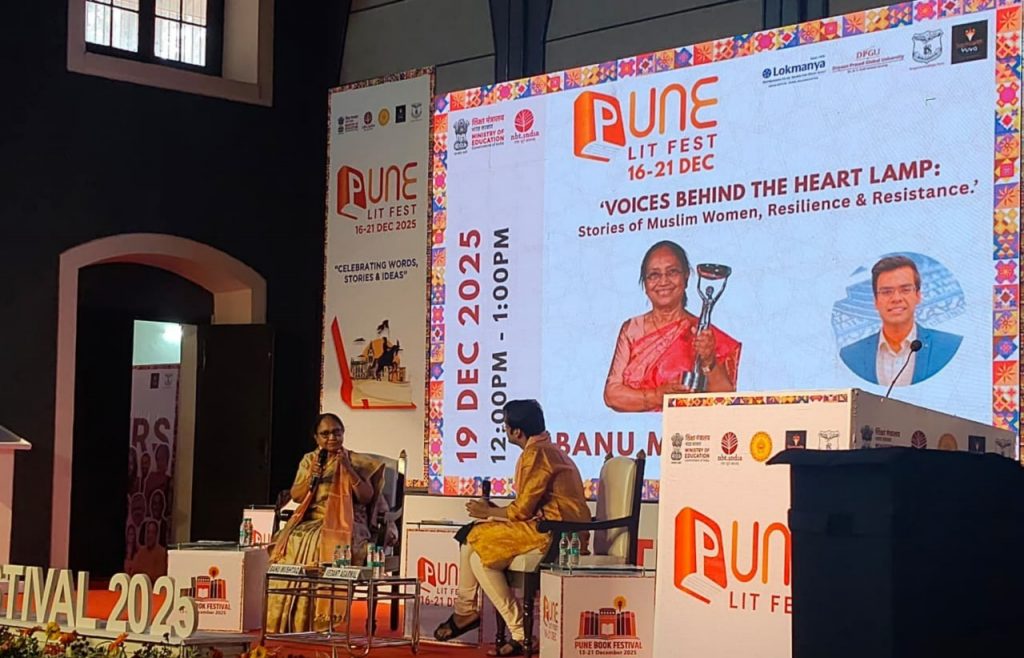
Pune, 19th December 2025: Banu Mushtaq, winner of the 2025 International Booker Prize for her Kannada short story collection Heart Lamp, headlined a poignant session at the Pune Book Festival on December 19, 2025, at Fergusson Auditorium. It was titled “Voices Behind the Heart Lamp: Stories of Muslim Women, Resilience & Resistance,” the event was moderated by former NDTV correspondent, Vedant Agarwal, brimmed with heartfelt personal anecdotes about her life, the writing process, and the profound reactions to her award-winning work.
The session opened with Prof. Milind Sudhakar Marathe, Chairman of the National Book Trust (NBT), felicitating Banu Mushtaq, the first Kannada writer to secure the Booker Prize, and Vedant Agarwal, the well-spoken moderator of the event.
Mushtaq’s characteristic humility infused her remarks, perfectly embodied by the Urdu proverb she shared: “Hakhdar tarse to angaar ka nuh barse” (When the oppressed weeps, embers rain down), encapsulating her message of resilient inner fire. Mushtaq credited her childhood amid Dalit and poor farmers’ movements for igniting her commitment to fairness, steering her toward feminist activism, advocacy for the marginalized, and a legal career.
Agarwal skillfully unpacked the book’s themes and symbols, spotlighting the “seragu”—a shawl or ghungat used for head-covering—whose deliberate fall signifies quiet rebellion against imposed norms. Mushtaq affirmed that veiling must remain a woman’s autonomous choice, unbound by societal judgments of her worth, aligning with her broader critique of patriarchal control in Heart Lamp. Mushtaq referenced the recent controversy involving Bihar Chief Minister Nitish Kumar, who on December 15, 2025, forcibly removed a Muslim woman doctor’s hijab during a Patna event while distributing appointment letters, citing “identification purposes.” She condemned the act as disorderly and impolite, pointing out the violation of personal dignity regardless of intent.
Shifting to sisterhood, Mushtaq dismantled stereotypes of female rivalry, illustrating unbreakable bonds: how women from all walks instinctively rally to help a stranger whose water breaks, transcending class barriers.
She candidly shared her postpartum depression and domestic dissatisfaction that nearly led to disaster—her house almost burning down, averted by her husband’s timely intervention and care, sparking their shared library escapes.
Praising “good men” like her proud father, who was encouraging of her education, and she recalled the time she learnt “Kannada in eight days”, Mushtaq rejected one-sided gender accusations while acknowledging diverse male perspectives and persistent patriarchal views confining women to kitchens. Addressing Agarwal’s query on patriarchy and husbands in Heart Lamp—asking whether she “hates men”—she resoundingly said “no”, cherishing her bonds with husband, son, and relatives, even amid outdated mindsets, yet her stance is pro-feminist.
In closing, Mushtaq revealed plans for her autobiography, touched by readers’ messages linking her stories to their own, mothers’, and grandmothers’ lives—joking that she seemed to know their secrets.
Grateful for her Booker triumph later in life, she mentioned eyeing a writing fellowship in Germany and her book’s long listing for the National Critics Award in the United States. The session concluded with her evocative reading of Heart Lamp’s final paragraph.