Why ‘Kejriwal Model’ Is Being Discussed in Pune: Marathi Edition of Jasmine Shah’s Book Released
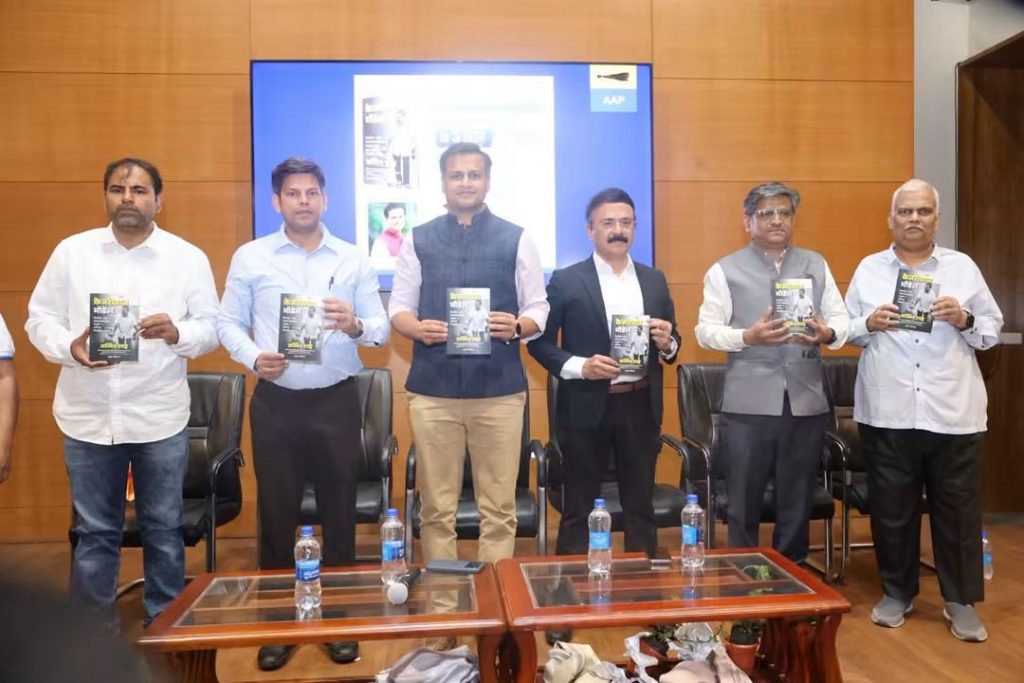
Pune, 5th October 2026: The Marathi edition of Kejriwal Model, a book by Jasmine Shah, former Vice-Chairman of the Delhi Government’s Dialogue and Development Commission and Advisor to the Chief Minister of Punjab, was released on Saturday at Bharat Itihas Sanshodhak Mandal in Sadashiv Peth, Pune.
Published by Madhushree Publications, the book examines the policies and welfare schemes associated with former Delhi Chief Minister Arvind Kejriwal and presents data and responses from beneficiaries in Delhi and Punjab.
A panel discussion was held during the launch, featuring former senior IAS officer Mahesh Zagade, Sakal Media Group Editor Samrat Phadnis, former Delhi MLA and AAP Maharashtra in-charge Prakash Jarwal, senior RTI activist and AAP Maharashtra State Vice-President Vijay Kumbhar, and Sharad Ashtekar of Madhushree Publications. AAP Maharashtra State Secretary Dr Abhijit More moderated the discussion.
According to the speakers, the book focuses on the economic rationale behind several welfare initiatives in Delhi and Punjab, particularly in education and healthcare. It argues that investment in human capital can play a central role in economic development and presents the “Kejriwal Model” as being based on three pillars—human capital development, the fight against corruption and fiscal discipline.
The book also compares the Kejriwal Model with the BJP’s “Gujarat Model”, arguing that the former places greater emphasis on strengthening public services and empowering ordinary citizens.
Speaking at the event, former senior IAS officer Mahesh Zagade criticised the functioning of governments and administration, saying that democratic politics had increasingly come under the influence of officials, politicians and, to some extent, the media.
“The theft of democracy must stop,” Zagade said, claiming that the Kejriwal government in Delhi had focused on providing public services and placing the common citizen at the centre of its development approach.
He also criticised what he described as excessive privatisation in Maharashtra and called for greater investment in healthcare, education, electricity, water, employment and agriculture.
Sakal Media Group Editor Samrat Phadnis raised concerns over Pune’s development priorities, saying that projects worth around ₹1 lakh crore were being implemented in the city but that basic civic services continued to face problems.
“The condition of public transport, government schools and clinics here is extremely pathetic,” Phadnis said. He also questioned the availability of buses for citizens and criticised the administration for what he described as inadequate field-level inspections.
Phadnis also referred to activist Abhijeet Dipke’s “School Thik Karo” campaign, saying it had received support from different sections of society.
Former Delhi MLA and AAP Maharashtra in-charge Prakash Jarwal spoke about his experience of Delhi’s water supply system and described the Kejriwal Model as a blueprint for public welfare and anti-corruption policies.
Senior RTI activist and AAP Maharashtra Vice-President Vijay Kumbhar said the book could serve as reference material for those studying administration and public policy.
“In Delhi and Punjab, Arvind Kejriwal transformed government schools, while in Maharashtra, thousands of government schools are being shut,” Kumbhar said.
AAP leaders and workers, including Sujit Agarwal, Vasantrao Doke, Sandeep Desai, Bhushan Dhakulkar, Manish Modak, Mukund Kirdat, Amit Mhaske, Raviraj Kale, Sanjay Kone and Sunita Kale, attended the event. District and city-level office-bearers from across Maharashtra were also present.