Astronomers Chart Hidden Dust Structures in Milky Way, Offering Clues to Star Formation
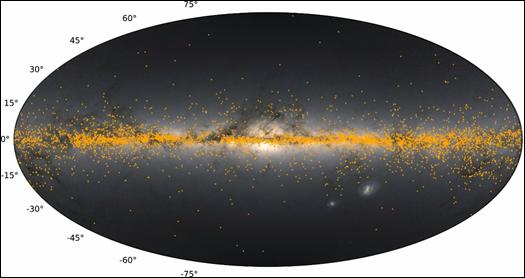
New Delhi, 16th September 2025: Indian astronomers have created a detailed map of the cosmic dust that obscures the Milky Way, offering new insights into how stars are born and how our Galaxy is structured.
Researchers at the Aryabhatta Research Institute of Observational Sciences (ARIES), an autonomous institute under the Department of Science and Technology, analyzed data from more than 6,000 open star clusters to trace the spread of interstellar dust across the Galaxy’s thin disk. These clusters, which lie close to the Galactic plane where most of the gas and dust are concentrated, served as markers to map how starlight is dimmed or reddened when passing through dust clouds.
“The distribution of dust in our Galaxy is far from uniform. Instead of lying along the central plane, it follows a slightly displaced, wavy structure that shifts above and below the disk,” explained study lead Dr. Y. C. Joshi. He noted that this “reddening plane” shows variations depending on direction, with the highest dust concentration found around Galactic longitude 41° and the least near 221°.
Interestingly, the team found that the Sun itself sits about 50 light-years (nearly 16 parsecs) above this dust layer. The thickness of the dusty regions also changes, appearing denser toward the Galactic center and thinner in other directions. This uneven pattern points to the dynamic nature of our Galaxy’s evolution.
According to the researchers, mapping interstellar dust is critical because it not only shapes how we observe stars but also marks regions where new stars are likely to form. “Our results give a sharper picture of how dust is arranged, which is essential for correcting astronomical observations and understanding stellar nurseries,” Dr. Joshi added.
The study underscores the importance of extending such surveys to more distant regions of the Galaxy. Upcoming missions, including future data releases from the European Space Agency’s Gaia project and the Vera C. Rubin Observatory’s Legacy Survey of Space and Time (LSST), are expected to provide deeper coverage, building a three-dimensional map of the Milky Way’s dusty skeleton.