The Glow of Fearless Serenity: Maa Chandraghanta
By Rhythm Wagholikar
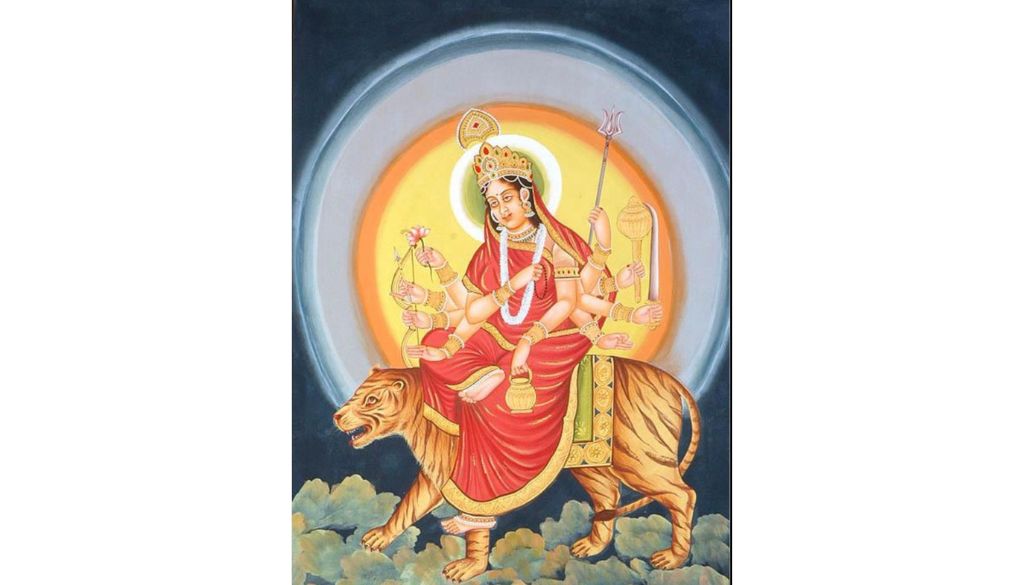
Pune, 24th September 2025: Maa Chandraghanta, the third manifestation of Goddess Durga worshipped on the third day of Navratri, embodies the rare union of courage and serenity, of fierce protection and gentle compassion. Her name itself carries a story, for she is adorned with a half-moon shaped like a bell on her forehead, a symbol that gives her the title Chandraghanta. She rides a lion, carries ten weapons in her many hands, and yet radiates the calm glow of peace and benevolence. She is the Goddess who teaches humanity that true strength is not the absence of gentleness, and true calm is not the absence of challenges, but the ability to hold both in balance even when surrounded by darkness.
The mythology of Maa Chandraghanta is deeply moving and symbolic. After Parvati, the daughter of the Himalayas, performed intense penance and austerities as Brahmacharini to win the love of Lord Shiva, she eventually became his consort. When their marriage was to take place, Lord Shiva, known for his ascetic ways, arrived with an unusual procession. His body was smeared with ash, snakes adorned his neck, ghosts and spirits made up his companions, and his overall appearance was terrifying. The very sight of such a groom unsettled Parvati’s family, who feared the strange and dreadful form of Shiva. It was in that moment that Parvati transformed into Chandraghanta, assuming a form of unparalleled radiance and courage, calming her family while also commanding respect from Shiva’s strange companions. With her bell-shaped crescent and divine aura, she bridged the worlds of fear and faith, ensuring the union took place with dignity and grace.
Her story is more than a tale of divine marriage. It is a powerful allegory of confronting the unknown and the terrifying with courage while maintaining inner calm. In the presence of daunting challenges, Parvati did not cower or resist; she transformed. She became the embodiment of strength balanced with compassion. This is the timeless lesson of Chandraghanta: when confronted with fear, uncertainty, or chaos, transformation arises from within. One does not deny the darkness but faces it with clarity, grace, and the power of calm courage.
Maa Chandraghanta’s lion is a symbol of unyielding bravery. To ride the lion is to master fear and transform it into strength. Her many weapons reflect preparedness for any challenge, yet her face radiates tranquility. This duality is not a contradiction but a profound truth of life. Strength without peace leads to aggression, while peace without strength risks vulnerability. In Chandraghanta we see the synthesis of both, a reminder that courage and calm are not opposites but companions.
In today’s world, where fear often manifests in new forms, her message is particularly relevant. The modern generation is confronted with uncertainties of career, relationships, health, societal expectations, and global issues. Anxiety and self-doubt have become companions for many, often leading to restlessness and despair. Chandraghanta teaches that it is possible to remain steady even in the midst of turbulence. She shows that fear can be transformed into focus, and challenges can be faced with resilience when the mind is calm and the heart is courageous.
Her crescent bell is also symbolic. A bell produces sound that dispels negativity and awakens awareness. The crescent itself is a symbol of rhythm and time, ever moving, ever shifting, yet constant in its cycle. Together, the crescent bell on her forehead signifies the awakening of consciousness, a vibration that removes fear and ushers clarity. For today’s seekers, this is a reminder that in moments of fear and doubt, awareness itself is a weapon. By becoming conscious of one’s thoughts, by observing rather than reacting, one awakens the inner strength to handle any situation.
The mythology of Chandraghanta does not merely belong to ancient scriptures; it plays out in every human life. Whenever one encounters unexpected challenges, whenever fear clouds the heart or uncertainty darkens the path, there arises an opportunity to invoke Chandraghanta. To invoke her is not only to chant her name but to embody her qualities. It is to cultivate courage that does not lose compassion, and serenity that does not weaken in the face of trials. It is to walk into life’s storms with the strength of a warrior and the calm of a sage.
The relevance of Chandraghanta for today’s generation also lies in her ability to harmonize opposites. The world often teaches that one must choose between being strong or being gentle, between being ambitious or being content, between being spiritual or being worldly. Chandraghanta teaches that these are not contradictions but dimensions that can coexist. One can pursue ambition with integrity, one can face conflict with compassion, one can achieve success while remaining humble. Her life and form remind us that balance is the true mark of maturity, and it is this balance that transforms ordinary living into a path of wisdom.
Her lion represents courage, yet courage is not simply physical strength or bold action. True courage, as Chandraghanta demonstrates, is the ability to stand firm in one’s values, to act with integrity even when it is difficult, to keep calm in the face of provocation, and to uphold compassion even when confronted with hostility. Such courage is rare and precious, and it is this that the Goddess inspires in her devotees.
For the modern youth, surrounded by comparisons, social pressures, and the race for success, Chandraghanta’s example offers an anchor. She teaches that dignity and calm are not signs of weakness but the foundations of true confidence. A person who is calm within is unshaken by outer storms. A person who carries compassion alongside courage earns not only respect but also harmony in relationships. This wisdom is timeless and urgently needed in the fast-changing dynamics of today’s society.
Chandraghanta is also a symbol of readiness. Her ten hands, each holding a weapon, symbolize the preparedness to face any direction and any challenge. Yet her readiness is not driven by fear but by clarity. She does not wield weapons recklessly but keeps them as tools of protection, using them when required, and resting them when not. This is a profound lesson for all, particularly for a generation that often feels compelled to react instantly to everything. Readiness is not the same as restlessness. Preparedness does not mean constant anxiety. Chandraghanta’s calm readiness shows that one can be equipped without being overwhelmed, proactive without being impatient, alert without being anxious.
Her story also reveals that even in the face of the unusual or the terrifying, beauty and grace have their place. When Shiva arrived with his ash-smeared body and ghostly companions, it was Chandraghanta’s grace that balanced the fear. She neither rejected Shiva’s essence nor let her family sink into despair. She became the harmonizer, the one who could transform dread into dignity. This reflects a profound truth: grace has the power to transform fear into acceptance. In our daily lives, when confronted with circumstances or people who seem unusual or unsettling, the presence of grace can create harmony where otherwise only chaos would prevail.
Maa Chandraghanta is thus not only a warrior goddess but also a philosopher in her symbolism. She teaches that life is not a battlefield alone, nor is it a peaceful retreat alone. Life is both, and wisdom lies in being able to carry courage into battle while carrying peace into one’s heart. Her lion and her crescent, her weapons and her serene face, are all metaphors for this higher truth.
To worship her is to cultivate a mind that is unshaken by fear, a heart that radiates compassion even when tested, and a spirit that walks with both courage and calm. Her message is a call to action for today’s generation to rise above fear-driven reactions, to embrace challenges as opportunities for growth, and to find strength in serenity.
As the third day of Navratri is dedicated to her, it becomes a reminder for every seeker that courage alone is not enough, nor is calm alone sufficient. True transformation occurs when both dwell together, when one’s life reflects the strength of a warrior and the serenity of a sage. Maa Chandraghanta’s presence inspires such transformation. She is a living beacon of courage and calm in the face of darkness, and her story continues to inspire those who seek to live with strength, compassion, and grace.
By invoking her spirit, one learns that no darkness is permanent, no fear undefeatable, and no challenge insurmountable. With courage in the heart and calm in the mind, every devotee can walk through life’s storms with dignity, radiating the same glow that shines on the forehead of Chandraghanta, a glow that dispels fear and awakens strength in all who behold it.