Pune: Are Junnar Leopards Family? Fresh Genetic Study Planned After Unusual Non-Territorial Behaviour
Junnar, 17th November 2025: Even as the leopard population in the Junnar landscape continues to grow, forest officials say reports of territorial clashes remain strikingly rare. The unusual pattern has prompted wildlife managers and researchers to examine whether leopards in the region are displaying a form of tolerance rooted in kinship — a behaviour that would differ sharply from the species’ typically aggressive territorial nature.
Officials confirm that a scientific inquiry into this possibility is now underway.
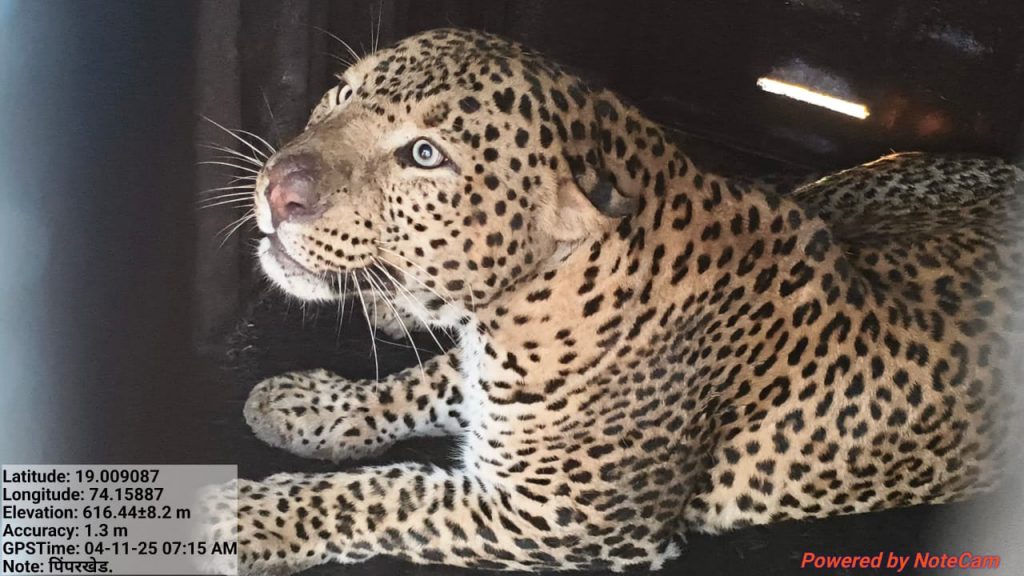
The latest trigger was a capture operation in Pimparkhed village of Shirur tehsil following a recent human fatality. During the drive, the Junnar Forest Division trapped three adult males within a three-kilometre radius. All were of similar age.
Forest officers said the discovery was unexpected because, under normal conditions, three adult males living so close together would almost certainly engage in frequent and violent territorial battles.
Similar clusters of leopards have been observed earlier across the division, yet documented cases of males fighting for territory remain very few, officials said.
Smita Rajhans, Assistant Conservator of Forests, Junnar Division, said the latest capture has raised fresh questions.
“The fact that three adult males were found in such close proximity without evident conflict is unusual. In other regions, this situation often leads to repeated territorial fights.
But Junnar does not show the same pattern,” she said. “We now plan to carry out a scientific examination of their genetic links to understand whether family bonds are influencing this behaviour.”
The pattern has caught the attention of researchers as well. Wildlife researcher Ankit Kumar, who worked with senior scientist Dr. Bilal Habib at the Wildlife Institute of India (WII), said their earlier study had also indicated a form of organised coexistence.
“Between 2021 and 2024, we radio-collared 14 leopards in Junnar. The data revealed that several individuals shared the same larger landscape. They maintained small, well-marked core territories within it,”
Kumar said. “Leopards tend to stay out of each other’s core areas, but outside those zones they appear to move around without conflict.”
According to him, each forest range in Junnar supports multiple leopards, yet individuals avoid intruding into the precise core zone of another leopard within the same range.
“This points to a structured system of tolerance rather than the kind of territorial aggression we typically associate with the species,” he added.
However, Kumar cautioned that any connection to kinship is still hypothetical.
“Whether this behaviour is linked to genetic relationships is not confirmed. We need more detailed studies to establish that. But the pattern we are observing is definitely unusual and deserves deeper investigation,” he said.
The radio-collar study also showed how extensively Junnar’s leopards travel — with some recorded moving as far as Ulhasnagar to the northwest of Pune and Igatpuri to the north.
Crucially, the study found relocation to be ineffective. Leopards translocated 10 km, 45 km and even 60 km away returned to their original locations within 10 to 30 days.
Based on this evidence, experts say relocation cannot be depended upon as a long-term conflict-mitigation strategy. Hunting or culling would require eliminating a large number of leopards, which researchers say is neither practical nor ethically acceptable.
Ongoing scientific assessments — including research into fertility-control methods — may help reduce conflict in the long run. But experts stress that the sugarcane-leopard dynamic in Junnar is deeply complex and will require a combination of sustained measures rather than a single, quick solution.