Pune: Navy Chief Admiral Dinesh K. Tripathi Envisions a ‘Viksit Bharat’ through Maritime Strength and Self-Reliance
Reported by Mubarak Ansari
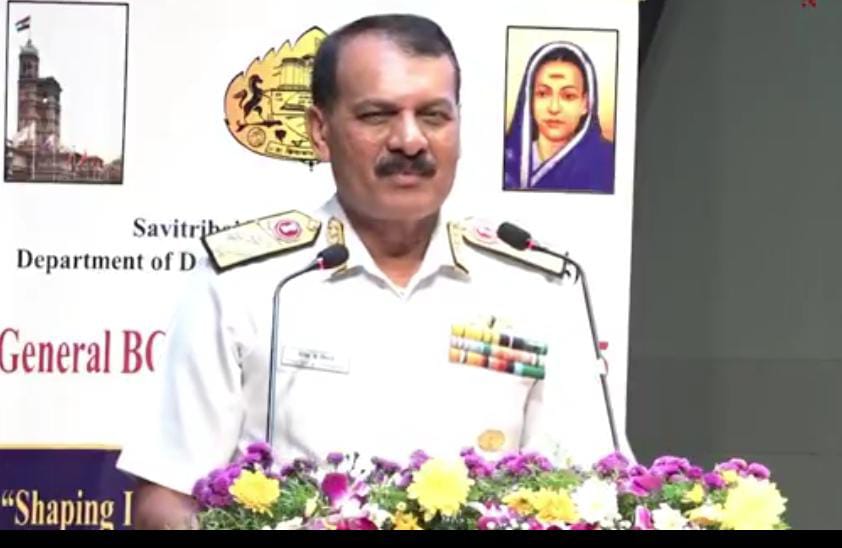
Pune, 1st December 2025: In a stirring address at Savitribai Phule Pune University, Chief of the Naval Staff Admiral Dinesh K. Tripathi asserted that India’s path to becoming a developed nation (Viksit Bharat) by 2047 is intrinsically linked to its maritime prowess and strategic self-reliance (Aatmanirbharta).
Delivering the prestigious General B.C. Joshi Memorial Lecture, Admiral Tripathi paid tribute to the legacy of General Joshi, a visionary military leader who emphasized the synergy between the military and academia. The Admiral’s address, titled “India’s Maritime Potential: Resources, Rewards, and Risks,” outlined a comprehensive roadmap for the Indian Navy’s role in the 21st century—a period he confidently termed “India’s Century.”
The Economic Imperative of the Seas
Moving away from a historically land-centric view of security, Admiral Tripathi highlighted the critical economic dependence India has on the oceans. With 95% of India’s trade by volume traveling by sea, he noted that the nation’s aspiration to become a $5 trillion economy by 2027 and the world’s third-largest economy by 2030 is heavily reliant on secure maritime trade routes.
“Shipbuilding is the mother of all industries,” the Admiral stated, drawing comparisons to the economic rise of South Korea, Japan, and China through their maritime sectors. He set an ambitious target for India to enter the ranks of the top five global shipbuilders by 2047, a move that would stimulate ancillary industries and generate mass employment.
Evolving Security Challenges: “Fear of Influence 2.0”
The Navy Chief warned of a shifting geopolitical landscape characterized by what he termed “Fear of Influence 2.0.” Unlike traditional military confrontations, this new competition involves a struggle for control over infrastructure, supply chains, and logistical standards.
He highlighted the rise of “Grey Zone” warfare, which includes cyber intrusions, legal warfare (“lawfare”), and the use of disguised vessels, making the distinction between peace and conflict increasingly blurred. He cited the recent drone and missile attacks in the Red Sea as examples of how fragility in maritime choke points can cause global economic disruption.
Aatmanirbharta: A Strategic Necessity
Admiral Tripathi emphasized that self-reliance is no longer just a slogan but a “strategic necessity.” He praised the Indian Navy’s transition from a “buyer’s navy” to a “builder’s navy.”
“Since 1960, we have commissioned about 140 warships that have been built in India,” he noted. He highlighted recent milestones, including the commissioning of INS Mahey—the first naval vessel designed and built by a private Indian firm—and the integration of niche technologies like AI, autonomous systems, and hypersonics through initiatives like iDEX (Innovations for Defence Excellence).
“Indian Navy, India’s Navy, Every Indian’s Navy”
Concluding his address, the Admiral reiterated the Navy’s commitment to protecting India’s national interests, ensuring the safety of seafarers, and acting as a “Preferred Security Partner” in the Indian Ocean Region. He called upon the youth and academia to engage with the maritime domain, stressing that the seas will determine India’s future.
“The 21st century will be India’s century,” he affirmed, “but our ascent will be determined by how we harness the oceans.”