Inside Pune’s ‘The Art of Perception’: An Exhibition Exploring Neuroaesthetics Through Art
By Diva Ajmera
Ghorpadi, 7th May 2026: Pune has always been a city that has prided itself in being a curator of art. With art exhibitions held almost every month, the city has always encouraged it’s artists to show the world what Art can bring in people’s lives.
Keeping that in mind, Arisa Foundation, a Non Profit organisation that primarily does research in the field of Neuroasthetics (a branch of neuroscience that deals with how one responds to aesthetic experiences), opened up the doors to an exhibition called The Art Of Perception.
According to Hansika Mangwani, the artist and lead curator of this exhibition, the exhibit is born from the observation that a lot of things happen to the world around us but it’s not what happens to one as much as how one responds to that happening that allows the person to experience it along with the curiosity of how do artists and Scientists respond to these questions.
The exhibit which started on 30 March 2026 has entered it’s last 10 days with the doors closing on 17 May 2026, translates neuroaesthetic into 7 zones to let people experience it themselves.
These zones are made keeping in mind the idea that perception is not passive and it will help the attendee learn to notice how their mind makes a world and how one can gently remake it.
The zone 1 is called Effection which allows one to experience their environment in connect with their heartbeat. According to Hansika, “The idea is for people to feel more connected to their internal processes an to realise that this kind of awareness can change how you experience the external world.”
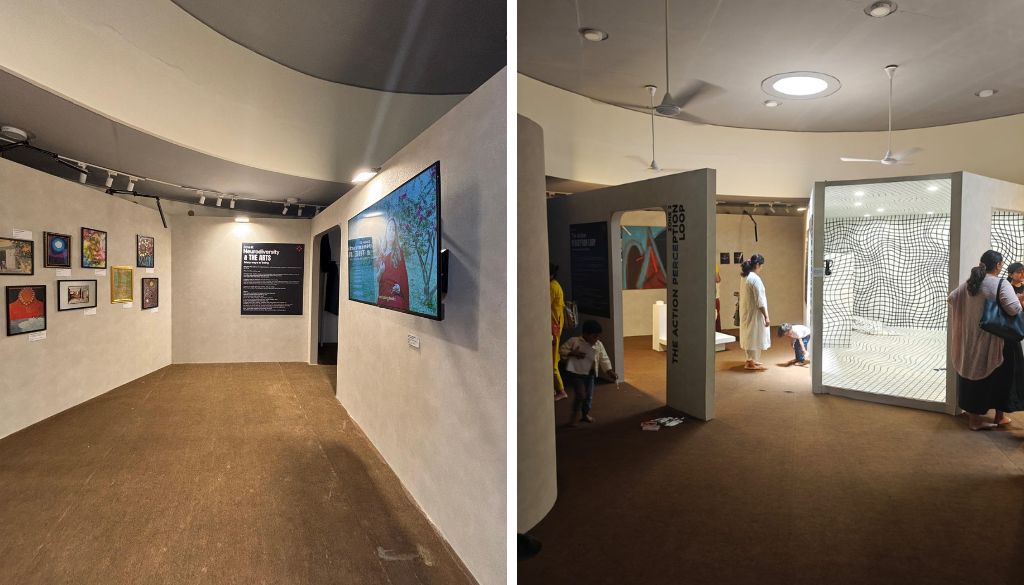
Zone 2 which is called The Action Perception Loop explores how tightly linked perception and movement are in the brain. “When you move fast, you feel more energetic but that same movement done slowly can actually start regulating your body, so doing the same actions again and again can help you feel more in control and centred in the body.” said Hansika as she explained the 2nd zone.
The 3rd zone is called The Aesthetic Triad which breaks the experiential side and asks the visitors to understand the anatomy of brain through a more creative lens by interpreting an artwork through three pathways which make up the aesthetic triad.
Zone 4 is the Illusions which is trying to throw the attendees in an illusion so that they become aware that not everything that one perceives is true. “There are things that may or may not be true, whether it’s sensorily or emotionally. A lot of times we are feeling something, but that feeling is because of the meaning we have attached to it but that meaning may not actually be true. So the zone tries to explain to look at life with a little more awareness and that the brain can be tricked too.” Hansika explains.
Zone 5, The Speed of Judgement, is looking at a bias that is called ‘beauty is good’. With the help of six faces and a question of “who seems the friendliest?”, the zone tries to show that humans choose the prettiest face as the friendliest very quickly because of the bias that something that is pretty is the one that would have all the positive attributes.
The 6th zone is called Neurodiversity and the Arts. This space is dedicated for neurodivergent artists and showcase the creations of neurodivergent artists who explain their thoughts and feeling through their artwork along with a documentary that is created with a Bangalore based organisational school called Sense Kaleidoscopes, that showcases autistic students talking about how art helps them express.
The last zone called The Living Pause is more about one’s relationship with nature. Pune based artists have showcased their work which answers to themes of inter-connectedness, corrections and feeling closer to oneself and closer to nature using natural materials.
The goal of this exhibition, at the end of the day, is not to explain perception from the outside but to help one notice how it unfolds in their own body and mind.
“We have spent so long to curate this exhibition because we wanted this to be applicable for all ages.” Hansika says as she invites everyone to come and experience The Art Of Perception no matter the age.
With the help of amazing zones that are not just thought provoking but also visually impressing, the exhibition invites everyone from scientist to artists to normal people who are curious about how our mind works to people who want an interactive experience and even people who just want to take aesthetic Instagram pictures. Everyone is welcome to experience The Art Of Perception.