Beyond the Creek : Raigad’s Most Stunning Escapes
By Samiccha Malik
Pune, 28th May 2027: There is a particular quality to Raigad district that sets it apart from everything around it. It sits where two very different worlds meet – the rugged, forested Sahyadri mountains pressing in from the east and the warm, unhurried Konkan coast opening up to the west. Between these two worlds lies a district of extraordinary variety: sea forts that rise from the ocean, ancient Buddhist caves carved into hillsides, quiet beaches where fishermen still pull in nets at dawn, and at the heart of it all, a hilltop fort that was once the capital of the greatest empire Maharashtra has ever known. Raigad does not ask you to choose between history and nature. It offers both, generously and all at once.
Here are ten places in this remarkable district that deserve to be on every traveller’s list.
1. Raigad Fort
There are places in Maharashtra that carry history, and then there is Raigad Fort a place where history was made. Perched atop a dramatic plateau in the Sahyadris at roughly 2,700 feet above sea level, Raigad was the capital of the Maratha Empire under Chhatrapati Shivaji Maharaj. It was here, in 1674, that Shivaji was crowned in one of the most significant coronation ceremonies in Indian history. The fort is vast and layered – a ruined city unto itself. The Coronation Point, the Jagdishwar Temple, the market ruins, the Queen’s Palace, and most poignantly, the samadhi of Shivaji Maharaj himself – each speaks of an era of extraordinary ambition and vision. A ropeway connects the base to the top for those who prefer not to trek, but the walk up through the forest is an experience in itself. Come here with patience and time to spare. Raigad is not something you rush through.
2. Alibaug
Alibaug is Raigad’s most famous face a coastal town that has drawn weekend travellers for generations without ever quite losing its essential character. The beaches here – Alibaug Beach, Varsoli, Akshi, Nagaon are long, relatively uncrowded, and fringed with casuarina trees that sway in the sea breeze. The water is calm and the pace is gentle. Right off the shore, rising directly from the sea as though placed there deliberately, is the Kolaba Fort a seventeenth century sea fort built by Shivaji Maharaj that can be walked to during low tide and reached by boat when the water rises. Watching the fort with the Arabian Sea behind it and the sunset turning the sky orange is one of those moments that does not need any editing.
3. Murud-Janjira Fort
If there is one fort in all of Maharashtra’s coastal history that stands apart from all others, it is Murud-Janjira. Built on a small island in the Arabian Sea near the town of Murud, this fort was never conquered not by Shivaji Maharaj, not by the British, not by the Portuguese. It stood impregnable for centuries, defended by the Siddis of Janjira, and that history alone gives it an aura unlike anything else on the Konkan coast. Accessible only by boat from Rajpuri village, the fort’s massive circular walls rise straight from the water, making it look less like something built by human hands and more like something the sea itself created. The interiors, with their freshwater tanks, towers, and cannons, are fascinating to explore. The boat ride across to reach it is half the experience.
4. Karnala Bird Sanctuary
Not far from the Mumbai-Goa highway, in the northern part of Raigad district, the Karnala Bird Sanctuary is a quiet, forested escape that rewards birdwatchers and nature lovers in equal measure. Over 220 species of birds have been recorded here, including numerous migratory visitors that arrive through the winter months. At the centre of the sanctuary stands the Karnala Fort, a lone basalt pinnacle rising from the forest floor that can be reached by a short but steep trail. The fort sits above the canopy and offers wonderful views of the surrounding hills. For anyone who enjoys the combination of wildlife, forest walks, and a little bit of history thrown in, Karnala is a deeply satisfying destination.
5. Diveagar Beach
South of Alibaug, past the busier coastal towns, Diveagar is the kind of beach that feels like a well-kept secret even though it is not particularly hidden. The sand here is clean and wide, the crowds are thinner than at more popular stretches of the coast, and the village behind the beach retains a genuinely Konkani character – coconut groves, simple homes, and the smell of salt and fish in the air. The beach also has a small but beloved Ganesh temple that sits quietly among the trees near the shoreline. Walk here early in the morning and watch the fishing boats come in as the light turns golden. It is unhurried and unpretentious, and all the better for it.
6. Harihareshwar
Known locally as the Dakshin Kashi – the Kashi of the South , Harihareshwar is a small coastal town where the Savitri River meets the Arabian Sea, and where the cliffs above the water are dramatic and dark. The Harihareshwar temple, dedicated to Lord Shiva, sits on a rocky promontory surrounded by sea on three sides a setting of such natural grandeur that even those who have not come on pilgrimage find themselves quietly moved. The beaches here are relatively wild, the atmosphere deeply spiritual, and the combination of crashing sea, black rock, and ancient temple creates a mood that is entirely its own. Harihareshwar is the kind of place you come to once and find yourself thinking about for a long time afterward.
7. Shrivardhan Beach.
Neighbouring Harihareshwar and accessible along a road that hugs the coastline, Shrivardhan is a long, curving beach that is one of Raigad’s finest. The sand stretches generously, the sea is relatively calm, and the town behind it has a relaxed energy that makes it ideal for a proper slow escape. Shrivardhan also holds a small but interesting piece of history – this town is considered the ancestral home of the Peshwas, the prime ministers of the Maratha Empire who wielded extraordinary influence across the subcontinent. A heritage monument marks this connection, adding a layer of historical texture to what is otherwise a serene and beautiful beach town.
8. Kondhane Buddhist Caves
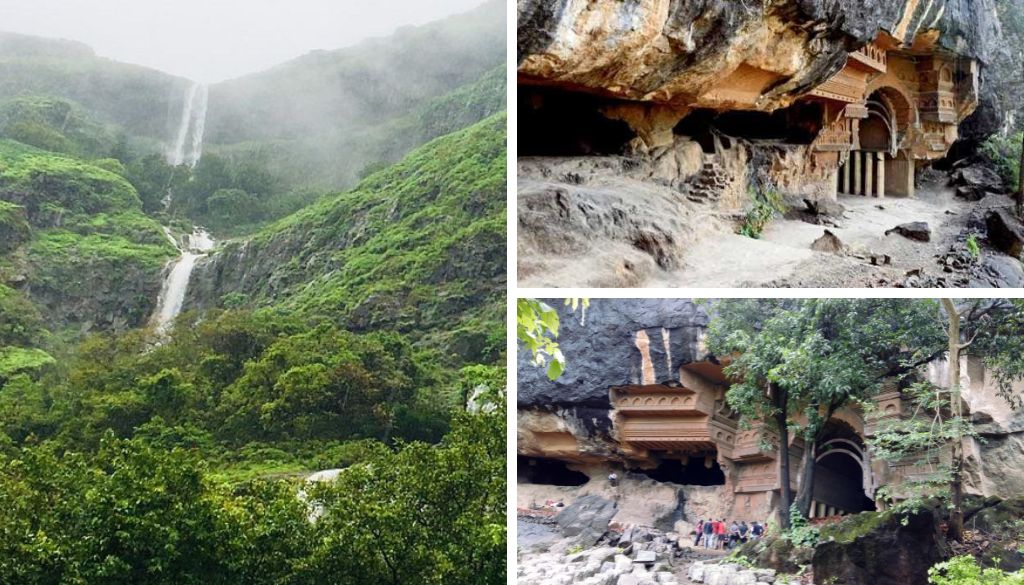
Among Raigad’s lesser known but genuinely remarkable sites are the Kondhane Caves – a set of ancient Buddhist rock-cut monuments tucked into the Sahyadri hillside near Karjat. Dating back approximately two thousand years, these caves were carved during the same period as the more famous Karla and Bhaja caves of Pune district, and they carry the same quiet, profound atmosphere. A waterfall cascades near the cave entrance during the monsoon, making the approach particularly beautiful in that season. The site receives far fewer visitors than it deserves, which means you can often explore it in near solitude a rare privilege when standing inside something two millennia old.
9. Shivthar Ghal
Hidden in the forest along the Varandha Ghat road, Shivthar Ghal is one of Raigad’s most spiritually significant and scenically extraordinary sites. This is the place where Samarth Ramdas Swami lived for twenty-two years and where, it is believed, he dictated his masterwork Dasbodh to his disciple Kalyanswami. It is also said to be where Chhatrapati Shivaji Maharaj first met Samarth Ramdas a meeting that shaped the course of Maratha history. The ghal itself is a dramatic rock overhang above a waterfall and a small valley, and the combination of natural beauty and spiritual weight makes it an unforgettable place to visit. It is not on most tourist itineraries, which only adds to its appeal.
10. Tamhini to Bhira : The Backwater Route
The road from Tamhini Ghat descending into Raigad district along the Bhira reservoir is one of those routes that travel writers keep quiet about for fear of it becoming too popular. The Bhira backwaters stretch through a valley of extraordinary quiet – forested hills on every side, the water a deep still green, and almost no sound except birds and the occasional boat cutting through the surface. The drive along this route, particularly in the post-monsoon months when everything is lush and the light is golden in the late afternoon, is one of the most beautiful things you can do in Raigad district without stepping out of your vehicle. Stop anywhere along the way, sit on a rock above the water, and you will understand why this corner of Maharashtra feels like it belongs to another, slower world entirely.
Best Time to Visit
Raigad rewards visitors across seasons but each period offers something different. The monsoon from June to September brings the ghats and forests to life with waterfalls and deep green landscapes – ideal for Shivthar Ghal, the Kondhane Caves, and the backwater routes. October to February is the best time for beaches, fort treks, and coastal exploration when the weather is cool and the sea is calm. The Kaas-adjacent months of September and October are also ideal for the interior forested areas of the district.
Getting There
Raigad district is accessible by road from Mumbai and Pune, both of which are within comfortable driving distance. The Konkan Railway passes through the district with stations at Roha, Mangaon, and Mahad serving as entry points for the southern parts. Ferries and boats from Mumbai’s Gateway of India provide a scenic alternative route to the coastal areas including Alibaug and Mandwa.
Raigad is a district that carries the weight of empires and the lightness of sea breeze in equal measure. From the fort where Maharashtra’s greatest king was crowned to the quiet beaches where fishermen greet the morning, it offers a version of this state that is layered, alive, and endlessly worth exploring.