Indian Railways Set to Flag Off India’s First Hydrogen Fuel Cell Train with 10 Coaches, 2,600-Passenger Capacity
Reported by Amit Singh
New Delhi, 16th July 2026: Indian Railways is set to introduce the country’s first Hydrogen Fuel Cell Powered Trainset, marking the debut of hydrogen-powered passenger rail operations in India. The train will initially operate on the 89-km Jind–Sonipat section of Northern Railway and is designed to generate electricity onboard using hydrogen fuel cells, eliminating the need for overhead electric power.
Unlike conventional electric trains that draw electricity from overhead wires, the hydrogen train produces power onboard through a chemical reaction between hydrogen and oxygen inside Proton Exchange Membrane (PEM) fuel cells. The electricity generated powers the train’s traction motors, while the only direct by-products of the process are water vapour and heat.
The train has been configured as a 10-coach passenger train with a carrying capacity of around 2,600 passengers, making it one of the highest-capacity hydrogen-powered passenger trains developed globally. Most hydrogen passenger trains currently operating worldwide consist of two to four coaches and are deployed on regional routes.
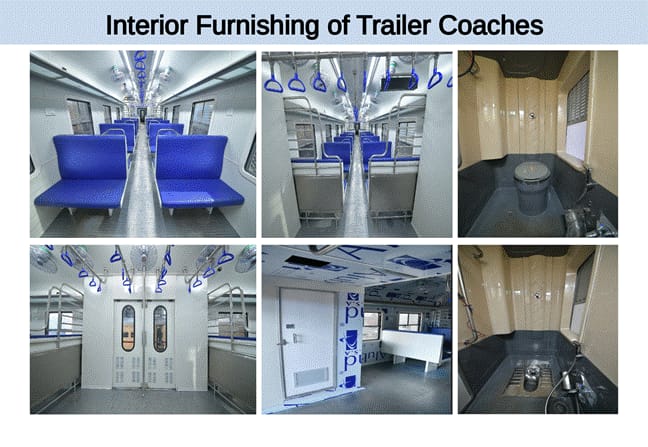
The train comprises two Hydrogen Driving Power Cars (DPCs) and eight trailer coaches. Each driving power car is equipped with hydrogen fuel cells, lithium iron phosphate (LFP) batteries and hydrogen storage cylinders, producing 1,200 kW (1,600 hp) of power. Together, the two power cars provide sufficient traction to achieve a design speed of 110 kmph, while the train will initially operate at 75 kmph on the Jind–Sonipat route.
The service will connect Jind Junction, Gohana Junction and Sonipat, covering intermediate stations and halts including Jind City, Pandu Pindara Junction, Lalit Khera Halt, Bhambhewa, Isapur Kheri Halt, Butana Halt, Khandrai Halt, Rabrah Halt, Lath Halt, Mohana, Barwasni Halt and Sonipat New.
To support operations, Indian Railways has established a dedicated hydrogen production, storage and refuelling facility at Jind, described as the country’s largest railway hydrogen refuelling station. The facility produces hydrogen through electrolysis, compresses it to 500 bar for storage and dispenses it at 350 bar through two independent refuelling dispensers, allowing both driving power cars to be refuelled simultaneously. The plant has a storage capacity of nearly 3,000 kg of hydrogen and has received approval from the Petroleum and Explosives Safety Organisation (PESO).
The train has been equipped with multiple safety systems designed to continuously monitor hydrogen storage and operation. These include hydrogen leak detectors, heat, flame and smoke detection systems, continuous ventilation, automatic hydrogen shut-off mechanisms and real-time system monitoring in the locomotive pilot’s cabin. Similar safety systems have also been installed at the Jind hydrogen facility.
According to Indian Railways, the hydrogen ecosystem has been developed in compliance with international standards, including NFPA-2 and the ISO 19880 Series, while also meeting statutory safety requirements prescribed by PESO. Before commissioning, the project underwent an independent third-party safety assessment by TÜV SÜD, Germany.
The train also completed a series of technical evaluations before operational deployment, including load box testing, radio frequency compatibility trials, oscillation trials and emergency braking distance tests.
The project has been developed using indigenous technology under the leadership of Indian Railways. The Research Designs and Standards Organisation (RDSO) prepared the technical specifications and oversaw design approvals, while Medha Servo Drives integrated the trainset. The Integral Coach Factory (ICF) contributed to the train’s exterior design and theme.
Indian Railways has also indicated that the experience gained from the Jind–Sonipat project will be utilised for future hydrogen-powered train operations, including on heritage railway routes such as the Kalka–Shimla Railway.