Khakee Varditeetala Yoddha: A Journey of Service, Courage, and Dedication
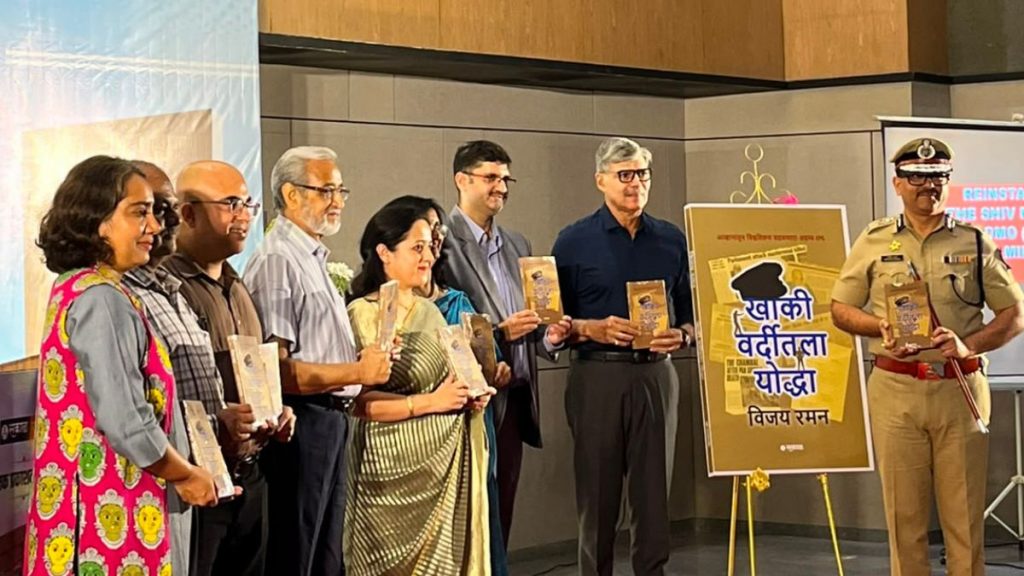
By Gargi Kashyap
Pune, 13th August 2026: The book Khakee Varditeetala Yoddha by Vijay Raman chronicles the remarkable professional journey of a decorated police officer, highlighting his bravery, courage, experiences, and commitment to public service.
The book was launched on 8th August, at an event attended by members of the police fraternity, family members, friends, and readers. The chief guests at the event were Padma Shri K. Vijay Kumar, IPS (Retd.), and Pune Police Commissioner Amitesh Kumar, IPS. The event brought together senior police officials, both serving and retired, as well as former colleagues who reflected on the profession’s challenges and the demands of field service.
During the launch, several members of the audience who had read the English version of the book, Did I Really Do All This?: Memoirs of a Gentleman Cop Who Dared to Be Different, shared their impressions of Vijay Raman’s memoir. One of them said, “I loved the parts about Pan Singh Tomar and Ghazi Baba; they were very exciting, but what I loved the most is how he went around the world in an Indian Contessa car.
The report is based on observations and remarks made during the book launch, which the author attended as a special invitee.
About the Book
Through this book, Khakee Varditeetala Yoddha, Vijay Raman tells us an enthralling tale of a life defined by his determination, valor, and character. It is not just about his career in law enforcement, but about his dedication to upholding the rule of law, courage, and integrity. It chronicles Raman’s career as a police officer in some of the toughest and most contentious parts of India and the dangers and duties he faced in his line of work. The book also delves into the intricacies of enforcing the law without losing compassion and humanity in an ever-evolving country.
About the Author
Vijay Raman, one of the country’s decorated police officers, joined the elite Indian Police Service in 1975 and went on to become a distinguished and courageous police officer, receiving several accolades for bravery, courage, and dedication to duty. Several notable achievements marked Raman’s distinguished career. These included leading a 14-hour encounter with the infamous dacoit Paan Singh Tomar in 1981, rescuing residents during the Bhopal gas tragedy while serving as an Assistant Inspector General, and apprehending Ghazi Baba, the alleged mastermind behind the 2001 Parliament attack, while serving as an Inspector General with the Border Security Force in Kashmir in 2003. He has also received the President’s Police Medal for Gallantry. Over more than 34 years of service, Raman gained extensive experience in general administration and policing. His assignments included Prime Minister’s security, Chief Minister’s security, anti-dacoity operations in the Chambal region, anti-terrorist operations in Jammu and Kashmir, anti-Naxalite operations, and the investigation of the Vyapam scam.
Awards and Honours
President’s Police Medal for Gallantry
President’s Police Medal for Distinguished Service
President’s Police Medal for Meritorious Service
Gold Medals in Law
He was also awarded citations in the Guinness Book of World Records and the Limca Book of Records for completing an around-the-world tour in an Indian Contessa car in 39 days, 7 hours and 55 minutes.
Reflections on a Distinguished Career
The event also featured Padma Shri V. K. Vijay Kumar, a senior police officer whose career included counter-terrorism operations in Jammu and Kashmir, work against Maoist insurgency and leadership of the Special Task Force that brought an end to the reign of forest brigand Veerappan. He later served as Director General of the CRPF, Director of the Sardar Vallabhbhai Patel National Police Academy and Senior Security Advisor in the Ministry of Home Affairs.
A former 1975-batch colleague spoke about his association with Vijay Raman and recalled the strong bond shared by members of their police batch. He described Raman as a professional who remained passionate about his work throughout his career. He also recalled their experiences while serving in the Prime Minister’s security detail and highlighted the importance of discipline and attention to detail in policing.
During the event, Vijay Kumar was asked about the author and his friendship with him. In response, he said, “I am privileged to be here. I was privileged to be his batchmate.”
The speaker recalled Vijay Raman as a graceful, humorous and highly professional officer who remained passionate about his work throughout his career. He also spoke about their shared experience as members of the 1975 IPS batch and their duty protecting former Prime Minister Rajiv Gandhi. He explained that the bond between police officers of the same batch is particularly strong because they undergo rigorous training and professional challenges together.
“The batch erases all other differences. You are together. When you say 1975, it’s a magnetic bond. Everywhere in the world, you say you are 1975-batch IPS, there is a special vibe about that.”
He also recalled Vijay Raman’s meticulous preparation for the Prime Minister’s visit to Lakshadweep, saying it demonstrated how particular he was about details.
Encounters and the Challenges of Policing
During the discussion, the speakers also spoke about the challenging encounters described in Vijay Raman’s career, particularly his experiences in the Chambal region. While discussing the term “encounter,” the speaker explained that police personnel have to act within the legal framework of self-defence, especially when protecting their own lives or the lives of others. He highlighted the difficult circumstances officers face during such operations, where quick decisions have to be made while balancing the responsibility of protecting lives and dealing with armed threats. The discussion also emphasised that encounters carry significant risks for police personnel, who may have to put their own lives in danger while responding to such situations.
Another important theme at the launch was the transformation of policing through technology. Pune Police Commissioner Amitesh Kumar spoke about the changes in mobility, communication and resources available to police personnel compared with earlier decades. He said that technology has now become an integral part of policing, with the government investing in modern equipment and exploring the use of artificial intelligence. Kumar also spoke about Pune’s expanding CCTV infrastructure. He said a proposal had been made to strengthen surveillance in the city through thousands of cameras equipped with technologies including facial recognition and automatic number-plate recognition. The discussion highlighted how technological interventions are increasingly being used to address security challenges, particularly in isolated areas on Pune’s outskirts.
Kumar said that after joining the Pune Police, he noticed that the city required greater CCTV coverage. He said a proposal was subsequently submitted for thousands of modern cameras equipped with technologies such as facial recognition and automatic number-plate recognition. He then connected the need for CCTV surveillance with safety concerns in Pune’s isolated outskirts, particularly areas that become deserted during the evening and night.
“There are outskirt areas where people travel, and people go, and unfortunately there are criminal elements; somehow these victims fall prey to them.”
Marathi Translation and Publishing Journey
The Marathi translation of the book was also highlighted during the event, with speakers from the Marathi literary community discussing the translation and its significance in bringing the story to a wider readership.
Representatives of Sakal Publication also spoke about the organisation’s publishing journey and its focus on producing books across diverse subjects, including inspirational works. The publication emphasised its commitment to readers and to bringing stories that can inspire different generations. The Sakal Publication representative also spoke about the publisher’s long-standing relationship with Pune’s readers and its commitment to producing meaningful and inspirational literature. Highlighting the publication’s diverse catalogue, the speaker said that Sakal has published around 50 print books across subjects ranging from agriculture to inspirational works.
“Sakal is always committed to these readers, and we take it as our responsibility to give something inspiring to all the generations.”
Vijay Raman’s wife described the Marathi release of his book as a deeply personal moment, saying that working on the book allowed her to revisit the life she shared with him.
“Today is really a special day for me because Vijay’s book is in Marathi. While working on the book, I have relived my life with him.”
She also expressed gratitude to everyone who helped bring the Marathi edition to readers, particularly Sakal Publishing, translators Arundhati Malhar and Rohan, and her friend Palguni, who designed the cover. She also acknowledged Vijay’s doctor for attending the event and thanked everyone for their continued support.
Thanking the audience and those who supported her through the journey, she said:
“And so the journey goes on, and I wish that you all be my support through this.”