60 Teachers Explore Microscopic World at ‘Life Across Scales’ Workshop in Pune
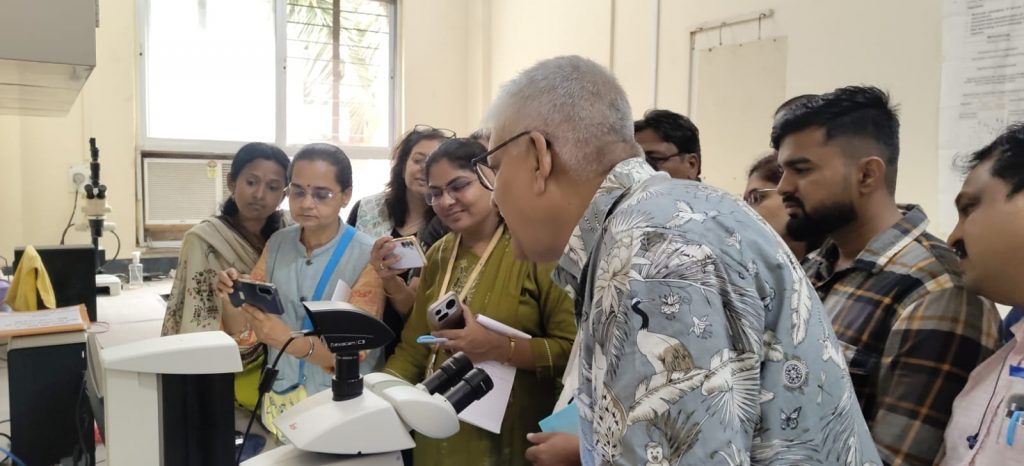
Pune, 25th August 2026: Sixty school teachers from rural Pune and adjoining districts got a rare opportunity to step inside a research laboratory and explore the microscopic world at ‘Life Across Scales’, a one-day hands-on teacher training workshop organised by the Pune Knowledge Cluster (PKC) in collaboration with the Agharkar Research Institute (ARI) and the Pune Chapter of the National Academy of Sciences, India (NASI).
Held at ARI, the full-day workshop aimed to bridge the gap between school science and real-world scientific research by giving teachers direct exposure to biological specimens, microscopy, and research infrastructure. The initiative particularly focused on teachers from rural and adjoining-district schools, creating an opportunity for them to interact with scientists and experience facilities that are generally not accessible in a regular school setting.
The workshop took teachers on a journey across different scales of observation—from the visible to the microscopic. Participants worked with hand lenses, stereomicroscopes, compound microscopes, confocal microscopes and scanning electron microscopes (SEM), observing how the same biological structures reveal increasingly finer details as magnification and resolution increase.
For several participating teachers, this was their first hands-on exposure to microscopes and advanced microscopy facilities in a research institution. Teachers also observed biological specimens including Drosophila, Hydra and other samples, gaining a first-hand understanding of how scientists study living organisms and biological structures.
More than an introduction to instruments, the workshop emphasised the importance of observation, questioning, critical thinking and scientific inquiry. Teachers were encouraged to look closely, compare what they observed at different scales and think about how similar experiences could be recreated for students using simple and low-cost classroom activities.
“When teachers experience science hands-on, they can take that curiosity back to their classrooms and students.”
— Dr. Surendra Ghaskadbi, Emeritus Scientist, Agharkar Research Institute & Fellow National Academy of Sciences India.
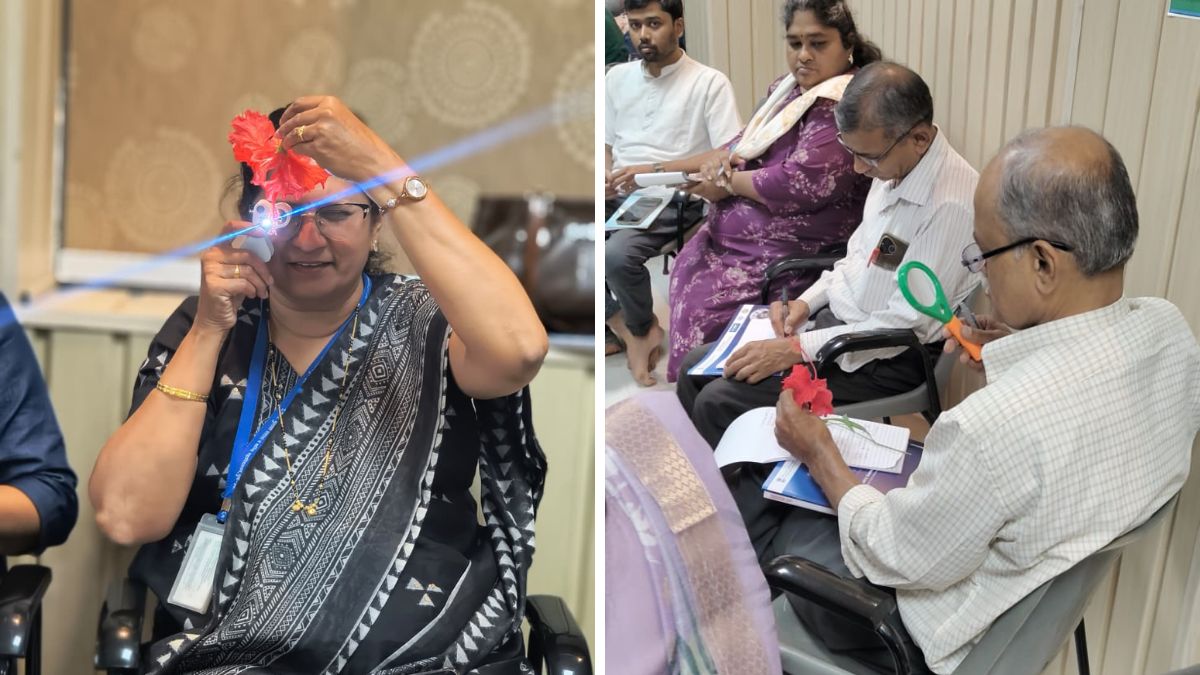
The workshop also provided teachers with ideas for adapting scientific demonstrations to their own classrooms, enabling them to turn abstract concepts from textbooks into experiences that students can observe and investigate.
“It is particularly important to create opportunities for teachers from rural schools to directly interact with scientists and gain exposure to research facilities that are otherwise difficult to access. Through the collaboration between PKC, ARI and NASI-Pune Chapter, we aim to build a stronger connection between scientific institutions and school education.”
— Gayatri Kshirsagar, Senior Program Manager, Pune Knowledge Cluster
“Science today needs a broader perspective and an interdisciplinary approach. When we bring together ideas and methodologies from different disciplines, we can look at scientific questions more holistically, encourage critical thinking and develop innovative solutions to complex challenges.” — Dr. Sharmila Bapat, President NASI
The workshop was conducted by Dr. Karthick Balasubramanian, Scientist E, ARI, and Dr. Surendra Ghaskadbi, CSIR-Emeritus Scientist, ARI. Teachers participated in laboratory-based rotational sessions, interacted with researchers and discussed ways of translating their learning into classroom practice.
Connecting Pune’s scientific institutions with school education
The workshop reflects PKC’s larger mandate of bringing together Pune’s academic institutions, research organisations, industry, government and other stakeholders to use science and technology for regional development. Established by the Office of the Principal Scientific Adviser to the Government of India, PKC serves as a catalyst for collaborative initiatives across areas such as capacity building, STEM education, health, sustainability, mobility, and Big Data & AI.
The collaboration with ARI builds on the institute’s long-standing strength in life sciences research. Established in 1946, ARI is an autonomous institute of the Department of Science and Technology, Government of India, with research spanning areas such as Biodiversity & Paleobiology, Developmental Biology, Genetics & Plant Breeding, Microbial Sciences and Nanobioscience. Its modern laboratories and research infrastructure provided the setting for teachers to experience scientific investigation up close.
The NASI-Pune Chapter also supported the initiative as part of its science outreach efforts for children and teachers in and around Pune. The three-institution collaboration brought together PKC’s capacity-building and education focus, ARI’s research expertise and infrastructure, and NASI’s science outreach network.
The ‘Life Across Scales’ workshop is envisioned as a model for continued engagement between research institutions and schools, particularly those in rural areas. By creating direct pathways between scientists, laboratories and teachers, such initiatives can help strengthen experiential science education and encourage teachers and students to approach science not merely as a subject to be taught, but as a process of observation, questioning and discovery.