Advancements along with National and International Collaboration will be key to management of peritoneal surface malignancies -Prof. Olivier Glehen
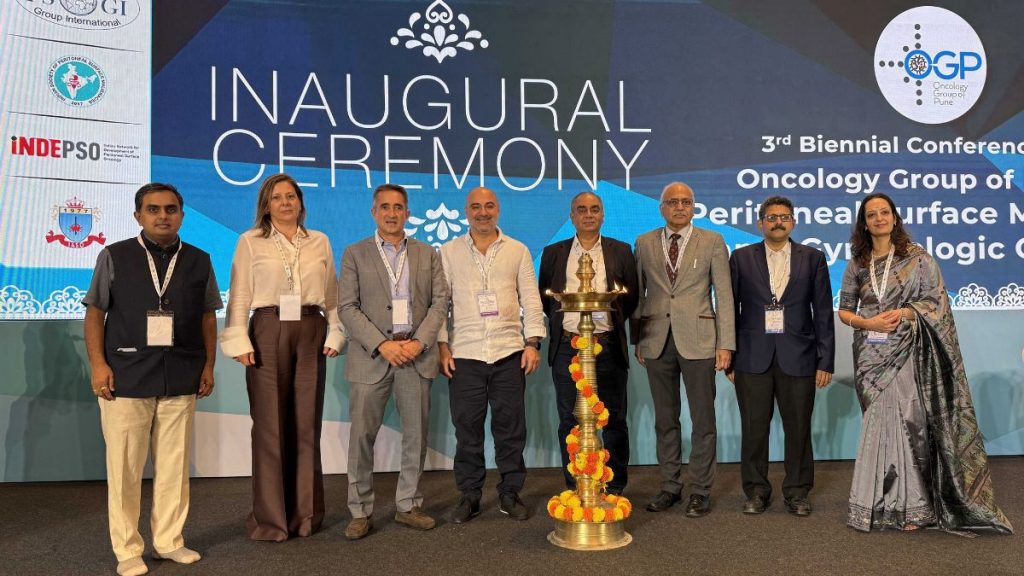
Pune, 18th September 2026: The future of treatments of peritoneal surface cancers lies in personalised care, minimally invasive and robotic surgery, advanced imaging and stronger collaboration among cancer specialists across India and the world, said Prof. Olivier Glehen, Professor of GI and Peritoneal Surface Malignancy Surgery, Hospices Civils de Lyon, France; while delivering the Prof. Shashank Shinde Memorial Oration at the 3rd Biennial Conference of the Oncology Group of Pune (OGP 2026) on Peritoneal Surface Oncology and Gynaecologic Oncology. The conference was inaugurated at Hyatt Regency Pune, bringing together around 500 delegates including leading national and international experts in oncology to discuss advances in the diagnosis and treatment of complex and advanced cancers. The conference provided a dedicated academic platform for clinicians to exchange expertise, discuss emerging evidence and explore innovative, multidisciplinary approaches to cancer care. (OGP 2026)
Dr. Debanshu Bhaduri President Oncology Group of Pune (OGP) and Senior Surgical Oncologist MN Budhrani Cancer Institute, Pune, along with organising secretaries Dr. Snita Sinukumar, Surgical Oncologist Apollo Hospital, Pune and Dr. Tushar Patil, Medical Oncologist Sahyadri Hospital, Pune were present at the inauguration.
Speaking on peritoneal surface malignancies, Olivier Glehen explained that these cancers are largely confined to the abdominal region and highlighted how advances in cytoreductive surgery and peritonectomy, along with newer techniques such as HIPEC, PIPAC and NIPS, have opened up new possibilities for improving patient outcomes. He stressed the need for specialised centres with trained teams, careful patient selection and a multidisciplinary approach involving surgeons, oncologists, radiologists and pathologists. He also emphasised that continued training, advanced imaging and the use of high-quality clinical data, together with national and international collaboration, will be important in further improving the management of these cancers.
Dr. Debanshu Bhaduri, President Oncology Group of Pune (OGP) and Senior Surgical Oncologist MN Budhrani Cancer Institute in his welcome address said that established in 2020 as an academic forum and charitable trust, OGP has expanded into a robust community of over 200 members. He highlighted that while Pune’s cancer incidence stands at around 82 per 100,000—substantially lower than the global average of 250 per 100,000 and lower than India’s national average of 100 per 100,000—predominently because of a younger population, the city benefits from a strong workforce density of 1.35 oncologists per 100,000 population.
The Executive Committee for the OGP conference included Dr. Shailesh Naik, Surgical Oncologist Indrayani Hospital, Pune, Dr. Vidita Powle, Surgical Oncologist Apollo Hospital, Pune, Dr. Nagesh Sirsath, Medical Oncologist Ruby Hall Clinic, Pune, Dr. Shweta Mutha, Radiation Oncologist Apollo Hospital, Pune, Dr. Anup Tamankar, Surgical Oncologist Deenanath Mangeshkar Hospital Pune, Dr. Rakesh Neve, Surgical Oncologist Sterling Hospital, Pune, Dr. Jayant Gawande,Medical Oncologist Aditya Birla Hospital, Pune and Dr. Rahul Kulkarni, Medical Oncologist Deenanath Mangeshkar Hospital.
The conference brought together experts in peritoneal surface malignancies, ovarian cancer, gastrointestinal cancers with peritoneal spread, cytoreductive surgery (CRS), Hyperthermic Intraperitoneal Chemotherapy (HIPEC), gynaecologic oncology and newer treatment modalities.
A key focus of OGP 2026 was the management of cancers involving the peritoneal surface, which often present complex clinical challenges and require highly specialised, multidisciplinary treatment. The scientific programme featured expert lectures, panel discussions, case-based deliberations and interactive sessions, enabling participants to discuss challenging clinical situations and evolving treatment strategies.
The conference hosted eminent international experts including Prof. Paul Sugarbaker, Ex-Chief of Peritoneal Surface Malignancy, MedStar Washington Hospital Center, USA; Prof. Olivier Glehen, Professor of GI and Peritoneal Surface Malignancy Surgery, Hospices Civils de Lyon, France; Prof. Artem Stepanyan, Head, Gynecologic Oncology Service, Nairi Medical Center, Armenia; and Prof. Lana Bijelic, Chief, Peritoneal Surface Malignancies Unit, CHU Moisés Broggi, Barcelona, Spain and Academic Coordinator, European School of Peritoneal Surface Oncology (ESPSO).
Advances in cancer treatment are increasingly demonstrating that selected patients with certain advanced Stage IV malignancies may benefit from aggressive, multimodal treatment approaches. In appropriately selected patients and tumour types, strategies such as cytoreductive surgery combined with HIPEC can offer the possibility of long-term disease control and, in some cases, potentially curative outcomes.
The conference underscored the importance of a multidisciplinary, patient-centred approach to cancer care. Specialists from surgical oncology, medical oncology, radiation oncology, gynaecologic oncology, pathology, radiology, anaesthesiology and allied healthcare disciplines will come together to discuss how collaborative decision-making can improve outcomes for patients with complex cancers.