Ancient Climate Study Explains How Extreme Global Warming Can Weaken Monsoon Systems
Reported by Akshata Pawar
Pune, 27th December 2025: A new international climate study drawing evidence from Earth’s deep past has revealed a crucial warning for the future: extreme global warming can weaken monsoon wind systems even when atmospheric moisture and rainfall increase.
The research, recently published in the peer-reviewed journal Paleoceanography and Paleoclimatology, examines climate conditions during the early Eocene epoch, around 55 million years ago—one of the warmest periods in Earth’s geological history. Scientists believe this era offers valuable insights into how today’s monsoon systems may respond to unchecked greenhouse gas emissions.
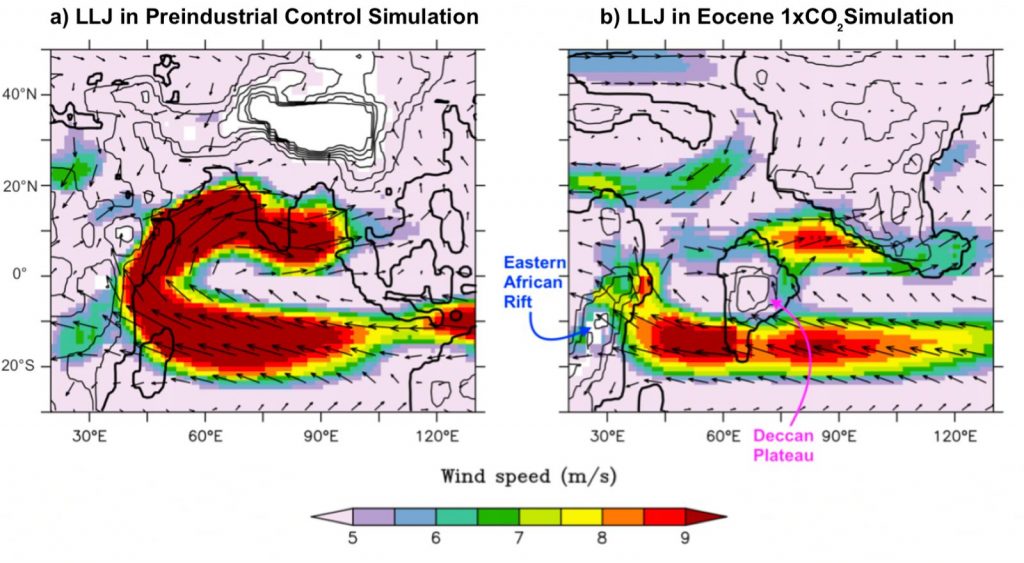
Using advanced climate simulations from the Deep-time Model Intercomparison Project (DeepMIP), researchers found evidence of a monsoon-like circulation over the Indian Ocean during the Eocene period.
However, despite extremely high carbon dioxide (CO₂) levels and a warm, moisture-rich atmosphere, the ancient monsoon system was far weaker than today’s South Asian monsoon.
A major finding of the study was the identification of a “Proto–Low-Level Jet” (Proto-LLJ)—an early form of the modern monsoon wind jet that transports moisture from the ocean to land. This proto-jet formed along geographical features such as the Eastern African Rift and the Deccan Plateau, even before the rise of the Himalayas.
Crucially, the study found that as CO₂ concentrations increased, the strength of this monsoon wind system declined, challenging conventional climate assumptions.
Why Higher CO₂ Did Not Strengthen Monsoon Winds-
The research overturns the long-held belief that stronger land-sea temperature contrasts automatically lead to more powerful monsoons.
According to the study, rising greenhouse gas levels during the Eocene caused the upper atmosphere to warm faster than the surface, increasing overall atmospheric stability. This reduced vertical air movement—an essential driver of large-scale circulation systems such as the Hadley cell.
With weaker vertical motion, the pressure gradients required to sustain strong monsoon winds diminished, leading to a weakening of the entire monsoon circulation.
Explaining the significance of the findings, Pratik Kad, lead author of the study and an international climate researcher, said the results carry a direct warning for the future.
“Our research shows that even in extremely warm climates, stronger land–sea temperature contrast does not necessarily translate into stronger monsoon winds. Increased greenhouse gases warm the upper atmosphere more efficiently, making it more stable and limiting the vertical motion needed to sustain powerful monsoon circulation,” Kad said.
Drawing from the Eocene evidence, Kad added, “The atmosphere became warmer and wetter, but also more stable. This stability reduced atmospheric overturning and weakened the monsoon low-level winds. More moisture does not automatically mean stronger monsoons.”
The early Eocene is often considered a partial analog for future high-CO₂ scenarios, with global temperatures estimated to have been 10–16°C warmer than today.
While many modern climate models predict increased monsoon rainfall, the study warns that monsoon circulation itself may weaken, leading to serious consequences, including:
-More erratic and uneven rainfall patterns
-Longer dry spells between rain events
-Higher risk of short-duration extreme downpours and flooding
-Disruption of ocean upwelling and marine ecosystems
Such changes could significantly impact South Asia, East Africa, and the Indian Ocean region, where billions depend on stable monsoon systems for agriculture, water security, and livelihoods.
The findings also challenge the idea that major mountain ranges alone control monsoon strength. While features like the Himalayas play a role today, the study highlights that atmospheric dynamics and vertical stability are equally decisive.
“Understanding how monsoons behaved during past extreme climates allows us to better anticipate how they may respond to ongoing global warming,” the researchers noted.
Although the Eocene climate is not an exact mirror of future conditions, the physical processes identified in the study remain relevant. The research underscores a critical paradox: global warming can increase rainfall potential while simultaneously weakening the winds that organize monsoon systems.
“The Eocene teaches us that warming does not always intensify circulation. In fact, under extreme warming, atmospheric stabilization can dominate and weaken monsoon systems. This insight is central to understanding how monsoons may evolve in a rapidly warming world,” said Kad.