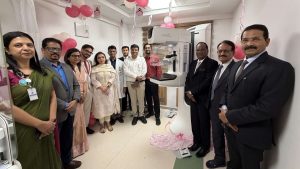
Asian Eye Hospital Adds World-Class Laser Cataract Technology in Pune

Pune, 22nd December 2025: Asian Eye Hospital in Pune has introduced the next-generation Catalys Femtosecond Laser System from Johnson & Johnson Vision, USA, marking a significant development in cataract surgery technology in India. The installation places the hospital among a limited number of global eye care centres equipped with robotic-precision femtosecond laser systems. According to the hospital, this is the first installation in the country featuring the factory-installed COS 7.0 premium upgrade.
The Catalys system is used at leading international institutions such as the Bascom Palmer Eye Institute in the United States and Moorfields Eye Hospital in the United Kingdom. The platform automates several critical steps of cataract surgery, aiming to improve precision and safety. The COS 7.0 upgrade digitally integrates cataract diagnostics with laser planning and delivery, allowing data-driven surgical execution.
Hospital authorities said the availability of this technology in Pune enhances access to advanced cataract surgery options for patients in the region and elsewhere in India.
Dr Vardhaman Kankariya, director of Asian Eye Hospital, was among the first Indian ophthalmologists to receive formal training in femtosecond laser cataract surgery in the US. He underwent year-long advanced training in femtosecond laser cataract and refractive surgery at the Bascom Palmer Eye Institute in 2012. Dr Kankariya has over 13 years of experience working with femtosecond laser systems, and his team has performed several thousand such procedures.
Explaining the significance of the upgrade, Dr Kankariya said, “The next-generation Catalys platform enables AI-driven, robotic-precision femtosecond laser cataract surgery. Computer-controlled guidance automates key surgical steps in under 30 seconds. Compared to conventional manual surgery, femtosecond laser-assisted cataract surgery offers higher accuracy in capsulotomy, lens fragmentation and astigmatism correction, while being gentler on the eye, particularly the cornea.”
The system uses advanced 3D optical coherence tomography (OCT) imaging to create a detailed map of the eye, allowing bladeless and repeatable surgical steps such as centrally aligned capsulotomies, laser-assisted lens fragmentation and precise arcuate incisions for astigmatism management. These features are expected to reduce ultrasound energy use during surgery and support quicker visual recovery.
Patients opting for premium intraocular lenses, including multifocal, trifocal and extended depth of focus (EDOF) lenses, are likely to benefit from more predictable lens positioning and stability, doctors said.
“With this technology, patients in Pune and those travelling from other parts of the country can access surgical precision comparable to leading global eye centres,” Dr Kankariya added.
Asian Eye Hospital stated that it continues to focus on expanding advanced eye care services by combining new technologies with specialised surgical expertise.