Beyond the Wild : Vidarbha’s Most Stunning Escapes
By Samiccha Malik
Nagpur, 18th July 2026: And so we arrive at the final chapter of this series and what a chapter to end on. Vidarbha, the vast eastern region of Maharashtra, is the state’s wild heart. Covering nearly a third of Maharashtra’s total land area and carrying close to 75 percent of the state’s entire forest cover, Vidarbha is a landscape of extraordinary ecological richness – teak forests, bamboo groves, rivers running through rocky gorges, and grasslands stretching to distant horizons. Every single tiger reserve in Maharashtra is located here. The Bengal tiger, the leopard, the wild dog, the sloth bear all find their home in these forests. But Vidarbha is more than its wildlife. It carries ancient temples, hill stations found nowhere else in the region, a meteorite crater that is one of only four in the world, and the sacred ground where one of modern India’s most transformative moments took place. It has been underestimated by Maharashtra’s tourism narrative for too long.
Here, finally, is the Vidarbha that deserves to be known. Here are ten places that capture it at its finest.
1. Tadoba Andhari Tiger Reserve
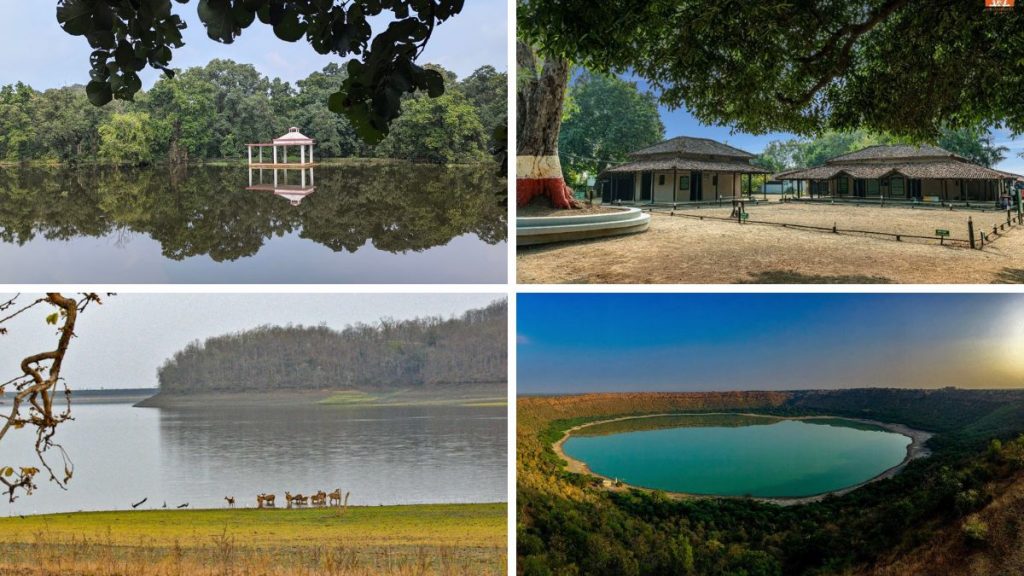
If there is one place in Maharashtra that every wildlife lover must visit before they die, it is Tadoba. Located in the Chandrapur district, the Tadoba Andhari Tiger Reserve is the oldest and largest wildlife reserve in Maharashtra established in 1955 and covering an area of over 600 square kilometres of some of the finest tiger habitat in India. The density of tigers here is among the highest in the country, and sighting rates during a jeep safari are genuinely excellent by any standard. But Tadoba is not just about tigers. The landscape itself mixed teak forest, bamboo, open meadows, the beautiful Tadoba Lake at the centre of the park is magnificent. Leopards move through the undergrowth. Wild dogs hunt in packs across the grasslands. Sloth bears lumber through the forest at dusk. Gaur stand in the clearings like dark, muscular statues. A morning safari at Tadoba, with mist over the lake and the forest coming alive around you, is one of the finest wildlife experiences anywhere in India.
2. Melghat Tiger Reserve & Chikhaldara
In the Amravati district, in the forested folds of the Satpura Range, the Melghat Tiger Reserve covers over 1,500 square kilometres of dense deciduous forest that is among the most biologically rich habitats in central India. Melghat means meeting of the ghats and the landscape here, where multiple ridges and valleys converge, creates an environment of extraordinary variety. Tigers, leopards, wild dogs, sloth bears, gaur, and sambar all inhabit these forests in significant numbers. Within the Melghat region sits Chikhaldara – the only hill station in all of Vidarbha, and one of Maharashtra’s most dramatically positioned. Sitting at over 1,100 metres above sea level in the Satpura hills, Chikhaldara is also the only coffee-growing area in Maharashtra, a fact that surprises almost everyone who hears it. The viewpoints here are spectacular – the Bhimkund Point, the Hurricane Point, the Prospect Point each offering sweeping views across the forest-covered valleys below. According to Hindu tradition, this is also the place where Bhima of the Mahabharata slew Keechaka and threw him into the valley below, giving the hill its ancient name of Keechakadara.
3. Pench Tiger Reserve
We visited Pench briefly in the Nagpur article, but it deserves its full measure of recognition here as well because Pench is quintessentially Vidarbha. Straddling the border of Nagpur and Seoni districts and continuing into Madhya Pradesh, the Pench Tiger Reserve is named for the Pench River that winds through its heart. The landscape here is classic central Indian jungle – teak and mixed forest, open meadows where sambar graze at dawn, rocky outcrops where leopards sun themselves, and a river system that draws animals in spectacular concentrations through the dry months. Kipling based The Jungle Book here, and the forest does feel like it carries stories in its canopy. Tiger sightings are regular, and the sheer beauty of the forest – the way light falls through the teak leaves in the morning, the sound of the river over rocks in the evening silence makes every safari memorable regardless of what you encounter.
4. Navegaon National Park
In the Gondia district of eastern Vidarbha, far from the more famous tiger reserves and visited by a fraction of their numbers, Navegaon National Park is one of Maharashtra’s most quietly beautiful wildlife destinations. A large, crystal-clear lake sits at the centre of the park surrounded by dense forest and the combination of water, woodland, and open sky creates a habitat that supports an extraordinary diversity of birdlife. Navegaon is considered one of the finest birding destinations in Maharashtra, attracting close to 65 percent of all bird species recorded in the state at various times of year. During winter, the lake fills with migratory ducks and waders arriving from across Central Asia. The park also offers tree house accommodation a unique experience that puts you inside the forest canopy at night, with the sounds of the jungle as your only company.
5. Lonar Crater Lake
We touched on Lonar in the Aurangabad article because it sits technically in Buldhana district on the edge of Vidarbha but it belongs here in spirit. Formed approximately 50,000 years ago by a meteorite strike of extraordinary force, the Lonar Crater is one of only four hyper-velocity impact craters in basaltic rock anywhere on earth. The crater is nearly two kilometres wide and over 150 metres deep, and the lake that fills it is both saline and alkaline an unusual chemistry that supports microorganisms found almost nowhere else on the planet and gives the water occasional reddish and greenish hues visible from the rim. Ancient temples ring the crater’s base, some partially submerged. Walking the rim and looking down into this vast, forested bowl of water knowing it was created by a rock falling from space at tens of thousands of kilometres per hour is one of the most genuinely extraordinary experiences in Maharashtra.
6. Wardha : Gandhi’s Sevagram Ashram
In the heart of Vidarbha, in the district of Wardha, stands one of the most historically significant sites in modern Indian history. Sevagram Ashram – the village ashram established by Mahatma Gandhi in 1936 was the place from which Gandhi directed much of India’s independence struggle during the final decade of British rule. Gandhi chose this remote location deliberately, wanting to live among ordinary rural Indians rather than in the comfort of a city. The ashram has been preserved almost exactly as it was during Gandhi’s time his living quarters, his prayer ground, the spinning wheel, the simple structures of mud and wood where some of the most consequential decisions in India’s freedom movement were made. Walking through Sevagram is a quiet, profoundly moving encounter with a man whose simplicity was itself a form of power.
7. Bor Wildlife Sanctuary
About 50 kilometres from Nagpur in Wardha district, the Bor Wildlife Sanctuary is one of the smallest tiger reserves in India covering just 61 square kilometres but what it lacks in size it more than compensates for in wildlife density and accessibility. Because of its compact area, tiger sightings at Bor are among the most reliable in Maharashtra. The sanctuary also supports leopards, wild dogs, sloth bears, and a rich diversity of birds. The Bor Dam reservoir within the sanctuary creates a beautiful water body that attracts wildlife in significant numbers, particularly in the dry season. For visitors who want a genuine tiger reserve experience without the longer journey to Tadoba or Melghat, Bor is an excellent and often overlooked option.
8. Chandrapur :The City of Black Gold
The district headquarters of Chandrapur, which serves as the gateway to Tadoba, is a city with its own considerable historical depth that most visitors drive straight through on their way to the forest. The Chandrapur Fort, built by the Gond kings in the fifteenth century, is a massive fortification with remarkable gateways – the Anchaleshwar Gate, the Balapur Gate, and others that are among the finest examples of Gond architecture in Maharashtra. The ancient Mahakali Temple within the fort walls is deeply revered and draws large numbers of pilgrims. The Gondwana Museum nearby documents the history and culture of the Gond tribal community one of India’s oldest indigenous peoples whose roots in this region stretch back thousands of years before any fort was built or any dynasty arose.
9. Tipeshwar Wildlife Sanctuary
In the Yavatmal district of southern Vidarbha, the Tipeshwar Wildlife Sanctuary is a small but remarkably productive tiger reserve that receives very few visitors which makes it all the more special for those who find their way there. With an area of just 148 square kilometres, Tipeshwar has a tiger population relative to its size that is extraordinary, and sighting rates here rival those at much more famous reserves. The sanctuary sits on the banks of the Painganga River and the landscape – rocky outcrops, dry deciduous forest, seasonal streams is classic Vidarbha in character. For serious wildlife photographers and tiger enthusiasts who want an experience entirely off the mainstream safari circuit, Tipeshwar is one of Maharashtra’s best-kept secrets.
10. Pralhad Prabhu Temple : Muktainagar
We close this series not with a tiger or a crater or a fort, but with a moment of quiet devotion because Vidarbha, for all its wildness, is also a land of deep faith. The Muktainagar temple complex in Jalgaon district, dedicated to Muktabai – one of the four great saints of the Varkari tradition and sister of the revered poet-saint Dnyaneshwar is one of the most important pilgrimage sites in northern Maharashtra. Muktabai is among the most beloved figures in Marathi spiritual literature, and the temple here, with its beautiful setting on the banks of the Tapi River, carries a devotional warmth and a cultural depth that connects this far northeastern corner of Maharashtra to the same thread of Bhakti tradition that runs through Pandharpur, Dehu, Alandi, and every Varkari heart in the state. It is a fitting place to end reminding us that Maharashtra’s greatest journey is not any single road or any single tiger sighting, but the long, living tradition of people moving across this landscape in search of something larger than themselves.
Best Time to Visit
October to April is the prime season for Vidarbha’s wildlife reserves – the dry months concentrate animals around water sources and thin the vegetation, making sightings significantly better. February to May is particularly productive for tiger sightings across all reserves. Chikhaldara is best visited between October and February when the hill station weather is at its coolest and clearest. Monsoon from June to September closes most forest areas but transforms the landscape into an intense, lush green that makes the non-wildlife destinations – Sevagram, Chandrapur, the temples particularly atmospheric.
Getting There
Vidarbha is well connected by rail and road. Nagpur serves as the primary hub with an international airport and a major railway junction connecting to cities across India. Chandrapur, Wardha, Amravati, and Gondia all have railway stations providing access to different parts of the region. The region is also connected by national highways running east-west and north-south through its centre, making road travel between destinations comfortable and straightforward.
And so Maharashtra’s Most Stunning Escapes comes to its end not with a final destination but with an invitation. Twelve districts, twelve different faces of the same extraordinary state. From the Maratha forts of the Sahyadris to the tiger forests of Vidarbha, from the sacred shores of the Konkan to the ancient caves of Marathwada, Maharashtra has given this series everything it asked for and more. The road through this state is long, endlessly varied, and completely worth every kilometre. Go find your own escape. Maharashtra is waiting.