Bhagat Singh’s Vision of Justice Still Unfulfilled, Says Nephew Kiranjit Singh in Pune
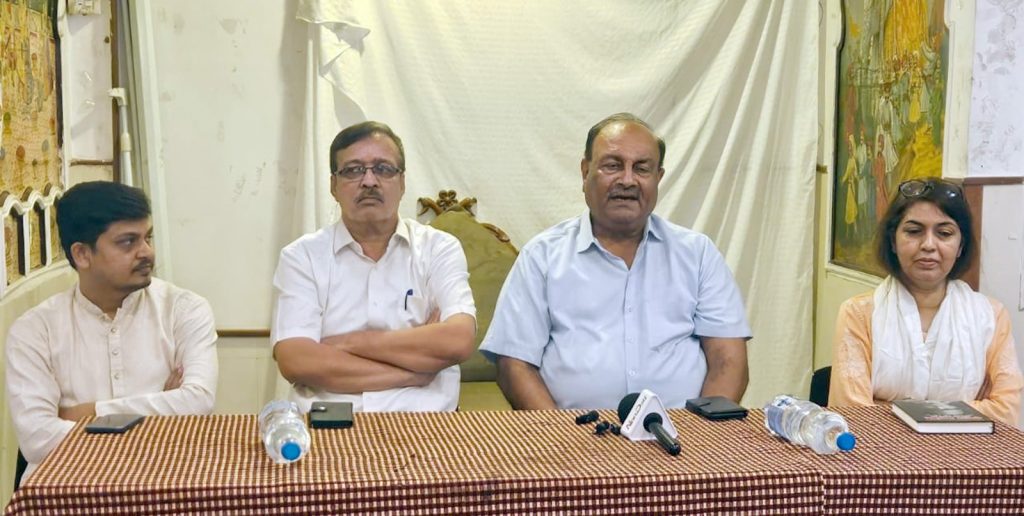
Pune, 19th March 2026: Bhagat Singh is not merely remembered as a martyr who sacrificed his life for the nation but remains a living ideology that continues to inspire generations, his nephew and thinker Kiranjit Singh said while interacting with the media in Pune on Thursday.
“Bhagat Singh represents the spirit of struggle for freedom, and for the rights of workers, farmers and the oppressed. Though he is not physically present today, his ideas remain deeply relevant and inspirational,” Singh said. He added that even 75 years after Independence, ordinary citizens and farmers are still fighting for basic rights and justice.
Singh was in the city for an event organised by Sarhad Pune and Krishna Publications. The programme, scheduled for Friday, will feature the release of an authorised biography titled ‘Yugdrashta Bhagat Singh ani Tyache Mrityunjayi Purvaj’, written by a member of Bhagat Singh’s family, and the presentation of the ‘Yugdrashta Bhagat Singh National Award’ to farmer leader Raju Shetti.
Speaking about Bhagat Singh’s legacy, Singh said the revolutionary came from a family with a three-generation tradition of fighting for the nation and the working class. “Revolution was not just about guns or bombs. Bhagat Singh believed that the sword of revolution is sharpened on the whetstone of ideas,” he said, adding that the book draws on authentic family accounts and offers deeper insights into his life and ideology.
He urged young people to draw inspiration from Bhagat Singh and fellow revolutionaries Shivaram Rajguru and Sukhdev Thapar, and to think beyond personal interests for the betterment of society and the nation.
Commenting on today’s youth, Singh said there appears to be a growing sense of directionlessness and self-centredness. “The motivation to fight for what is right seems to be fading. Through Bhagat Singh’s life and writings, we hope to present an ideal that resonates with the younger generation,” he said.
He added that while governments may change, systemic issues persist. “The vision of true self-rule that Bhagat Singh dreamt of is yet to be realised. The struggle is far from over,” he said.
Highlighting contemporary concerns, Singh noted that issues such as farmers’ distress, workers’ rights and social inequalities continue to persist. “Even today, farmers are committing suicide and protests are ongoing in the capital.
These concerns were reflected in Bhagat Singh’s writings as well, making them relevant even today,” he said, stressing the need to understand his ideas rather than merely idolising him.
He also criticised the idea of “one nation, one religion, one election”, saying it is incompatible with India’s diversity. “The country’s strength lies in its plurality. Such concepts are neither practical nor desirable,” he said.
At the interaction, Sanjay Nahar highlighted that Bhagat Singh’s work extended beyond revolutionary activities and also addressed the concerns of marginalised communities.
Translator Indrayani Chavan noted that the book sheds light on the struggles faced by women in Bhagat Singh’s family. Publisher Chetan Koli delivered the welcome address.