Ganpati Visarjan 2025: Pune Records High Noise Levels Despite Restrictions
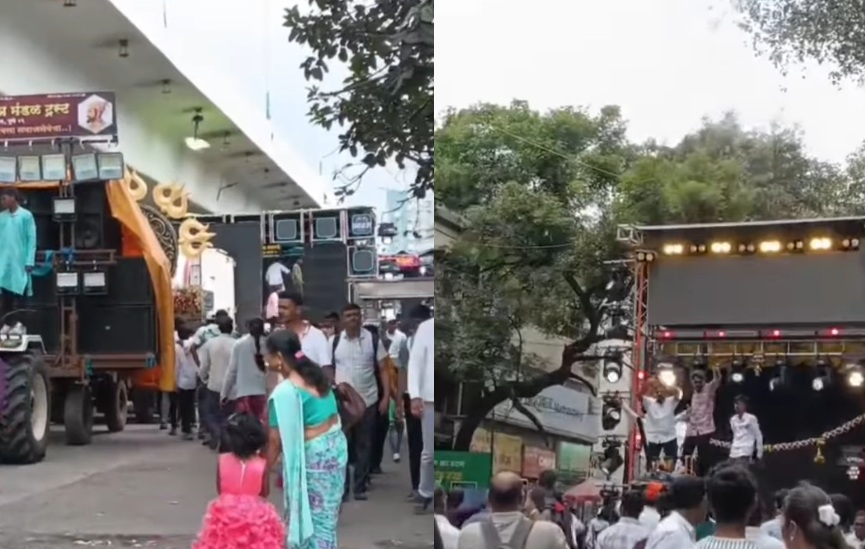
Pune, 7th September 2025: The 2025 Ganpati Visarjan in Pune once again highlighted concerns over rising noise levels during the city’s most celebrated festival. This year also marked the 25th consecutive year that COEP Technological University monitored noise pollution during the immersion procession, an initiative that has become a benchmark for environmental awareness in the city.
Since the turn of the millennium, COEP Tech has been consistently tracking sound levels during the Ganeshotsav visarjan to raise awareness about the health hazards of excessive noise exposure. The monitoring is carried out at major crossroads every four hours during the 32-hour-long immersion procession along Laxmi Road.
“This is purely a scientific activity of recording and monitoring the spatio-temporal scenario of noise to which Punekars are exposed,” said faculty coordinators, adding that prolonged exposure to high decibel levels can severely affect hearing as well as the physiological and psychological health of citizens—especially children, senior citizens, and patients with hypertension or diabetes.
Key Findings in 2025
- Average Noise Levels:
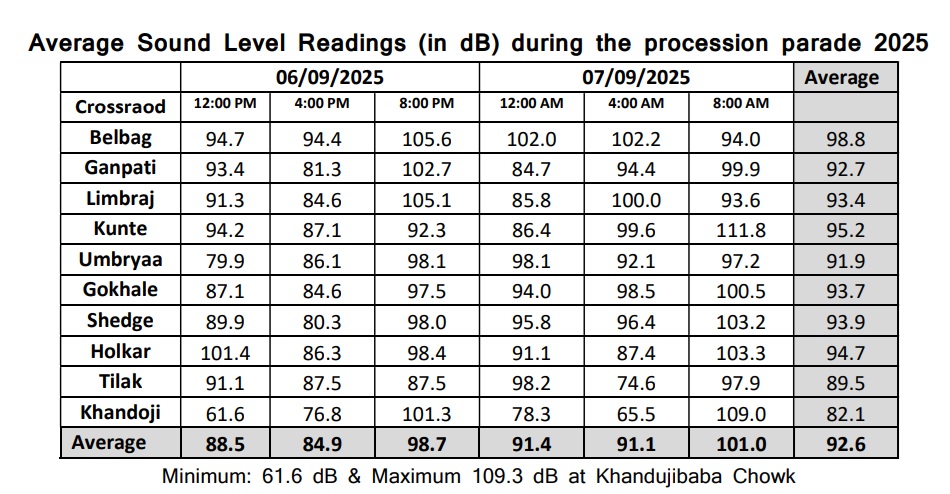
- The overall average sound level this year was 92.6 dB, the lowest recorded in the post-Covid phase.
- Minimum sound level: 61.6 dB at Khanduji Chowk.
- Maximum sound level: 109.3 dB at Khanduji Chowk.
- Highest average levels were noted at Belbag (98.8 dB) and Kunte Chowk (95.2 dB), with Kunte peaking at 111.8 dB at 8 am on September 7.
- Comparison with Previous Years:
- Noise levels have gradually declined from peaks of 98–100 dB in earlier years.
- Last year (2024), the average was 94.7 dB, while this year’s 92.6 dB shows a small but significant improvement.
- Contributing Factors:
- Police administration and Ganesh mandals played a major role in managing the crowd and reducing DJ system usage, especially at night.
- However, traditional dhol-tasha instruments continued to generate sound levels similar to DJ systems.
- The Pune Metro also helped in dispersing crowds more efficiently, easing congestion around key immersion points.
25 Years of Continuous Monitoring
COEP Tech’s monitoring initiative has now completed a quarter century, making it one of the longest-running citizen science and environmental awareness projects in Pune. “We are well aware of the effects of higher sound levels on our very sahanshil (sensitive) organ—the ear. Such social events expose our senses to considerably higher sound levels for longer periods, which impacts health,” said the coordinators.
The project was conducted this year by 25 volunteers from NISARG, COEP Tech’s environment club, under the leadership of Mohit Kandalkar and Shreya Karande.
Team members included: Mrunal Khutemate, Sumedh Brahmankar, Arya Ghadge, Aditi Talokar, Shravni Shinde, Krish Kholiya, Atharv Rakhonde, Prathmesh Podhade, Om Sonawane, Shantanu Kele, Sanchita Patil, Om Behare, Sahil Agrawal, Bhoomika Awachat, Aditya Sanjeevi, Kartik Gaikhe, Suyog Sawant, Adarsh Choudhury, Utkarsha Kakad, Asmita Gogate, Swarali Awalkar, Siddharth Shidid, Vedant Joshi and Mehar Raghatate.
Public Health Perspective
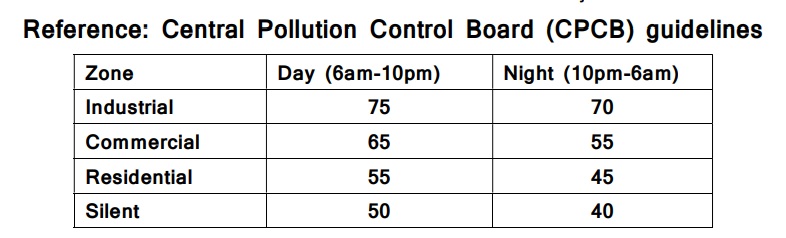
Experts warn that exposure to 90 dB and above for long durations can cause irreversible hearing damage. With several locations recording sound above 100 dB during the procession, the risk remains high. “Children, the elderly, and people with existing health conditions are the most vulnerable,” the report emphasized.