Independence Day Series | Pune’s Forgotten Freedom Fighters: The Stories Many Young Punekars Don’t Know
By Samiccha Malik
Pune, 17th August 2026: Ask most young Punekars to name a freedom fighter from this city and the answer comes quickly Lokmanya Tilak. Maybe Gokhale. Maybe Gandhi, who spent years here. And those names deserve every bit of recognition they get.
But here’s what the textbooks left out.
Pune’s freedom movement was not built only by the famous. It was built by three brothers from Chinchwad who waited in darkness on a Pune road with guns in their hands. By a government scholar who went to England to study engineering and spent the time learning to make bombs. By a Dalit wrestler in Ganj Peth whose gymnasium quietly shaped the next generation of revolutionaries. By a woman who started with satyagraha and ended by leading an armed revolt.
These are their stories. And if you grew up in Pune and never heard them you are not alone. But it is time that changed.
1. The Chapekar Brothers – Three Brothers From Chinchwad Who Said Enough
Damodar (1869–1898) | Balkrishna (1873–1899) | Vasudeo (1879–1899)
Most people who drive down Senapati Bapat Road every day have no idea that the road is named after a freedom fighter or that the events that indirectly gave it that name happened right there, in the dark, on a June night in 1897.
In 1896, the bubonic plague arrived in Pune. The British government’s response was fast, heavy-handed, and deeply contemptuous of Indian dignity. A Special Plague Committee was formed under ICS officer Walter Charles Rand. The measures employed included forcible entry into private homes, the stripping and public examination of residents including women by British officers in public, evacuation to hospitals and segregation camps, and restrictions on movement. The people of Pune viewed these actions as oppressive. Complaints were ignored by Rand.
Three brothers from Chinchwad – Damodar, Balkrishna, and Vasudeo Chapekar watched all of this and made a decision.
On the night of June 22, 1897 the Diamond Jubilee of Queen Victoria’s coronation the brothers waited in pitch darkness on Ganeshkhind Road, armed and ready. As Rand’s carriage passed, Damodar ran alongside it, called out a prearranged signal to his brother, lifted the carriage flap, and fired at Rand at point-blank range. His military escort Lieutenant Ayerst was shot simultaneously by Balkrishna.
The aftermath was swift and merciless. Damodar was arrested, tried, found guilty, and hanged at Yerawada Prison on April 18, 1898. Balkrishna was hanged on May 12, 1899. Vasudeo who had separately shot the informant who betrayed his brothers to the British was hanged on May 8, 1899.
Three brothers. The same jail. Within a year of each other.
Before his execution, Damodar requested a meeting with Tilak, who was being held in the same prison at the time. The meeting was granted. Damodar asked Tilak for a copy of the Bhagavad Gita and requested that his last rites be performed according to Hindu tradition. Tilak personally arranged the final rites of all three brothers.
They were not politicians. They were not leaders of organised movements or prominent public figures. They were three young men from Chinchwad who decided that what was being done to their city’s people was not something they could watch in silence. They paid for that decision with everything they had.
The road where they waited that night carries a freedom fighter’s name today. Most people who cross it every morning don’t know the story behind it.
2. Senapati Bapat – The Man Who Hoisted Pune’s First Flag of Independence
Pandurang Mahadev Bapat (1880–1967)
Here is the part of Senapati Bapat’s story that most people don’t know the part that happens before the Mulshi Satyagraha, before the Gandhian transformation, before the title “Senapati” was ever spoken.
Bapat went to Britain on a government scholarship to study engineering. He spent most of his time not in classrooms but at India House the hub of Indian revolutionary activity in London at the time learning to make bombs. He returned to India not as an engineer, but as a revolutionary.
He then underwent a remarkable transformation moving from revolutionary to committed Gandhian, and channelling that fire into one of the most significant struggles of the early independence era.
In 1921, Bapat led the Mulshi Satyagraha described by social scientist Ghanshyam Shah as “the first recorded organised struggle against the forced displacement” caused by an irrigation project in India. The Tata Company, backed by the colonial administration, was constructing the Mulshi Dam near Pune, displacing thousands of farmers mostly tenants with no land rights of their own. When a British engineer threatened a farmer who objected to test trenches being dug on his land without permission, strong protests broke out in Pune. Bapat led them.
His leadership earned him the title “Senapati” commander not from any organisation or government, but from the farmers themselves, the people he stood beside when no one else would.
On August 15, 1947, Senapati Bapat was given the honour of hoisting the Indian tricolour over Pune for the very first time.
The man who raised Pune’s first flag of independence was a bomb-maker turned Gandhian satyagrahi who spent decades fighting for farmers long before it was politically convenient to do so. He lived until 1967 long enough to see the country he helped build find its footing, and wise enough to keep asking whether it was finding it in the right direction.
He has a road named after him in Pune. Most people don’t know the man behind the name.
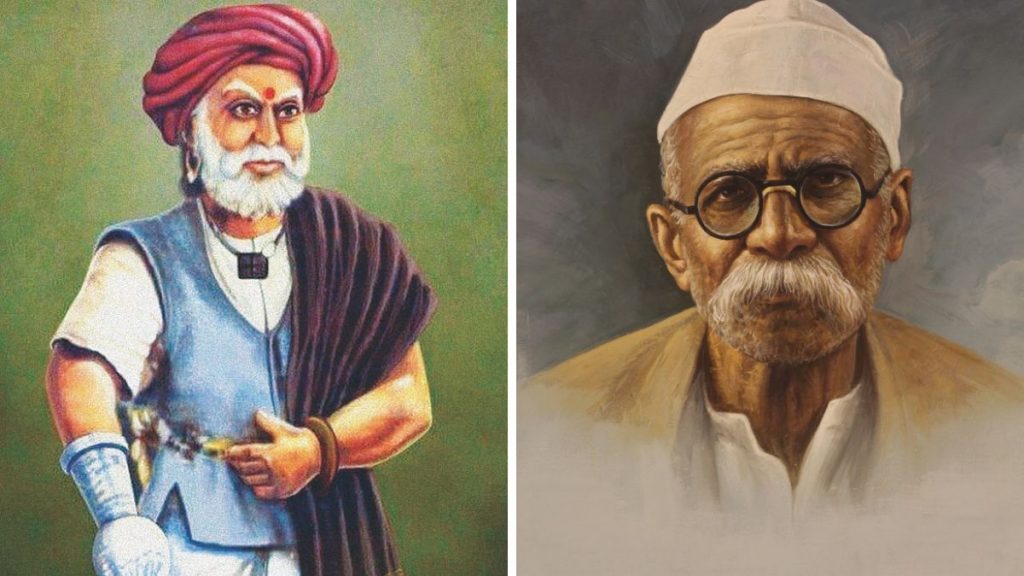
3. Lahuji Raghoji Salve -The Dalit Wrestler Who Built the Movement From a Gymnasium
Lahuji Vastaad Salve (1794–1881)
Ganj Peth, Pune
Before the Indian National Congress existed. Before Kesari was published. Before the independence movement had a name or a leader there was a man in Ganj Peth running a gymnasium, teaching wrestling, and quietly planting the seeds of resistance in every young man who walked through his door.
Lahuji Raghoji Salve known as Vastaad, meaning master was a Dalit activist, preacher, and freedom fighter from Pune. He learned wrestling from his father and became one of the most skilled wrestlers of his time. He ran his gymnasium at Ganj Peth, teaching martial arts and mentoring young men and alongside the physical training, he preached, consistently and fearlessly, the necessity of freedom from British rule and the upliftment of untouchables.
Lahuji joined Jyotirao Phule’s Satyashodhak Samaj, making him one of the earliest Dalit activists to explicitly link the struggle against caste oppression with the struggle against colonial rule understanding, decades before most of the mainstream movement caught up, that political independence and social liberation were inseparable.
Among his most significant students was Vasudev Balwant Phadke widely considered one of India’s earliest armed revolutionaries against British rule. Lahuji, from the Mang community one of Maharashtra’s most marginalised taught Vasudev the critical importance of bringing backward castes into the mainstream freedom movement. Vasudev listened, and built his revolutionary group accordingly.
Lahuji died in 1881 sixty-six years before India became free. He never saw the tricolour go up. He built the foundation anyway, from a gymnasium in Ganj Peth, one student at a time.
4. Vasudev Balwant Phadke – Pune’s Revolutionary Who Took Control of the City
Vasudev Balwant Phadke (1845–1883)
Pune
Most Indians who revere Bhagat Singh as a revolutionary hero don’t know the name of the man who, decades before Bhagat Singh was born, organised what is widely considered India’s first armed uprising explicitly aimed at overthrowing British rule.
Vasudev Balwant Phadke moved to Pune as a young man and worked as a clerk in the military accounts department for fifteen years quietly watching, learning, and growing increasingly convinced that Swaraj was the only answer to the condition of India’s farmers and poor. His mentor was Lahuji Salve, the wrestler from Ganj Peth, who taught him that freedom had to include those at the bottom of Indian society or it meant nothing at all.
With the help of Koli, Bhil, and Dhangar communities across Maharashtra, Phadke formed a revolutionary group called the Ramoshi, launching raids on wealthy British businessmen and establishments to fund their liberation struggle. He came to national attention when his group took control of the city of Pune for several days catching British soldiers entirely off guard in a series of surprise attacks.
He was eventually captured and sentenced to transportation for life to Aden, where he died in 1883, aged 37. He had spent barely a decade in active resistance. In that decade, he built something that had never existed before an organised, multi-community armed movement for Indian independence, rooted in Pune, taught to him by a Dalit wrestler in a Ganj Peth gymnasium.
5. Godavari Parulekar – The Woman Who Began With Satyagraha and Ended With Revolution
Godavari Parulekar (1907–1996)
Most freedom fighters who appear in Pune’s history books are men. Godavari Parulekar is one of the reasons that imbalance is a distortion of what actually happened.
Parulekar was convicted by the British in 1932 for conducting individual satyagraha. After her conviction, she came to Pune and took up social service with the Servants of India Society the organisation founded by Gopal Krishna Gokhale in 1905 becoming the first woman to be inducted as a life member of the Society.
But the Servants of India Society was not where her story ended. It was where it transformed.
Influenced by Marxist thought and deeply committed to the idea that freedom from British rule was only the beginning not the end of what India’s most marginalised communities needed, Parulekar went on to lead the armed struggle for the liberation of Dadra and Nagar Haveli from Portuguese colonial rule, and played a central role in the Warli Adivasi Revolt of 1945 one of India’s earliest and most significant tribal uprisings demanding land rights, human dignity, and economic freedom alongside political independence.
She understood something that many of her more celebrated contemporaries did not always articulate clearly enough: that political freedom and social freedom are not the same thing, and that for millions of Indians, one without the other was still a form of bondage.
She lived until 1996 long enough to see free India turn fifty. Whether she believed the country had become what she had fought for is worth wondering about.
Why These Stories Were Lost
There is a version of India’s independence story that is clean and linear Gandhi, Nehru, Patel, the midnight speech, the flag. It is a powerful story. Much of it is true.
But the full story is messier, wilder, and far more extraordinary. It includes three brothers from Chinchwad who walked into darkness with weapons. A government scholar who used his scholarship money to learn bomb-making. A Dalit wrestler in Ganj Peth whose gymnasium was quietly producing the next generation of revolutionary thinkers. A woman who started with peaceful resistance and ended by leading armed struggle on two fronts.
These people did not make it into most textbooks because history has always had limited space and has traditionally filled that space with those who already had power, visibility, and access to the people writing the records.
But their stories are Pune’s stories. They happened on these streets, in these neighbourhoods, in the jail that still stands in Yerawada, in the gymnasium in Ganj Peth, on the road we now call Senapati Bapat Road.
This Independence Day, before the flags go up and the sweets come out take a moment for the ones who made it possible. Not just the names on the road signs. All of them.
Jai Hind.