Induction vs Infrared: Which Cooktop Is Better for Indian Cooking
Pune, 14th March 2026: With LPG availability becoming uncertain in some areas, many households are increasingly shifting to electric cooking options such as induction and infrared cooktops. However, one common challenge people face after making the switch is that not all utensils are suitable for every type of electric cooktop.
This issue is particularly relevant in Indian kitchens, where cooking methods often involve techniques such as tempering (tadka), sautéing masala, deep-frying, and using a kadhai. Choosing the right cookware becomes important to ensure efficient cooking and safety.
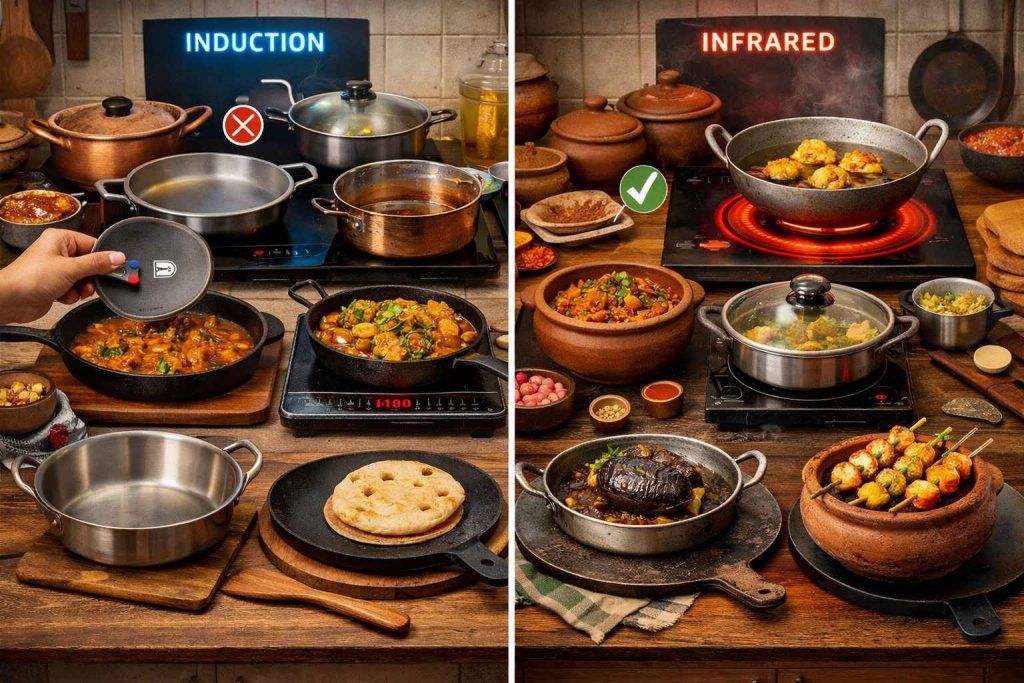
Understanding the difference between induction and infrared cooktops is the first step. Induction cooktops generate heat directly in the vessel using electromagnetic energy. Because of this, they work only with utensils that have a magnetic base. Infrared cooktops, on the other hand, heat the cooking surface first and then transfer the heat to the vessel placed on it. As a result, infrared cooktops can generally accommodate a wider range of utensils, although cookware with a flat base performs best.
For induction cooktops, the simplest way to check compatibility is by using a magnet. If a magnet sticks firmly to the bottom of the utensil, it will usually work on an induction stove. Utensils specifically labelled as “induction compatible” are the safest option for consistent performance.
Cookware that typically works well on induction includes cast iron, carbon steel, enamelled iron and certain types of stainless steel that contain a magnetic base.
However, many commonly used utensils do not function on induction cooktops unless they are specially designed with an induction-compatible base. These include pure aluminium vessels, copper utensils, glass cookware, ceramic pots and some non-magnetic stainless steel vessels.
Infrared cooktops are generally considered more flexible because they can operate with a wider variety of cookware. Still, for best results, utensils should ideally have a flat bottom, a thicker base and stable contact with the cooking surface. Thin or uneven vessels may heat poorly or inefficiently.
A frequent concern in Indian homes is whether a traditional kadhai can be used on electric cooktops. Many conventional kadhais have a rounded base, which can cause problems. On induction cooktops, the appliance may fail to detect such utensils. On infrared cooktops, the kadhai may heat but often not evenly.
For everyday Indian cooking on electric stoves, experts recommend using a heavy, flat-bottom kadhai. Suitable options include tri-ply stainless steel kadhais with an induction base, cast iron kadhais, or carbon steel kadhais designed with flat bottoms.
Aluminium utensils can also be used in certain cases, though they come with limitations. Plain aluminium typically does not work on induction cooktops unless it has a special induction base. Infrared cooktops can accommodate aluminium cookware more easily, but very thin aluminium vessels tend to heat unevenly and may warp over time.
The same considerations apply to other kitchen items such as tawas, frying pans and pressure cookers. For induction stoves, utensils should be clearly marked as having an induction base. For infrared cooktops, most cookware works as long as the base is sturdy and flat.
Deep-frying is possible on both induction and infrared cooktops, but the choice of vessel is important. A wide, heavy-bottomed utensil with a flat base provides better stability, especially on glass-top cooking surfaces. Narrow or lightweight vessels can become unstable when filled with hot oil.
Preparing traditional foods such as rotis is also possible on electric cooktops, although the results may differ slightly from gas cooking. Without a direct flame, rotis may not puff up in the same way as a phulka cooked on gas. However, using a thick iron or steel tawa and gently pressing the roti while cooking can help achieve better results.
Similarly, roasting vegetables such as brinjal for dishes like baingan bharta can be done on a pan or tawa, though it may not develop the same smoky flavour as when roasted over an open flame. Many households use alternative methods such as roasting in an oven, air fryer or electric grill, or finishing the dish with a charcoal smoking technique to recreate the smoky taste.
Cooking techniques may also require some adjustment when switching from gas to induction. Induction cooktops heat up very quickly, so starting at a lower heat setting and gradually increasing the temperature is often recommended. This helps prevent oil from overheating and reduces the risk of burning spices or masala.
Some users attempt to use older utensils on induction cooktops with the help of converter plates. While this method can work, it generally reduces heating efficiency and makes temperature control less precise.
For most households, buying a few induction-compatible utensils is usually the more practical solution. A basic starter set for daily cooking could include a flat-bottom induction-compatible kadhai, a sturdy tawa or frying pan, and a saucepan or pressure cooker designed for induction use.