Is Railway Drinking Water Safe? CAG Flags Harmful Bacteria, Railways Act
Reported By Amit Singh
New Delhi, 17th August 2026: The Railway Ministry has ordered immediate measures to improve drinking water facilities across the railway network following findings in the CAG’s Report No. 31 of 2026, which flagged deficiencies in water availability, quality testing and monitoring at selected railway stations.
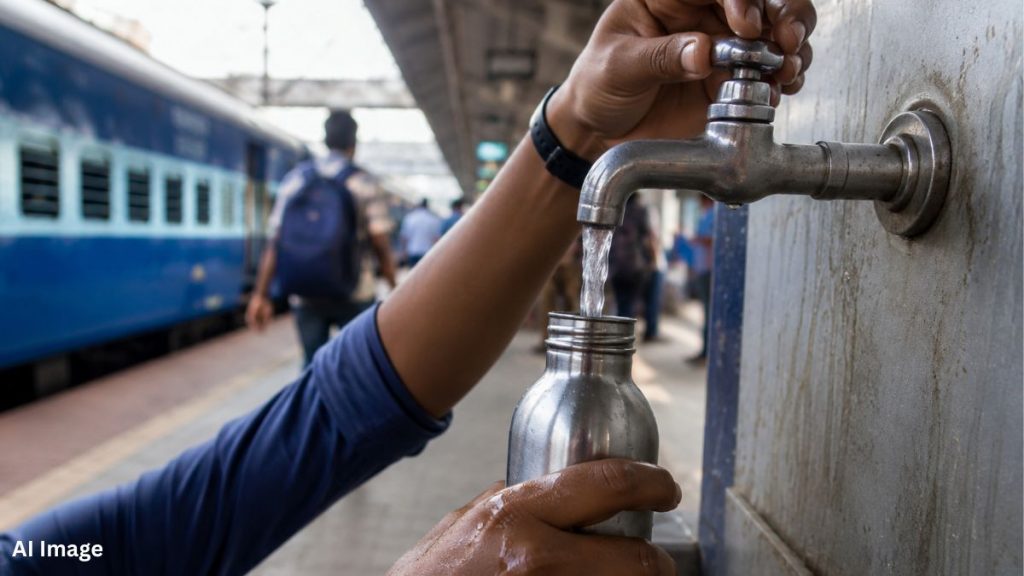
The CAG audit covered 512 selected railway stations and found deficiencies in drinking water taps at 138 stations. Taps were not provided at four stations, while 134 stations had fewer taps than prescribed.
The audit also found deficiencies in water coolers at several stations and identified gaps in the testing and monitoring of drinking water.
E. coli found in water samples
Water samples from water coolers tested positive for E. coli at eight stations Coimbatore and Palakkad Junctions in Southern Railway, Hyderabad in South Central Railway, Chhatrapati Shivaji Maharaj Terminus, Bhiwandi Road, Kalyan and Lonavala in Central Railway, and Madhupur in Eastern Railway.
The audit further found total coliform bacteria, including E. coli, in drinking water samples collected from platform taps at 49 stations across eight zones in 2022-23 and 56 stations across nine zones in 2023-24.
Bacteriological analysis of drinking water was not carried out at 59 stations across six zones. Other bacteriological tests were found unsatisfactory at eight stations in 2022-23 and 11 stations in 2023-24.
Gaps in chemical and chlorine testing
Chemical analysis of drinking water was not conducted at 179 stations across 11 zones, while the prescribed twice-a-year testing frequency was not followed at another 77 stations across six zones.
Chemical analysis indicated deficiencies in drinking water at 28 stations in 2022-23 and 34 stations in 2023-24.
The audit also found gaps in residual chlorine testing. Testing was not carried out at 78 stations across 13 zones. Among the tests conducted, chlorine levels were below or above the prescribed 0.2 ppm to 0.5 ppm range at 135 stations in 2022-23 and 139 stations in 2023-24.
Railway Board orders ‘Tank to Tap’ system
Following the CAG findings, a review was conducted by Railway Minister Ashwini Vaishnaw, the Chairman and CEO of the Railway Board and senior officials. The Railway Ministry said immediate corrective measures have been ordered for safe drinking water.
A new “Tank to Tap” water filtration system will be installed at approximately 20,000 locations across the railway network, including water coolers. The system will include filtration and water-quality monitoring arrangements.
The Railways has also ordered the replacement of water tanks.
Regular testing and tank maintenance
The action plan includes strict compliance with regular water-quality testing at source and outlet points, along with centralised monitoring and accountability.
The Railways has also ordered scheduled cleaning and maintenance of drinking water storage tanks.
The CAG found that records of cleaning of drinking water storage tanks were not available for 122 stations across 15 zones. At 39 stations across seven zones, tanks were not adequately protected against pollution from birds or animals or had algae growth.
The audit also found that multi-parameter water-quality testing kits required for periodic inspection of water supply systems had not been provided at 436 stations across 15 zones.
The Railway Ministry said drinking water has been identified as a top-priority area and that the progress of the measures and water-quality reports will be published periodically.