Journalism Course in India: How AAFT Noida Trains Reporters for the Digital Newsroom
Noida, 26 August 2026: — A journalism course in India used to be judged by how well it taught you to file a print report or read a bulletin. That test has changed. Today’s newsroom is digital first, and the same story often has to work as a written piece, a short video, a social post and sometimes a podcast, all within the same hour. AAFT Noida has built its journalism degrees around that reality, training reporters for the newsroom that exists now rather than the one that existed ten years ago.
India’s news industry has moved online faster than almost anyone predicted. Digital news now reaches more people than print across many markets, and the reporters getting hired are the ones who can work across formats, verify quickly, and understand how an audience actually finds a story. Closing that gap is what a modern mass communication course in India has to do.
At AAFT Noida, the BA in Journalism and Mass Communication and the MA in Journalism and Mass Communication are delivered inside a live media campus at Marwah Studios, Noida Film City, where students report with MSTV and Radio Noida from the first semester. Admissions for the 2026 batch are open.
How Is India’s Newsroom Going Digital?
Ten years ago a reporter could specialise in one medium and build a career on it. That is no longer how newsrooms are staffed. A single desk now expects one journalist to report, shoot, edit and publish across print, broadcast and digital. The skills have not been replaced so much as stacked on top of each other, and a BJMC course that only teaches the old ones leaves graduates a step behind on day one.
| Skill Area | Traditional Newsroom | Digital Newsroom Today |
| Reporting | One beat, one format | Multi-platform reporting across print, video and social |
| Production | Handed to a separate team | Reporter shoots, edits and publishes their own story |
| Speed | Daily deadline | Live updates and rolling verification |
| Audience | Broadcast to everyone | Data-led, understanding how a story is found and shared |
This is why practical training matters more than before. Reading about digital journalism is not the same as doing it under a deadline. That is the experience AAFT Noida builds into every semester.
Students build a set of practical, career-ready skills through the course:
- Multimedia storytelling — telling one story across text, video and audio.
- Digital content creation — making content built for social and web.
- Fact-checking — verifying claims quickly and correctly.
- Media research — finding and using data to back a story.
- AI-assisted journalism — using AI tools to research, draft and edit.
- Mobile journalism (MoJo) — shooting and filing a full story from a phone.
Which Journalism Course Is Best for Today’s Job Market?
AAFT Noida offers a full undergraduate and postgraduate Journalism and Mass Communication course rather than short programmes, so graduates leave with a recognised qualification and a portfolio of real work. Whether you are looking for a journalism course after 12th or a postgraduate route into senior editorial roles, both degrees follow a 70:30 industry-centric model, with 70% of the programme built around practical work.
| Programme | Level | Duration | Best For |
| BA in Journalism and Mass Communication (BJMC) | Undergraduate | 3 Years | Building a multi-platform reporting foundation from the ground up |
| MA in Journalism and Mass Communication (MAJMC) | Postgraduate | 2 Years | Moving into senior editorial, content and production roles |
Both degrees carry 100+ industry workshops and masterclasses, and AAFT Noida reports a 100% placement record for its 2025 journalism batch. The BA in Journalism and Mass Communication Course is the three-year undergraduate entry point, while students on the MA in Journalism and Mass Communication graduate with two years of production experience on top of their undergraduate qualification, which puts them in a strong position for newsroom leadership roles.
Which Journalism Specialisation Should You Choose?
Rather than a single elective, students choose one of three specialisations that deepen across two levels through the degree, so their chosen track becomes a genuine area of strength by graduation.
| Specialisation | What You Learn | Companies That Commonly Hire |
| Digital Media | Content across social and video, audience behaviour, data-led storytelling | Jagran New Media, News18 Digital, Curious Media, OTT content studios |
| Sports Journalism | Live reporting, match analysis, real-time content across broadcast and digital | Sportskeeda, Star Sports, broadcast and digital sports desks |
| Investigative Journalism | Investigative research, fact-checking, ethical long-form reporting | ABP, ANI, Amar Ujala, independent investigative outlets |
The Toolchain and the Training Ground
Students train on the same tools a working digital desk uses: WordPress and other CMS platforms, Adobe InDesign for layout, Premiere Pro, Final Cut Pro and After Effects for video, and Photoshop and Lightroom for images, alongside DSLR, mirrorless and professional video cameras. The point is not the software list. It is that graduates arrive already fluent in the workflow a newsroom runs on.
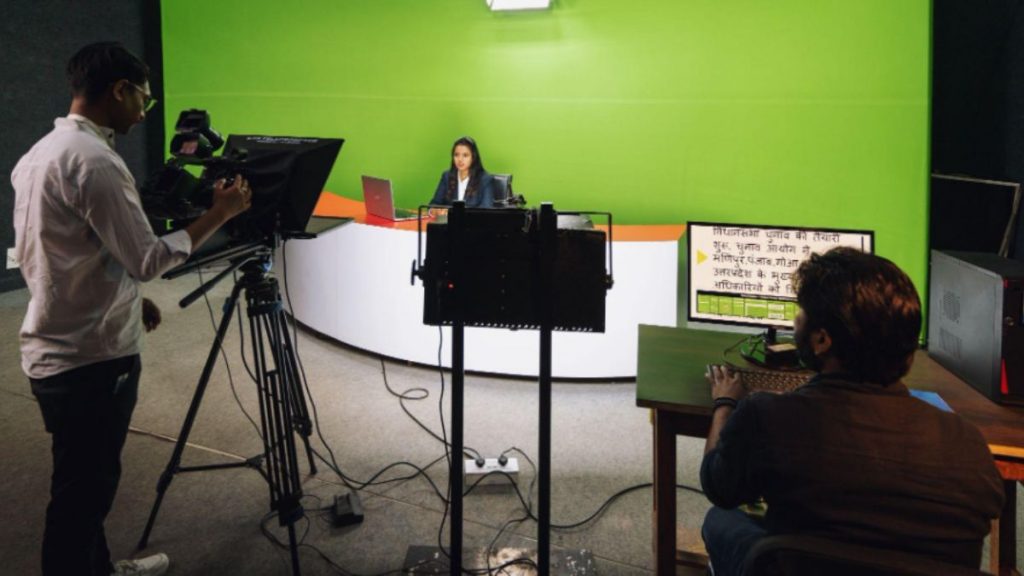
The campus itself is the training ground. It has a newsroom simulation, a photography studio, a broadcast studio, and its own channels: MSTV, AAFT24x7 and Radio Noida 107.4 FM. Students report and produce for these from the first semester, which means that for anyone looking at a TV journalism course in India as part of a wider digital skillset, the gap between campus and a real newsroom is unusually small.
Who Teaches the Programmes
The Industry Dean of the School of Journalism and Mass Communication is Faye D’Souza, a trailblazer in Indian journalism known for fearless, people-first reporting. Formerly the face of Mirror Now, she now leads her own independent digital platform, and has been honoured with the RedInk Award and named among Fortune India’s 50 Most Powerful Women. Her mentorship gives students masterclasses, portfolio reviews and access to industry pathways.
Dr. Syed Nawaz Ahmad, Joint Dean, holds a PhD in Journalism and Mass Communication from the University of Lucknow, with over 19 years across academia and the media industry in India and the UAE.
Mr. Harinder Kumar, Head of Department, brings over 23 years as a television editor across DD News, DD National and Network 18, with four Network-18 Best Editor Awards.
They are supported by faculty who have worked in the newsrooms students are aiming for:
- Ms. Geeta Chaudhary — 15+ years across All India Radio and 92.7 Big FM as a radio jockey and presenter.
- Ms. Lubna Fatima — former copyeditor at The Times of India and editor at NDTV Good Times.
- Ms. Mehak Zaidi — 10 years across academia and the media, including The Hindu.
- Anoop Ray — photojournalist published in The New York Times and Aperture.
In Their Own Words
Dr. Sandeep Marwah, President, AAFT Noida, said: “Journalism has not become less important. It has become faster, more visual and more demanding. A young reporter today has to think across print, television and digital at the same time, and do it responsibly. We built our programmes so that students learn this the only way it can be learned, by doing it. When they report for a real channel, meet a real deadline and answer to a real audience while they are still studying, they graduate as journalists, not as students who have only read about journalism. That is what the industry has always valued about our graduates.”
Placements and Industry Connect
AAFT Noida’s journalism graduates work across print, digital, television and independent media. Recent placements include Arush Prabhakar and Hemant Sharma at ABP, Rounit Kumar at ABP Network, Dishant Narang at ANI, Manoranjan Jha at Amar Ujala, Ananya Trivedi at Jagran New Media, and Ayushi Pal at ITV.
With 2,800+ hiring partners and a dedicated Career Resource Cell, the institution has a consistent record of placing journalism graduates in roles that match what they trained for. Its 37,000+ alumni network spans newsrooms, digital platforms and content studios across India and internationally. For students weighing journalism colleges in Delhi NCR, that combination of live channels, a digital-first curriculum and a strong hiring network is what makes AAFT Noida one of the more career-focused choices for the best journalism college in India.
Admissions Open for 2026
Students who have completed 10+2 from a recognised board can apply for the BA in Journalism and Mass Communication, and graduates from any discipline can apply for the MA in Journalism and Mass Communication. Applicants need a minimum of 50% marks in 10+2 (45% for reserved categories) and must clear the AAFT Global Entrance Test (GET). Both are offered at the AAFT campus in Sector 16A, Noida Film City.
Seats are limited for the 2026 batch. Students can apply at admissions.aaft.com or visit the campus for a tour and a free career counselling session. Anyone specifically comparing a journalism course in Noida is welcome to see the newsroom and studios in person.
About AAFT Noida
Established in 1993, AAFT Noida carries a 33-year legacy in creative education and is ranked among the Top 10 creative institutions globally. Its network of 37,000+ alumni spans films, OTT platforms, television, journalism, advertising, fashion, animation and digital media across India and the world.
The institution operates from Marwah Studios, Noida Film City, one of India’s most active production facilities, with full infrastructure including newsroom simulation, broadcast studios, a radio station and professional field equipment. With 90+ career-driven courses, 2,800+ hiring partners and 20+ global academic affiliations, AAFT Noida follows a curriculum that balances creative training with real-world application and remains committed to preparing globally competitive talent for India’s growing media and entertainment economy.
For Admission and Media Inquiries, Contact:
AAFT Noida
FC-14/15, Sector-16A, Noida Film City, Uttar Pradesh, India