Marathi Christian Sahitya sammelan in Nashik from January 9 to 11,Poet Simon Martin to preside over
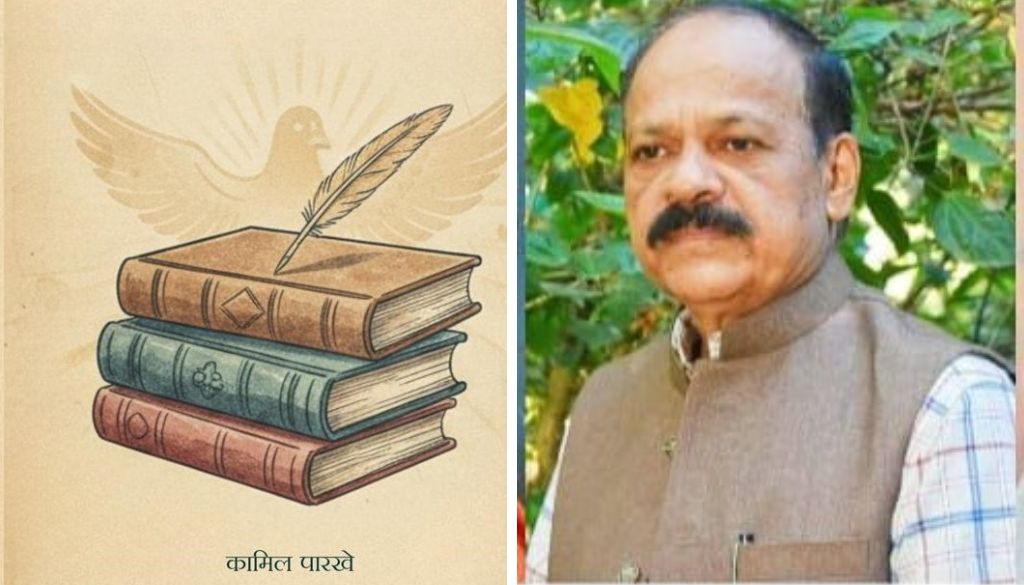
By Camil Parkhe
Pune, 7th January 2026: Although Christianity has a 2000 year-old tradition in Kerala, there is no distinct category known as “Christian Malayalam literature” within Malayalam literature. In Tamil, which has been accorded the status of a Classical language, Christian clergy have produced literature of a high classical standard since the medieval period. Even so, in Tamil too there is no separate category called “Christian Tamil literature.”
In no other State or region of India does literature identified explicitly by religion exist in this manner.
In Goa, many European Christian missionaries enriched Konkani and Marathi literature, and likewise many native Goans went to Lisbon, Paris, and Rome and made valuable contributions to Portuguese, French, and other literatures. Yet even in Goa there is no separate genre called Konkani Christian literature or Portuguese Christian literature.
In Maharashtra, however, – though not from very ancient times, but certainly from the medieval period onward—there exists a distinct identity known as Marathi Christian literature.
At the beginning of the 17th century, in 1616, the British Jesuit Fr. Thomas Stephens, who printed the Marathi epic Kristapurāṇ in the Roman script, is regarded as the founder of this unique stream of Marathi Christian literature.
This year, right at the beginning of 2026, two Marathi literary conferences with a very long tradition are being held in quick succession. The 99th All-India Marathi Sahitya Sammelan was held during the first week of January at Satara under the presidentship of Vishwas Patil.
Immediately thereafter, the 27th Marathi Christian Sahitya Sammelan is being held in Nashik under the presidentship of veteran poet and writer Simon Martin.
Among the prominent personalities to attend the Sahitya Sammelan include veteran writer Raosaheb Kasbe and veteran editor and writer Uttam Kamble. Christian writers, poets and literature lovers from all over Maharashtra are expected to attend the literary meet.
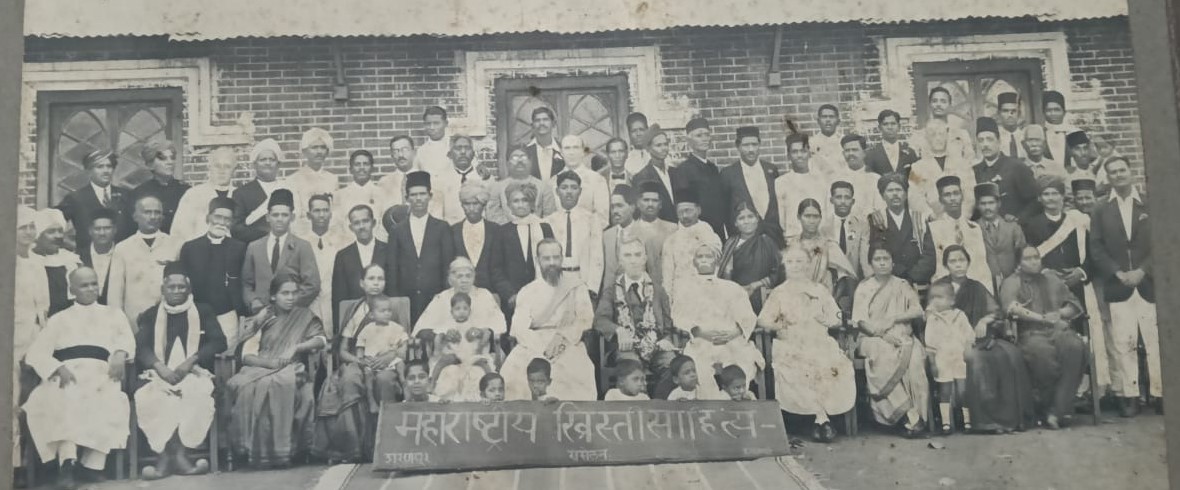
Incidentally, Marathi Christian Sahitya Sammelan has a century-long history. It was Justice M. G. Ranade who initially organized the first few Marathi Sahitya Sammelan during the last quarter of the 19th century. Christian litterateurs were the first ones who formed an independent stream of Marathi Christian Sahitya Sammelan in 1927.
The first Marathi Christian Literary Conference was held on 18 and 19 April 1927 at the Church Missionary Society’s Marathi school at Sharanpur in Nashik, with Reverend Nicol Macnicol as its president.
Reverend Dr. Nicol Macnicol was a missionary of the Church of Scotland.
Veteran writer Anupama Ujgare writes in her book History of Marathi Christian Literature, 1810–1927 that Dr. Nicole had a profound command over the Indian languages Marathi and Sanskrit. Prominent saints of Maharashtra, Dnyaneshwar, Tukaram, Ramdas, and Eknath were frequent subjects of his lectures and since he lived in Pune, he was known as ` Punya Nagariche Muni’ or “the Sage of Pune city. ”
Audiences would flock to hear Dr. Nicole’s lectures at venues such as Gokhale Hall and Torrance Memorial Hall in Pune, and people would come from far and wide to listen to his sermons at the church in Nana Peth in Pune.
Macnicol translated veteran Marathi poet Narayan Vaman Tilak’s Bhaktiniranjan into English. The cover of this book was incidentally designed by Balasaheb Thackeray, the founder of the Shiv Sena.
Nicole Macnicol also wrote an essay on saint literature titled “The Poetry of Devotion.” In his book Psalms of Marathi Saints, published in 1919, he translated into English Marathi abhangas of six Maharashtrian saints—Dnyaneshwar, Janabai, Muktabai, Namdeo, Eknath, and Tukaram.
Marathi Christian Sahitya Sammelans deserve appreciation for various reasons. First of all, these separate Sammelans inspired many others thereafter to muster the courage to establish their own separate literary forums. In due course, Dalit, rural, Muslim, rural and regional Sahitya Sammelans were held and nowadays, such Sahitya Sammelans are being held on a regular basis.
The fourth Marathi Christian Sahitya Sammelan was held in Nagpur in 1933. The writer chosen to preside this Sahitya Sammelan was, in fact, fully qualified to be elected president of the mainstream Marathi Literary Conference as well. The president of the fourth Marathi Christian Sahitya Sammelan was the author of legendary Marathi autobiography, `Smritichitre, Lakshmibai Tilak.
After the Marathi Christian Literary Conferences held in 1927, 1930, 1932, and 1933, there was a gap of as many as 21 years before the fifth conference was held in 1954 at Kedgaon under the presidentship of P. L. Patole.
The sixth conference was held in Pune in 1955 under the presidentship of Rev. Sumant Dhondo Ramteke, and the seventh session was held at Punatambe in Ahilyanagar district in 1956 under the presidentship of Vasant Bhaurao Samudre. After two conferences were held in quick succession following 1954, there was again a gap of 16 years before the next literary conference was held in 1972.
Thereafter, many lovers of literature contributed to the continuous organization of Marathi Christian Sahitya Sammelans, Among them were Fr. (later Bishop of the Aurangabad Diocese) Dominic Auriol, Roque Carvalho, Fr. Francis Correa, Joseph Noronha, Dr. Kamalakar Kolhatkar, Vijaya Punekar, Fr. Nelson Machado, Sumant Dayanand Karandikar, Anil Dahivadkar, Sunil Adhav, Ashok Angre, Fr. Gabriel D’Silva, Niranjan Ujgare, Sudhir Sharma, and Jayantkumar Tribhuvan.
In the year 2000, the Marathi Khristi Sahitya Parishad was formally registered.
An important point is that, like the All-India Marathi Sammelanas, Marathi Christian Sahitya Sammelans and Marathi Dalit Christian Sahitya Sammelans have also been documented.
Sunil Shyamsundar Adhav has made available for future generations a substantial 420-page volume titled “Dharma Khristacha, Vichar Sahityacha – Shatakatil Khristi Sammelandhyakshiya Bhasahne wa Tyawaril Sameeksha’ (Religion of Christ, Thought of Literature!—Presidential Addresses of Christian Sahitya Sammelanas of the Century and Reviews Thereof.’’
Moreover, Sunil Adhav has provided detailed critical reviews of these addresses. This book is of great importance as a valuable document. It contains the presidential addresses of almost all Marathi Christian Literary Conferences and Marathi Dalit Christian Literary Conferences held between 1927 and 2001.
A compilation of the presidential addresses of the Marathi Christian Sahitya Sammelans and Marathi Dalit Christians Sahitya Sammelanas held after 2001 and till 2022 has been done by the present writer (Camil Parkhe), entitled ‘Shatakatil Marathi Khristi Sahitya Sammelane’ (Marahi Christian Sahitya Sammelans held during the century), published by White Light Publications, Pune.
Till today, a total of 26 Marathi Christian Sahitya Sammelans and 10 Marathi Dalit Christian Sahitya Sammelanas have been held—38 literary conferences in all.
What exactly is meant by “Christian literature,” and how should it be defined? This question has caused intense debate for many years both within the Christian community and outside it, and there have been major controversies.
Defining terms such as “Christian literature” and “Christian writer” is extremely difficult. Does Christian literature mean writings on Christianity produced by Christians? And what should we call literature on Christ written by non-Christians?
The founder of the Snehasadan Institute in Pune, the German Jesuit Fr. Matthew Lederley, has included in “Indian Christian Art” the series of paintings on Mother Teresa and Jesus Christ created by veteran artist Maqbool Fida Husain.
Veteran political leader and trade unionist George Fernandes was a multilingual; besides his mother tongues Konkani, Tulu, and Kannada, he had mastery over Marathi, Hindi, and English. If he had penned books, would his writings be called Christian literature?
This debate on Christian Literature has thus gone on for many years, with no satisfactory answers.
Veteran Marathi writer Fr. Francis D’Britto, who was the president of the Marathi Christian Sahitya Sammelan held in Pune in 1992 was later chosen to preside over the All-India Marathi Sahitya Sammelan in 2020.
Unique Confluence of Catholics and Protestants
These Marathi Christian Sahitya Sammelans have also served as unique confluence of Catholics and Protestants.
The effort to bring together the various denominations within Christianity is known as ecumenism or interdenominational harmony. As part of this ecumenical movement, the Popes, the supreme pontiff of the Catholic sect, over the past several decades have been meeting leaders of various Christian denominations worldwide, including the Orthodox churches. The recent meeting between the Anglican Church’s head, King Charles III, and the Pope Leo is also seen as part of this ecumenical process.
It can be said that ecumenism has been implemented very effectively through the Marathi Christian Sahitya Sammelans that have been held for nearly half a century.
All four of the earliest Marathi Christian Sahitya Sammelans held from 1927 onward had Protestant presidents. In 1972, when efforts were made to revive these literary conferences, both Catholics and Protestants came together. Since then, for the past five decades, this ecumenism or Christian unity has remarkably endured without any major disputes or conflicts.
Thus, even when the Sahitya Sammelan president has been a Protestant, Catholic church institutions have accepted the role of hosting the Sammelans —and vice versa as well.
The same has been true in the case of Marathi Dalit Christian Sahitya Sammelans.
In both streams—the Marathi Christian Sahitya Sammelans and the Marathi Dalit Christian Sahitya Sammelans—the roles of conference presidents as well as hosts (reception committee presidents) have been played by several Catholic and Protestant bishops and clergy.
These include Catholic Bishop Dominic Auriol, Fr. Dr. Elias Rodrigues, Fr. Francis D’Britto, Fr. Nelson Machado, Fr. Gabriel D’Silva, Fr. Michael G., Jesuit Fathers Joe Pithekar, James Shelke, and Joe Gaikwad, along with Protestant clergy Rev Nicol Macnicol, Rev. Sumant Dhondo Ramteke, Acharya Dinanath S. Pathak, Rev. Arvind P. Nirmal, Rev. Subhash Chandorikar, Protestant Bishop Vinod Peter, Bishop Pradeep Kamble, and Bishop Paul Dupare.
The unity of the Catholics and Protestants during these Sahitya Sammelans is very significant in one considers the centuries-old clashes between the Catholic and Protestant sects.
From the perspectives of both Catholics and Protestants, followers of other Christian denominations are often not considered Christians at all. When missionaries of the American Marathi Mission arrived in Mumbai in 1813, the first two people they converted—that is, baptized—were a Muslim and a Roman Catholic. The chronicle of the American Marathi Mission records:
“In November 1825, a Roman Catholic man named Manuel Antonis D’Mello became a Protestant in this mission.”
There is no doubt that these literary enthusiasts of different Christian denominations, who come together during the Marathi Sahitya Sammelans, have accomplished the immensely valuable task of dismantling a large, invisible wall that existed between them for a long time.