Pune Bike Taxis Return: Rapido Resumes Service as Commuters Hope for Affordable Last-Mile Travel
Reported by Shoaib Tadvi
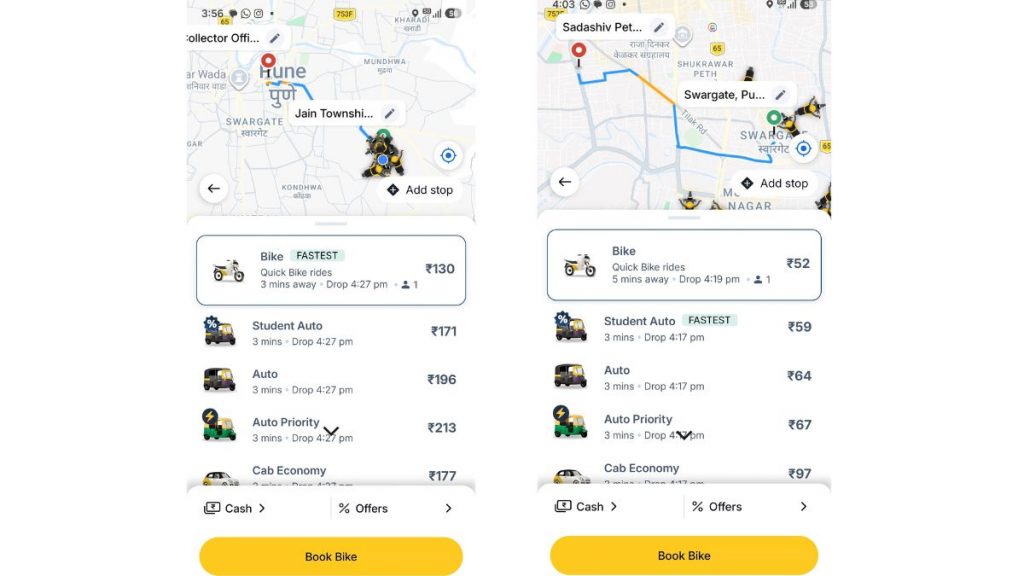
Pune, 7th October 2026: Bike taxis have returned to Pune, with app-based mobility platform Rapido resuming its bike taxi service in the city after years of regulatory uncertainty. The service is now available alongside Rapido’s auto and cab options, giving commuters another choice for short-distance and last-mile travel.
The return comes at a time when Pune residents are increasingly concerned about rising transportation costs and traffic congestion. Commuters travelling short distances often face higher auto and cab fares, particularly during peak hours.
Bike taxis back after regulatory hurdles
Bike taxi services had earlier operated in Pune, but their legality became a subject of regulatory scrutiny, particularly over the use of privately registered two-wheelers for commercial passenger services.
In January 2023, Maharashtra prohibited the use of private or non-transport two-wheelers for app-based passenger services. Operators subsequently sought regulatory approval under the state’s evolving framework.
The Maharashtra Bike-Taxi Rules, 2025 established a licensing system for bike taxis and provided Regional Transport Authorities with powers to determine conditions such as the number of permitted vehicles, fares and designated pickup and drop-off points.
Rapido and Uber had approached the Pune Regional Transport Office (RTO) seeking permission to operate e-bike taxi services. The RTO examined their applications based on safety standards, vehicle conditions and the state’s aggregator policy.
The Maharashtra government had earlier announced that permits for app-based bike taxi services would be issued from August 1, 2026.
Commuters hope fares will come down
The return of bike taxis has also raised expectations among commuters that increased competition could put pressure on auto-rickshaw and cab fares.
Many passengers have complained that short-distance journeys that earlier cost around ₹50 can now cost ₹80–₹90, while app-based cab fares can rise further during periods of high demand.
Sandeep Sharma, a resident of Hadapsar, said, “The return of bike taxis is a welcome option for daily commuters. During peak hours, travelling by auto or cab can be expensive and time-consuming. If bike taxis offer reasonable fares, they can make short-distance travel much easier.”
Hussain Shaikh, a resident of Kondhwa, said, “Auto and cab fares have increased considerably, especially for short-distance journeys. Bike taxis could provide some relief if their fares remain affordable. At the same time, passenger safety and proper regulation should be given priority.”
Useful for last-mile connectivity
Bike taxis could be particularly useful for commuters travelling between Metro and railway stations and their final destinations. Two-wheelers can also navigate congested roads more easily than larger vehicles, potentially reducing travel time.
Ramdev Kulkarni, a resident of Swargate, said, “Swargate is a major transport hub, and many passengers need affordable last-mile connectivity. Bike taxis can be useful for reaching nearby destinations without getting stuck in traffic. Fares should be transparent and commuters should not face unreasonable surge pricing.”
Traffic congestion remains one of Pune’s major transport challenges, especially during morning and evening office hours.
Ramesh Bhosale, a resident of Baner, said, “Traffic congestion has become a major problem in Pune, particularly during office hours. A two-wheeler can move through congested roads more easily than a car. If bike taxis are properly regulated and reasonably priced, they could become a practical option for daily commuters.”
Electric transition by July 2027
The bike taxi sector is also expected to undergo a major shift towards electric mobility. Maharashtra has directed bike taxi aggregators to transition to fully electric fleets by July 2027.
This gives operators a limited period to shift their existing fleets and could accelerate the adoption of electric two-wheelers for passenger transport in Pune.
Priyanka Jadhav, a resident of Pimpri, said, “For students and working professionals, even a small increase in daily travel expenses can make a difference. Bike taxis could be useful for short trips and last-mile connectivity, but affordability and passenger safety should be given equal importance.”
Will competition reduce fares?
The return of bike taxis has created another option for Pune commuters, but whether it will actually reduce auto and cab fares remains to be seen.
While lower operating and travel times could make bike taxis attractive for short-distance journeys, their success will depend on pricing, availability, safety compliance and the number of vehicles operating across the city.
For commuters, the expectation is clear: more transport options, shorter travel times and, most importantly, affordable fares.