Pune investors turn attention to mid-cap segment amid dynamic market conditions

Pune, 19th February, 2026: At a time when equity markets are balancing optimism with caution, retail investors are trying to recalibrate their portfolios to aim to capture long-term growth opportunities. Among the segments drawing renewed interest are mid-cap mutual funds in the current market cycle.
A combination of global and domestic factors is shaping this outlook. On the global front, improving trade engagement between major economic blocs such as the US and Europe is expected to lend support to overall business sentiment. Such developments seek to create a more predictable environment for companies with export linkages and manufacturing exposure.
Domestically, the recent Union Budget’s continued emphasis on infrastructure, manufacturing, capital expenditure and allied core sectors endeavours to have a multiplier effect across the economy. As government spending feeds into private sector activity, demand for goods and services is likely to broaden beyond large corporate, potentially benefitting mid-sized companies that are closely integrated into domestic growth cycles.
Reflecting this, the mid-cap category saw robust participation throughout 2025. According to the latest AMFI data, inflows in mid-cap funds, contributed to the industry’s record-breaking equity tally. The category continued its momentum, with net inflows reaching Rs 3,185 crore for January 2026, indicating that the appetite for Indian enterprises striving for potential growth remains unsatiated.
Mirroring this national sentiment, the Tata Midcap Fund (an open-ended equity scheme predominantly investing in mid cap stocks) has witnessed a similar interest from regional markets like Pune. As of January 31, 2026, the fund’s Assets Under Management (AUM) stood at approximately Rs 26.10 crore, suggesting a growth of 27% as compared to last year. (Internal data)
In Pune, the fund’s local footprint has been progressive. In January 2026, the Tata Midcap Fund recorded gross sales of Rs 5.29 crore (Source: Internal data). This data underscores the local investor interest—towards equity strategies that seek to participate in India’s growth story.
Satish Mishra, Fund Manager, Tata Asset Management, noted that the current economic environment favors companies that aim to scale. “In 2026, we are seeing a transition where mid-sized companies are potentially benefiting from domestic capex and the revival in consumption. A Midcap strategy allows investors to invest in these ’emerging bluechips’ before they become household names. These funds are suitable for investors who are seeking Long Term Capital Appreciation.”
Another factor supporting mid-cap funds is the valuation comfort in this segment. The Nifty Midcap 100 Index currently trades at a price-to-earnings level in the low 30s, reflecting a valuation that sits between those of large-cap and small-cap equities. While this does not imply mid-caps are cheap, it suggests that valuations are not excessively elevated.
While the growth potential is optimistic, Tata Mutual Fund continues to advocate for a disciplined investment approach. Given that mid-cap stocks can be more sensitive to market swings than large-cap peers, the fund house recommends the Systematic Investment Plan (SIP) route.
The appeal of mid-cap funds lies in their ability to capture “The Middle Path.” While large-cap funds aim to offer relatively lower volatility as compared to mid-caps and small caps and small-cap funds aim to offer growth with higher volatility as compared to large caps and mid-caps, mid-cap funds try to provide some features of both worlds.
As the “India Story” unfolds, the Tata Midcap Fund seeks to identify high-quality businesses with strong governance, helping retail investors transform their savings into potential long-term wealth.
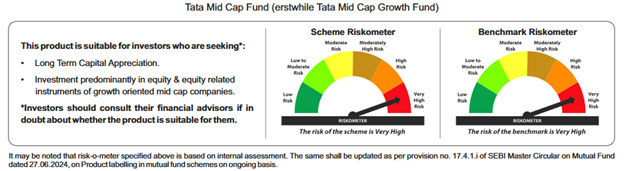
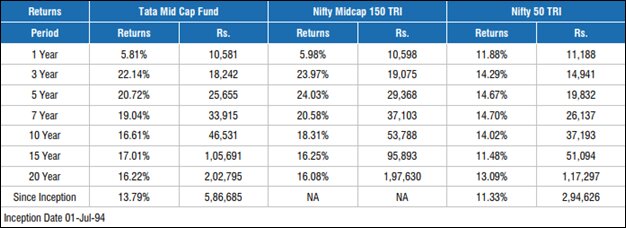
SCHEME PERFORMANCE IN SEBI FORMAT
PERFORMANCE OF OTHER FUNDS MANAGED BY THE FUND MANAGERS
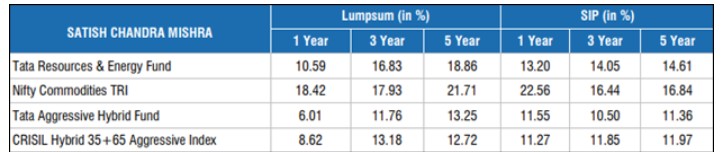
Disclaimer: 1) Scheme returns in terms of CAGR are provided for past 1 year, 3 years, 5 years and since inception. 2) Point-to-point returns on a standard investment of Rs. 10,000/- are in addition to CAGR for the schemes. 3) Different plans shall have a different expense structure. The performance details provided herein are of regular plan growth option except for Tata Mid Cap Growth Fund where performance details given is for regular plan dividend option. 4) NA stands for schemes in existence for more than 1 year but less than 3 years or 5 years, or instances where benchmark data for corresponding period not available. 5) Period for which schemes performance has been provided is computed basis last day of the month – ended preceding the date of advertisement. 6) For computation of since inception returns the allotment NAV has been taken as Rs. 10.00. Schemes in existence for less than 6 months, performance details for the same are not provided. 7) For Benchmark Indices Calculations, Total Return Index (TRI) has been used. Where ever TRI not available Composite CAGR has been disclosed. Please refer Disclaimer sheet for composite CAGR disclosure. 8) Scheme in existence for more than six months but less than one year, simple annualized growth rate of the scheme for the past 6 months from the last day of monthend is provided. 9)Total Schemes managed by Satish Chandra Mishra: 3. 10) Past performance may or may not be sustained in future.