Pune: Red Alert Active as Western Ghats Experience Torrential Downpours; Dungerwadi Records 398 mm, Chinchwad Lashed by 77 mm of Rain
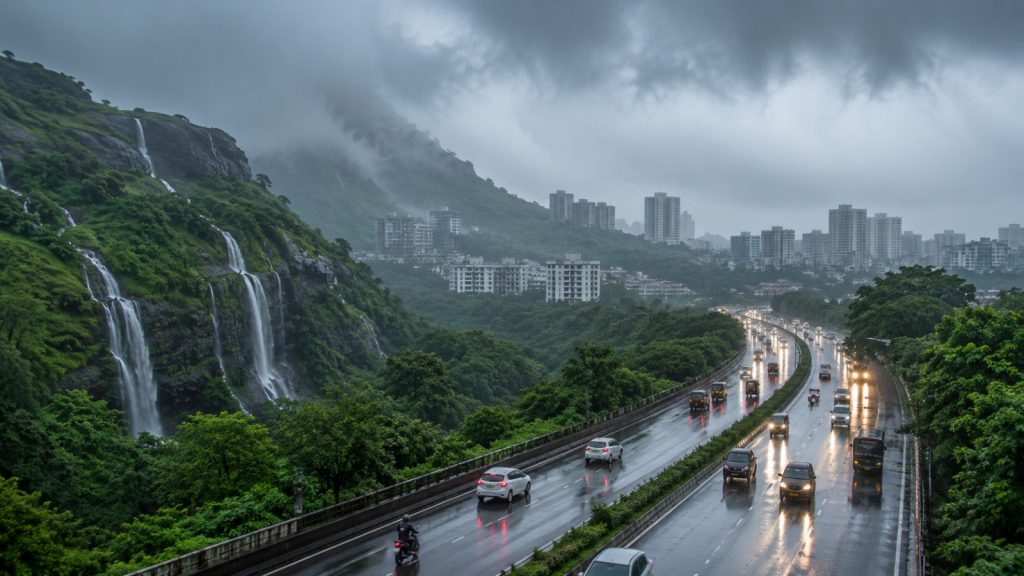
Pune, 5th July 2026: An active and aggressive monsoon has placed Pune and its surrounding districts under a state of high alert, as continuous heavy downpours lash the region for the third consecutive day. With the India Meteorological Department (IMD) maintaining a strict Red Alert for the ghat (hill) areas, the district administration has escalated its safety warnings, urging citizens to avoid all non-essential travel to hilly destinations, waterfalls, and areas prone to landslides or waterlogging.
In the 24 hours leading up to 8:30 AM on Sunday, July 5, 2026, the region saw historic levels of precipitation, with some stations in the Western Ghats registering nearly 400 mm of rainfall.
Western Ghats and Catchment Lakes Hammered by Torrential Rain
The core of the monsoon’s fury was concentrated in the Western Ghats, where multiple stations recorded extraordinary, life-threatening rainfall. Dungerwadi emerged as the wettest location in the region, recording a staggering 398.0 mm of rainfall in a 24-hour window, pushing its seasonal cumulative total to a massive 1,381.0 mm. Close behind was Bhira, which registered 386.0 mm of rain, propelling its phenomenal season total to 2,304.0 mm. Other extreme downpours in the ghats were reported in Tamini at 310.0 mm, Khopoli at 285.0 mm, and Shirgaon at 275.0 mm.
Shirgaon’s rainfall officially pushed its seasonal cumulative past the millennium mark, standing at 1,011.0 mm. Davdi also crossed the milestone, recording 268.0 mm of daily rain for a seasonal total of 1,052.0 mm. Lonavala (Tata) and Ambone recorded heavy downpours of 263.0 mm and 249.0 mm respectively.
This torrential precipitation extended directly into the critical catchment lakes supplying metropolitan drinking water. Tulsi Lake recorded an exceptional 321.0 mm of rainfall, while Vihar Lake registered 275.0 mm. Other key reservoirs also received substantial replenishment, with Tansa recording 92.0 mm, Bhatsa logging 87.0 mm, Mid Vaitarna receiving 86.0 mm, Vaitarna registering 82.0 mm, and Upper Vaitarna logging 59.0 mm.
Heavy Rural and Taluka Showers Cause Localized Flooding
In Pune’s rural talukas and sub-divisions, Nimgiri was the hardest hit, registering a massive 121.5 mm of rain. Malin, highly vulnerable to landslides, recorded a substantial 63.5 mm of rainfall, raising administrative vigilance. Steady downpours were also logged in Bhor (55.5 mm), Dapodi (43.5 mm), Rajgurunagar (42.5 mm), Dudulgaon (39.0 mm), and Narayangaon (36.0 mm). While the eastern and southern plains recorded lighter showers—including Shirur (22.5 mm), Haveli (14.5 mm), Talegaon (3.5 mm), Baramati (3.4 mm), and Daund (2.5 mm)—the cumulative run-off from the hills has kept local water bodies swollen.
Urban Pune Hit by Strong Downpours; Chinchwad Records 77 mm
Within the urban limits of Pune and Pimpri-Chinchwad, heavy rains continued to trigger severe waterlogging and major traffic snarls. The industrial corridor of Chinchwad registered the city’s highest urban rainfall at a significant 77.0 mm. Lohegaon followed with an impressive 48.2 mm of rain. The National Defence Academy (NDA) registered 40.0 mm, while Pashan logged 33.4 mm. Central Pune’s Shivajinagar recorded a steady 30.7 mm, and Lavale registered 15.5 mm.
The heavy rains severely disrupted evening traffic, with water accumulation on roads in low-lying areas like Swargate, Hadapsar, Katraj, Kothrud, Sinhagad Road, Baner, and parts of Pimpri-Chinchwad slowing vehicular movement to a crawl. Motorists had to navigate deep water pools, and major intersections reported severe vehicle gridlocks.
Plunging Temperatures and Saturated Air
The continuous rain has maintained a cool, damp climate across Pune, keeping temperatures exceptionally pleasant. Lavale was the coolest location in the urban cluster, recording a minimum temperature of 19.8°C (with a dry-bulb reading of 20.5°C). Pashan registered a minimum temperature of 21.2°C, while Lohegaon dipped to 21.6°C. Shivajinagar and NDA recorded minimums of 22.0°C and 22.1°C respectively, while Chinchwad hovered at 22.4°C. Relative humidity levels hit complete saturation, reaching 100% in Pashan, Lohegaon, and Chinchwad, while Shivajinagar (98%), Lavale (98%), and NDA (95%) remained exceptionally damp.