Pune: Rising Seas, Melting Glaciers, and Urban Heat; New Indo-Pacific Study Warns of Widening Climate Adaptation Gap
Reported by Akshata Pawar
Pune, 18th July 2025: A groundbreaking scientific study has issued a stark warning about the accelerating climate crisis in the Indo-Pacific region, calling for a paradigm shift in how nations approach resilience and adaptation. Led by the Indian Institute of Tropical Meteorology (IITM), Pune, the study identifies urgent vulnerabilities stemming from sea-level rise, urban heat stress, and Himalayan glacier retreat — and urges better integration of local knowledge and AI-driven technologies into climate strategies.
Published in Frontiers in Climate, the research emphasizes that climate adaptation efforts in the Indo-Pacific are being outpaced by intensifying threats. The region, home to two-thirds of the global population and a cornerstone of global trade, faces mounting risks from coastal flooding, extreme weather events, and the rapid urbanization that is reshaping both plains and mountainous terrains.
“The Indo-Pacific is ground zero for the world’s most complex climate challenges. If we fail here, we risk failing globally,” the authors caution.
Key Findings
Sea-Level Rise & Coastal Vulnerability:
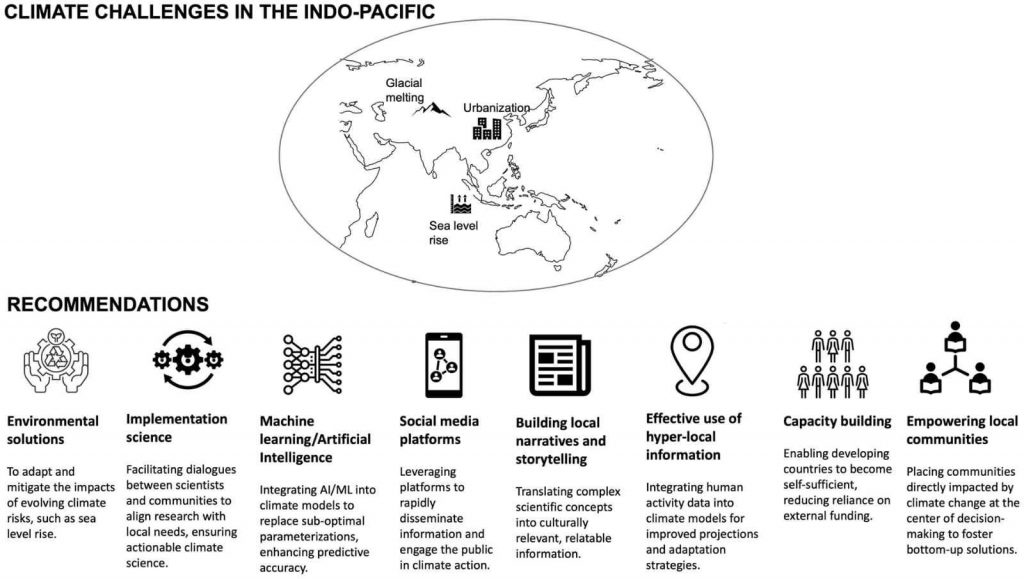
Sea levels in parts of Southeast Asia are rising four times faster than the global average, placing densely populated coastal cities like Jakarta, Manila, and Kolkata at severe risk. In island nations such as Tuvalu and the Maldives, even a 0.5–1.1 meter rise by 2100 could prove catastrophic. Current infrastructure and policy frameworks are ill-prepared for the growing frequency of extreme sea-level events — projected to become annual by 2050.
Urban Heat and Infrastructure Pressure:
Rapid urbanization across Asia is compounding the climate crisis. With over 70% of global greenhouse gas emissions coming from cities, Indo-Pacific urban centers are experiencing intensified heatwaves, altered rainfall patterns, and deteriorating air quality. India alone has seen an 85% increase in urban land conversion over four decades. Meanwhile, urban-scale climate models remain limited in scope and resolution, especially in countries with minimal computational infrastructure.
Melting Glaciers in the Hindu Kush Himalaya:
Dubbed the “Water Tower of Asia,” the Hindu Kush Himalaya is warming faster than the global average. Glacial melt is threatening the freshwater supply of nearly 2 billion people, exacerbating risks like landslides, floods, and agricultural instability. The study warns that conventional climate models often overlook indigenous knowledge, which is crucial to building localized resilience in these fragile mountain ecosystems.
Despite advances in climate modeling and data science, the study identifies persistent institutional, financial, and communicative gaps that are stalling progress:
-Fragmented governance and lack of coordination between local and national agencies.
-Limited access to localized climate projections, especially in underserved areas.
-Underuse of AI and machine learning, which could enhance precision in climate forecasting.
-Insufficient integration of indigenous and community-based knowledge into policy frameworks.
The authors advocate for a “value cycle” approach, where scientific research not only informs policy but is also shaped by local realities and feedback from communities. They emphasize the importance of co-developing solutions through regional hubs like the Indo-Pacific My Climate Risk Hub at IITM, Pune.
Additionally, the paper calls for:
-Blending ecosystem-based solutions (like mangrove restoration) with hard infrastructure (like seawalls).
-Scaling up city-specific climate modeling using hybrid AI and physics-based systems.
-Expanding science communication through multilingual storytelling, local translators, and platforms like Climate Cardinals to reach wider, culturally diverse audiences.
-Empowering local governments and early-career researchers through capacity-building and international collaboration.
The multi-institutional study was authored by a diverse and interdisciplinary team of scientists and communicators from across the globe. Lead author Aditi Modi and co-author Dr. Mathew Koll Roxy are affiliated with the Centre for Climate Change Research at IITM, under the Ministry of Earth Sciences, India. Other contributors include Shipra Jain from University College London, Chi Huyen Truong from ICIMOD in Nepal, Quang-Van Doan from the University of Tsukuba, Japan, and Christopher Jack from the University of Cape Town. The international team also featured Svetlana Jevrejeva of the UK’s National Oceanography Centre, Arvind Singh from PRL Ahmedabad, Chirag Dhara of Krea University, and Sahana Ghosh, a science journalist from Nature India.