Pune: ‘Where Are the Footpaths?’ Citizens Slam PMC Over Pedestrian Safety Crisis in Mohammadwadi
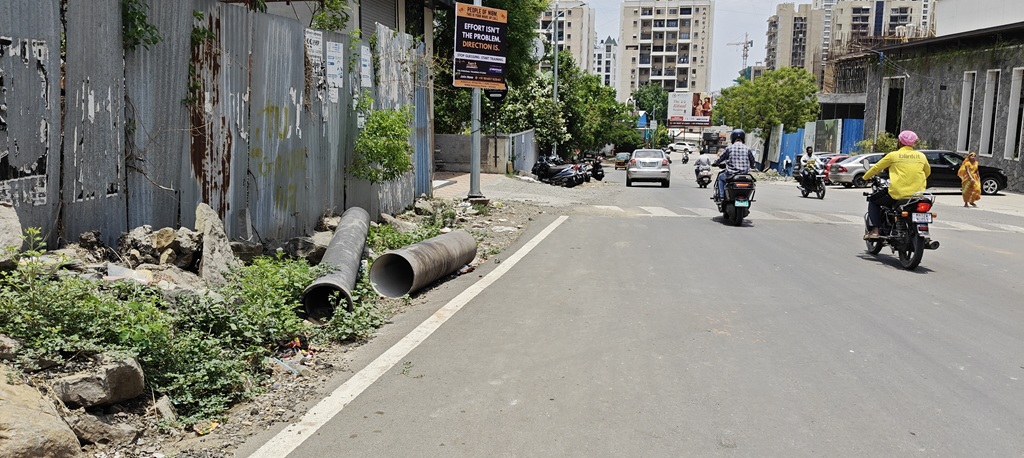
Missing footpath in Mohammadwadi Pune
Mohammadwadi, 7th June 2026: In what residents describe as a glaring example of civic neglect, entire stretches of public footpaths in Mohammadwadi and NIBM Annexe have virtually disappeared under a growing maze of encroachments, illegal structures, advertising hoardings and commercial activities, forcing pedestrians onto busy roads and exposing them to serious safety risks.
Residents have accused the Pune Municipal Corporation (PMC) of turning a blind eye to the steady erosion of pedestrian infrastructure in one of the city’s fastest-growing residential corridors, despite repeated complaints and years of unchecked violations.
The worst-affected stretches include the road from S.M. Ghule Circle to Pristine Viva Society, S.M. Ghule Circle to Dorabjee Heritage Mall, and the route leading towards Archana Greens. According to residents, footpaths along these roads are either broken, obstructed, occupied or completely absent, leaving thousands of daily commuters with little choice but to walk alongside moving traffic.
As large residential complexes continue to mushroom across Mohammadwadi and NIBM Annexe, residents say basic pedestrian infrastructure has failed to keep pace with the area’s rapid urbanisation.
“What is the purpose of paying some of the highest property taxes in Pune if basic pedestrian infrastructure is unavailable?” asked Rajesh Mehta, a resident of the area for more than a decade. “The PMC talks about smart cities and sustainable mobility, but here pedestrians are treated as an afterthought.”
Residents allege that public walkways have gradually been appropriated by private interests. Driving school installations, advertising hoardings, signboards, temporary structures and what residents describe as unauthorised commercial and political offices have steadily encroached upon spaces originally intended for pedestrians.
The consequences are most severe for senior citizens, schoolchildren, women and persons with disabilities, who are often forced onto carriageways shared with speeding vehicles.
Farzana Shaikh, another resident, said the situation becomes particularly hazardous during evenings and the monsoon season.
“Street lighting is inadequate in some stretches, vehicles are parked on whatever remains of the footpath, and pedestrians are left with no option but to walk on the road. It is an accident waiting to happen,” she said.
Several residents alleged that complaints submitted to civic authorities over the years have produced little tangible action. They claim encroachments that would likely be removed swiftly in central Pune have remained untouched in Mohammadwadi and NIBM Annexe.
“The PMC’s enforcement mechanism seems to disappear the moment it reaches this part of the city,” said resident Pradeep Kulkarni. “There is a complete failure of urban planning and enforcement. Footpaths belong to citizens, not to advertisers, businesses or encroachers.”
Urban planning experts have long argued that footpaths are not optional amenities but essential public infrastructure that ensures safe, inclusive and sustainable mobility. However, residents say multiple stretches in Mohammadwadi feature pathways that abruptly end, narrow to unusable widths or remain blocked for extended distances.
For senior citizens, the impact is particularly acute.
“I have stopped taking evening walks because I do not feel safe,” said Nandini Deshmukh, a resident of the area. “The footpath is either broken or occupied, so I have to walk on the main road. Senior citizens should not have to risk their lives for a simple walk.”
Residents have also questioned why the PMC has not conducted a comprehensive audit of pedestrian infrastructure despite the area’s explosive residential growth over the past decade. Thousands of families now reside in large housing societies across the locality, yet continuous footpaths, pedestrian crossings and accessible walkways remain inadequate or missing altogether.
“This is not merely an issue of convenience; it is a matter of public safety and civic accountability,” said Amit Verma, a member of a local residents’ group. “The city cannot claim to be modern while denying pedestrians their most basic right—the right to walk safely.”
Residents are demanding an immediate joint survey by the PMC Road Department, Encroachment Department and the local Ward Office. Their demands include the removal of all encroachments from public walkways, restoration of continuous footpaths, installation of bollards to prevent vehicle parking and public disclosure of action taken against violators.
As Pune continues its rapid expansion towards the southern suburbs, residents say the condition of footpaths in Mohammadwadi and NIBM Annexe has become a stark symbol of a larger urban challenge—whether the city’s development priorities favour citizens and public infrastructure or allow public spaces to be steadily consumed by private interests.
Until corrective action is taken, pedestrians in the area say they remain trapped between speeding traffic on one side and encroached public land on the other, waiting for authorities to reclaim the footpaths that were originally built for them.