Regional Inequality in Maharashtra: Study Highlights Development Gap Beyond Mumbai and Pune

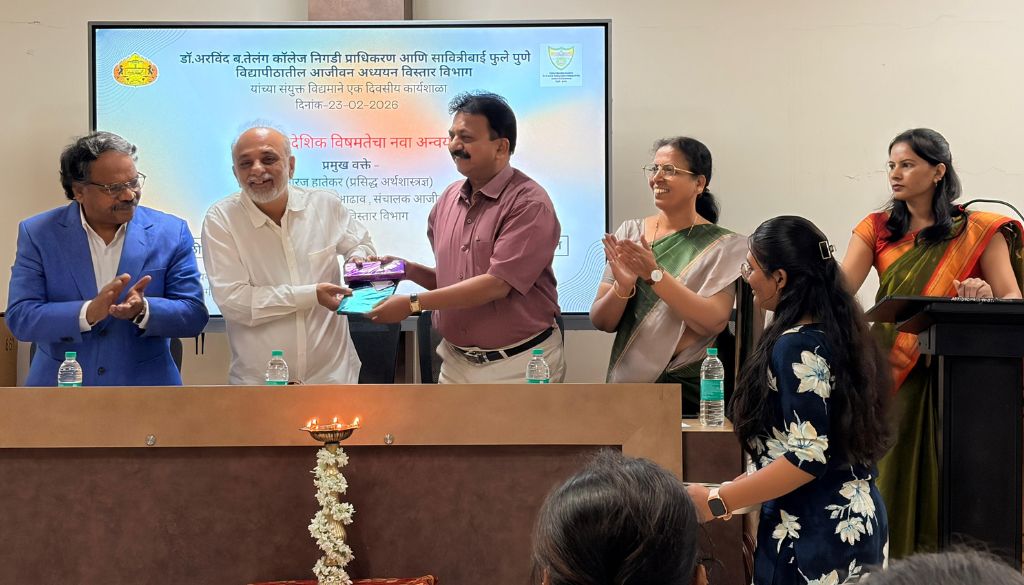
Pune, 24th February 2026: A workshop on “Regional Inequality – A New Interpretation” was held at Dr. Arvind Telang College in Nigdi, bringing together academicians, researchers and students to deliberate on widening development gaps in Maharashtra and across India.
The programme was organised by Dr. Arvind Telang College in association with the Department of Lifelong Learning and Extension (DLLE) of Savitribai Phule Pune University.
The keynote address was delivered by Dr. Neeraj Hatekar, economist from Azim Premji University, Bengaluru. In his presentation, he referred to major development models including Harrod-Domar, Robert Solow and Paul Romer, while analysing patterns of economic growth and regional disparity.
Presenting his research findings, Dr. Hatekar stated that Maharashtra ranks low on parameters determining inequality despite being one of India’s most industrialised states. He observed that development in Maharashtra remains concentrated largely in Mumbai, with limited spread to cities such as Pune, Nashik and Nagpur. A map prepared as part of his study illustrated the clustering of economic growth in select regions of the state.
Explaining what he termed a “new interpretation” of regional disparity, Dr. Hatekar said that economic development is concentrated in a handful of states, and within those states, only a few villages show measurable progress. He cited Shengaon village in Hingoli district as an example, arguing that while some pockets show development, a large section continues to remain deprived. He supported his arguments with documentary evidence and data analysis.
Prof. Dr. Vilas Adhav, Director and Head of the Department of Lifelong Learning and Extension at Savitribai Phule Pune University, also addressed the gathering. He highlighted disparities in development through examples from Maharashtra’s agricultural marketing system and discussed differences in product markets.
College Principal Dr. Prakash Patil and Programme Coordinator Dr. Sangita Salve shared their views on the relevance of the topic in the current socio-economic context. An interactive session followed, during which students raised questions that were addressed by Dr. Hatekar.
Faculty members including Dr. Azhar Khan, Dr. Sachin Kalel, Prof. Maruti Shinde and Prof. Asha Lipare were present, along with students and teachers from nearby colleges. Prof. Sangeeta Salve coordinated the workshop, while Dr. Rupali Jadhav proposed the vote of thanks.