The Library of Lost Buttons: Where Every Missing Fastener Finds Its Story

Mumbai, 26th August 2025: There is a particular hush to places that keep what the world casually discards: shoeboxes of ticket stubs, jars of single socks, the drawer where your grandmother’s recipe cards live. Imagine, then, a library whose stacks are filled not with books, but with buttons—tiny universes of plastic, shell, metal, and thread—each catalogued, labeled, and whispered-about.
If you want to picture that first scene—a brass chandelier reflecting off a thousand glossy buttons, a cat padding between narrow aisles—seed a quick mood frame into AI generators, which transform your imagination into visuals in seconds. Use Dreamina’s AI photo generator and watch the image make fiction feel tangible. The idea is simple: every lost fastener carries a story, and the library is where stories and buttons reconnect.
A map of the stacks
The Library of Lost Buttons is arranged by provenance rather than by material. One wing houses the commuter buttons: dull, scratched, perfectly round, found on coats abandoned in station crowds. Another wing caches theatrical buttons—oversized sequined things that once punctuated a chorus line. There are shelves for domestic buttons, brittle with age and stained with tea; for utilitarian buttons from tool belts and uniforms; for children’s novelty buttons shaped like frogs and rockets. Each shelf has a small placard that offers a teasing fragment: where the button was found, what pocket it came from, and the single line of witness testimony that made librarians keep it.
Visitors enter through a lobby tiled in mismatched mother-of-pearl. A kindly librarian—someone who speaks in the soft, amused tone of people who catalogue small tragedies and triumphs—hands you a magnifying glass and a small card for note-taking. The expectation is simple: look closely, listen when a button creaks (they do, sometimes), and always, always respect provenance. This is a place for gentle curiosity.
Cataloguing rules that teach you to look
Cataloguing in this library is part taxonomy, part compassion. Each entry follows a ritual: identify, record, and ask the tiny question that begins the story. Identification notes the form—shank or sew-through, number of holes, and material. Recording captures the physical state: chipped, sun-faded, threaded with remnants of a lost fabric. Then the librarian asks: Who lost you, and when? Often the answer is speculative, offered by the button itself in its small, obdurate way.
- Buttons tell stories in their scars; a burn mark might point to a kitchen mishap, a stray patch of paint could track a move, and a polished depression could mark where pockets were rubbed by careful hands.
- Provenance notes are brief: “Found in the lining of a coat last worn at a seaside funeral, October 1986,” or “Unthreaded near the stage door of a vaudeville house, smell of greasepaint.”
- Each record also includes a suggested use: the button’s next life might be as a bookmark, a pin for a memorial shawl, or a replacement on a beloved coat.
These small acts of description make the collection both practical and reverent.
Patients of the repair table
At the library’s heart is a long oak repair table where retired seamstresses, retired tailors, and curious volunteers mend, label, and sometimes listen. This is where buttons are coaxed back into readiness: missing threads are restored with mindful stitches; small splinters of shell are polished and preserved; corrosive bits are stabilized so they don’t claim neighboring buttons. Repair is a ritual of respect: not every button is reincarnated onto clothing, but every button is given a care note, a date, and a quiet ceremony.
Repairs are social events. A day at the table might include a story about the coat the button once lived on, laughter over a child’s shirt that vanished in a single, unforgettable backyard tempest, or a moment of silence for things people lost in war. Repairs make the library a living place, not merely an archive.
Making plates and postcards from the stacks
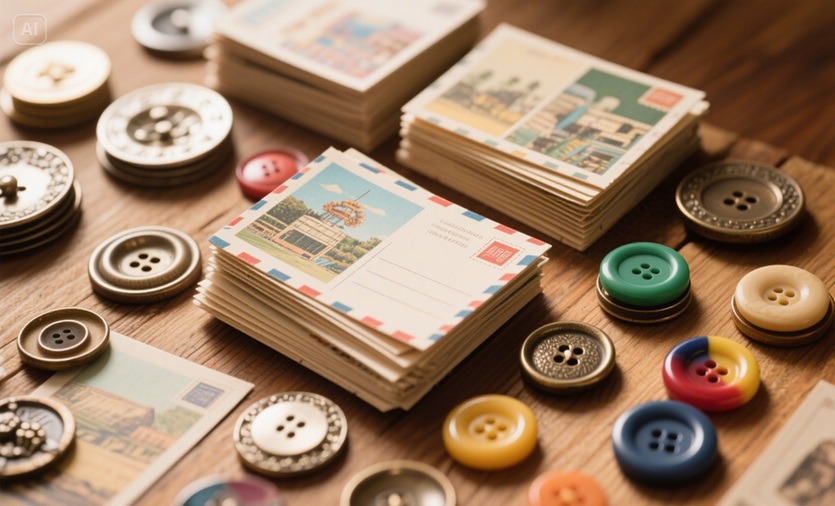
For sharing the collection, the library prints small button plates: matte cards with a photograph, provenance blurb, and catalog number. These are perfect for zines, postcards, or tiny gallery walls in cafes. If you want to stylize your own plates, a free AI art generator is a playful tool to experiment with background textures or to make whimsical frames that pair with button photos. Use generated textures sparingly—the object should remain the center of attention.
The reader’s alcove and how to listen
The reader’s alcove is dotted with small velvet cushions and tiny lamps. Here, patrons sit to read the appended stories that come with selected buttons. The stories are short—vignettes that imagine a life for the object: a button as the last thing a shy suitor touched before stepping bravely into a proposal, or as the thing that fell off a performer mid-anthem and later appeared beneath an empty theater seat. Some entries are factual, collected from donors; some are speculative, little fictions spun from clues. Both kinds ask the same thing: that we pay attention.
Listening is part of the exercise. Buttons are said to remember their last touch and will sometimes hum when held to the ear. This is, of course, gentle nonsense—but it’s the delightful kind that encourages attentiveness. People learn to slow down, to make space for small objects to speak.
Exhibits that invite participation
Each month, the library stages a small exhibit. One month might focus on “Buttons of Departure” with items found in suitcases and train coat pockets; another on “Buttons of Repair,” which traces needlework traditions across regions. Exhibits ask visitors to contribute: bring a button you found at a market, a spare that belonged to an old jacket, or a tiny story you recall from childhood. The library doesn’t hoard; it circulates meaning.
Workshops often happen—sessions on button conservation, short storytelling circles where participants craft miniature biographies for anonymous buttons, and swaps where people exchange buttons with a note. These events stitch the community to the collection and teach that small, ordinary things can anchor memory and connection.
Imaginative uses and playful projects
The Library of Lost Buttons inspires creative projects beyond repair.
- Artists are invited to borrow buttons as palimpsests for prints, poets to write micro-sonnets for single fasteners, and designers to create limited brooch editions from reclaimed collections.
- A community project once wove buttons into a tapestry made up of donated backyard garments—each button marked the maker’s name and a single wish.
For those looking to create visual tie-ins or promotional emblems for their tiny exhibits, a quick run through an AI logo generator can produce elegant little badges—icons that read well on small placards and online thumbnails. These emblems help make a pocket exhibit feel public and recognizable.
Playful catalog exercises you can try at home
If you want to practice the library’s gentle cataloguing at home, try a small exercise: pick five buttons from a drawer or collect five singletons at a thrift shop. For each, write a three-line entry: material and condition, a speculative provenance, and a one-sentence use for the future. Don’t worry about being “true”; the point is to listen to detail and find a story hidden in plain sight.
Another exercise is to stage a miniature exhibit across a windowsill: arrange the five buttons, write tiny labels, and invite a friend to view them. See how they invent histories for each piece—often more creative and kinder than you would expect.
Closing the reading room
The Library of Lost Buttons is a gentle antidote to an age that treats every small thing as trash. It asks us to slow down, to treasure the trivial, and to remember that belonging can be salvaged. Dreamina helps make the dream visible at the beginning and the end: generate an opening plate that imagines the lobby glow, then a closing image that captures a repaired button reunited with a coat.
Visit this imagined space—whether in the corner of your room, in a shoebox, or in a community zine—and invite one friend to bring a button and a story. The shelves are waiting, and every small fastener has a story that wants, quietly, to be told.