The Sun has ‘pimples’.
By Arvind Paranjpye,
Director, Nehru Planetarium
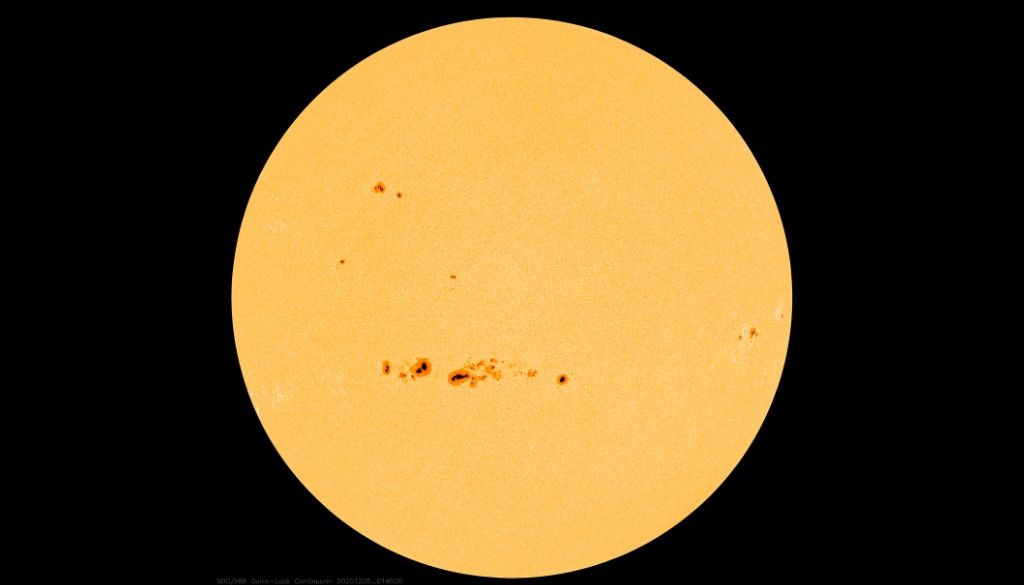
Mumbai, 5th December 2025: The Sun’s surface, called the photosphere in technical parlance, is currently dotted with numerous dark spots called Sunspots. Some sunspots are many times larger than the Earth. It is expected that we will continue to see these spots for the next 10 days or so. This is one of the rare events when so many large sunspots are seen. One such group was seen in 1947 and then in October 2014. Sunspots can unleash powerful X-class flares. These are also responsible for what is called a Coronal Mass Ejection (CME), when they spew out electrically charged particles, which can cause beautiful auroras near the northern and southern polar regions.
The temperature of a sunspot is about 4000 degrees Celsius, whereas the temperature of the photosphere is about 6300 degrees Celsius. Sunspots appear dark because they are relatively cooler regions on the Sun. If the area surrounding the sunspot is blocked and only the umbra or penumbra is seen, then they appear red or orange, respectively.
A closer look at a sunspot reveals a dark central region, called the umbra, and a surrounding less dark region, called the penumbra.
In the picture taken by NASA/Solar Dynamic Observatory, one can clearly see the sunspots’ umbra and penumbra.
The Sun is about 108 times the size of the Earth. One can also make out that
How to observe the sunspots – One should never look at the sun with naked eyes. One can use a wielder’s glasses with a number 14 or more. The best way to observe the sunspots is to project an image of the sun using a telescope. One can also use the safe eclipse goggles.
Some points.
· The earliest recorded sighting of sunspots is by Chinese astronomers, way back in 28 BC. Comparatively recently, in 1128, English monk John of Worcester drew the sun, showing sunspots.
· Such observations were made at sunrise/sunset or when the sun is seen through the fog. The sun is so bright that it can cause severe eye damage if viewed without appropriate filters.
· An English astronomer, Thomas Harriot (1560 – 1621), and an Italian astronomer, Galileo Galilei (1564 -1642), were the first to sketch the Sun and sunspots. But they did no further work.
· Galileo carefully observed the Sun and kept a systematic record of his observations. His drawings showed two distinct features, the umbra and the penumbra.
· The number of sunspots increases and decreases periodically over 11 years.
· The year that had the most number of sunspots is called the sunspot or solar maximum. After about five and a half years, there will come solar minima years. During the period of minima, one may not observe a single spot on the Sun for many weeks.
· Sunspots are associated with powerful magnetic fields
· Presently (2025), the cycle is at its peak.