They Quit Corporate Jobs and Built a Fairytale Mud House in the Himalayas—Now Guests Call It a Harry Potter Home
By Samiccha Malik
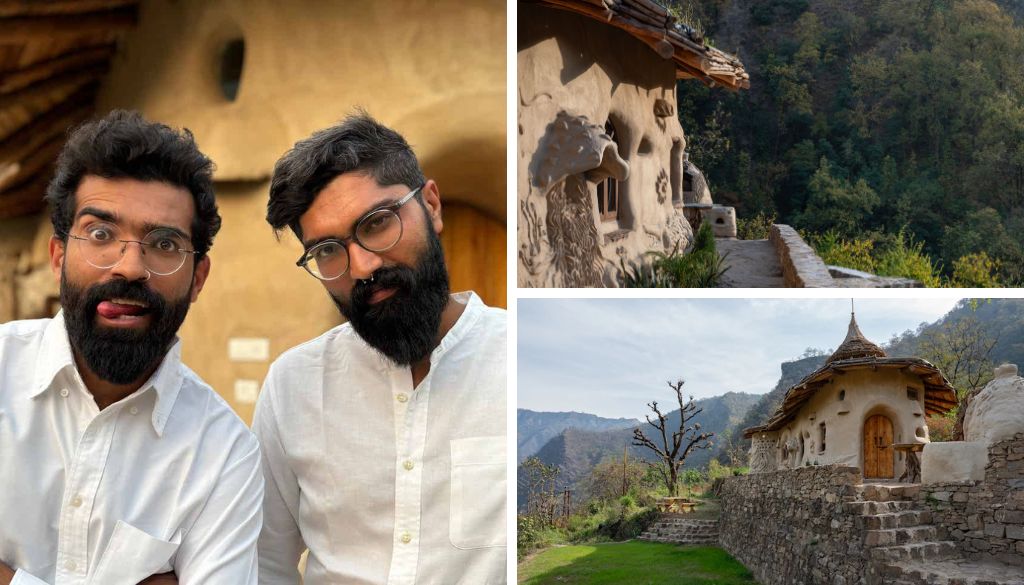
New Delhi, 5th June 2026: There is a house near Rishikesh that guests struggle to describe. Some call it a Harry Potter house. Others say it feels like something out of a hobbit story, or a fairytale they half-remember from childhood. Raghav Kumar, 32, who built it alongside his younger brother Ansh, 29, takes this confusion as a compliment. “Someone sees it as a Harry Potter house, someone sees it as a hobbit house, someone sees it as a fairytale house,” he says. “For us, it’s a labor of love, and every curve tells the story of all the beautiful people who had come and put in the effort.”
That effort was considerable and the story behind it begins not in the jungle, but inside the glass-and-steel corridors of corporate architecture.
A Leap of Faith
Raghav had interned with a German architectural company after architecture school, then transitioned into a full-time role at another German firm based in Ahmedabad. He loved the work culture and the flat hierarchy, but struggled with the long hours the kind where working yourself into exhaustion is worn as a badge of honour.His younger brother Ansh had followed a different path, interning in Germany before freelancing on sustainable architecture projects in mountainous and rural parts of India, where he got his first real taste of mountain life.
The pandemic changed the equation entirely. While quarantining at home in New Delhi, the two brothers began experimenting with making their own building materials ,testing mycelium from homegrown mushrooms, learning about cob, a natural building material made from soil, straw, and water. Somewhere in those months of forced stillness, a plan took shape. “Covid showed us life is short,” Raghav said. “We agreed that we needed to take a leap of faith.”
They prepared seriously before making that leap. They completed permaculture courses online, read books on self-build houses, and attended natural building workshops to be as prepared as possible for their rural endeavour.
The Place They Chose
The settlement they moved into near Rishikesh has only six houses, nestled at the foothills of the Himalayas, overlooking the Ganges. The surrounding forest lies in the buffer zone of a national park, which means the village is sometimes visited by elephants, bears, and leopards. The nearest grocery shop is 10 kilometres away.
Getting there requires commitment. Guests must park their cars and walk down to the river and cross a small wooden bridge built by the villagers a 1.5-kilometre trek through forest before the house even comes into view. There is no Wi-Fi, and this is by design. The remoteness is the point.
Building with Their Hands
The three-year project culminated in a functional Airbnb listing that now draws guests from across the country. The house named Tiny Farm Fort sits at roughly 600 square feet and is built using cob: a sustainable mixture of soil, straw, and water shaped entirely by hand. The construction was not a solo endeavour. The project drew participation from a remarkable range of people 90 individuals from 18 different countries volunteers who came and left their physical mark on the walls, the curves, the texture of the place.
The interiors are equally deliberate in their sustainability. A table was made from discarded slate salvaged from an old home’s roof. A chandelier was crafted from driftwood collected from the Ganges. Every piece of décor is, as the brothers describe it, a sustainable rendition. They see the space as more than a homestay. Ansh describes it as a museum that exhibits products and materials of different designers working with waste.
Community, Trust, and Belonging
Moving into a remote mountain village as two young men from Delhi was not without friction. The villagers were initially suspicious. The brothers had to earn their trust over time, adapting to local customs and accepting their outsider position with patience.Over the years, that distance closed. They currently share a rented house with the elderly mother of their landlord, whom they call “dadi,” and have daily meals together. On occasion, they project films on the outside walls of their house for the whole village to watch.
Raghav speaks about this adjustment with honesty. “It’s nice to hang out with friends, but I feel more anxious in the city. Everything is done for you. I don’t do any physical labour which means I’m not tired in the same way. The deep work happens in the mountains,” he said.
What the House Has Become
The Tiny Farm Fort now operates as a bed and breakfast, drawing what the brothers describe as conscious travellers people actively seeking disconnection. Ansh and Raghav are also dedicated to local ecotourism training and to advocating for accessible, sustainable living through mud house construction.
Guests who visit can go rafting on the Ganges, go birdwatching for species like the White-crested Himalayan Forest Laughing Thrush or the Red-billed Blue Magpie, learn to brew kombucha, or go foraging for mushrooms in the surrounding forest. The food served is grounding in its simplicity ; dal, roti, aloo sabzi – the kind of meal that asks nothing of you except that you sit down and eat it slowly.
At ₹13,000–14,000 a night, the Tiny Farm Fort is not inexpensive. But what the brothers have built is not easily replicated – it is three years of labour, a philosophy of living, and the quiet stubbornness of two people who looked at the city and decided there had to be another way.
“We wanted to build a house with our own hands,” Raghav has said, “something pure and sacred.”Walking 1.5 kilometres through jungle to reach it, with no signal on your phone and mud walls around you that ninety pairs of hands helped shape, it is hard to argue that they did not succeed.