Two Women Changing the Face of Modern Indian Poetry
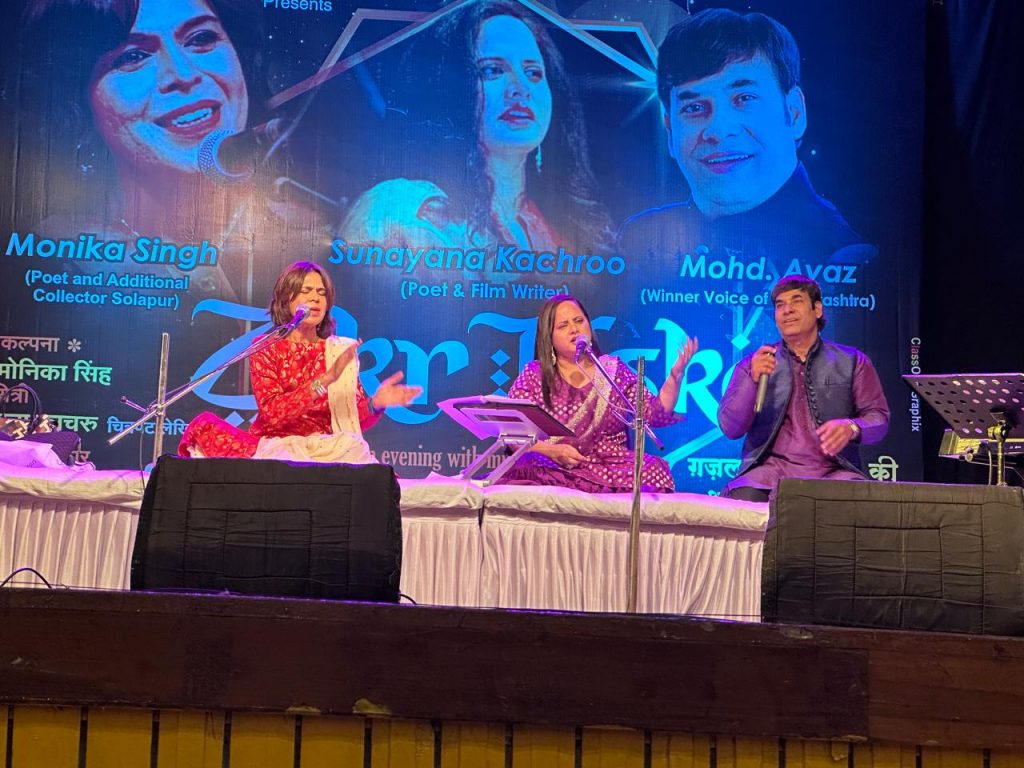
Pune, 1st September 2026: From a software professional and filmmaker based in Boston to an Additional Collector and Urdu poet in Maharashtra, Sunayana Kachroo Bhide and Monika Singh are taking original Hindustani poetry to new audiences and challenging a stage long dominated by men.
For decades, the Hindustani poetry stage has largely been a man’s world.
Men have dominated the mushaira, shaped its vocabulary and occupied the centre of the performance space. Women have always been part of its literary tradition, but far fewer have built a sustained presence as writers and performers of their own original poetry.
That is precisely where Sunayana Kachroo Bhide and Monika Singh are breaking new ground.
In 2018, the two poets created Zikr Uska, a unique poetry-and-music production built around original poetry written and performed by women. The concept was simple but powerful: two women poets bringing their individual voices into conversation through ghazals and nazms about love, loss, desire, faith, womanhood and everything in between.
The chemistry between the two is central to the format. One poet might speak of loss, the other of longing; one might explore desire, while the other examines an inner struggle. Rather than two separate recitals, Zikr Uska becomes a poetic conversation.
What began as an idea over coffee, after the two connected through social media and discovered a shared love for poetry, has grown into a performance journey spanning Pune, Delhi, Solapur and Boston. This year, Zikr Uska returns to Pune on September 6, with folk singer and performer Shounak Kulkarni joining the duo.
Maya Angelou once wrote, “There is no greater agony than bearing an untold story inside you.” Zikr Uska gives many such stories a voice—particularly those emerging from the lived experiences of contemporary women.
From Software to the Poetry Stage
Sunayana Kachroo Bhide’s journey is itself a story of crossing boundaries.
Raised in Kashmir, she moved to Pune for higher education before moving to the United States in 2000. For more than two decades, she built a career in technology and the corporate world. Alongside that professional life, she developed an increasingly significant creative identity as a poet, author, lyricist, filmmaker, creative producer and performer.
Her poetry reflects the multiple worlds she inhabits. Written across Hindi, Urdu, Kashmiri and English, it draws on Kashmir, migration, memory, displacement, love and the experience of living between cultures.
Kachroo is also a GRAMMY voter and has written lyrics for artists including Sonu Nigam, Shankar Mahadevan, Sunidhi Chauhan, Ali Sethi and Hariharan. She has authored three books—Waqt Se Ppare, Sunny Side Up and The Book That Saved Me.
Her recent illustrated work turns to the memory and trauma of Partition, bringing together poetry, visual storytelling and history.
Her creative career extends into cinema as well. Kachroo is the co-writer of the acclaimed film Songs of Paradise, inspired by the life and legacy of Kashmir’s legendary female playback singer Raj Begum. Her other work in film and storytelling has further established her as a creative voice operating well beyond the conventional boundaries of poetry.
Her work has taken her to literary and cultural platforms including Harvard, the Indian Consulate in New York and Capitol Hill.
The Additional Collector Who Writes Ghazals
Monika Singh’s story is equally unconventional, though her world is very different.
An Additional Collector in Ahilyanagar district, Singh works within the demanding environment of Indian civil administration. Yet alongside government files, public responsibilities and the pressures of a high-profile career is a deep engagement with Urdu poetry.
Singh is the author of three collections—Seher Ke Khwaab, Lams and Baat Baqi Hai. Her poetry explores love, spirituality, society and women’s experiences, bringing the emotional and philosophical vocabulary of Urdu poetry into conversation with contemporary life.
Her relationship with Urdu is not merely that of a poet drawn to the language. She pursued its formal academic study, earning both a BA and an MA in Urdu.
Her literary journey therefore runs parallel to her administrative career rather than serving as an escape from it. That duality is perhaps what makes her voice particularly distinctive: the poet and the public administrator coexist in the same person.
A Different Kind of Literary Revolution
What connects Kachroo and Singh is not simply that they are women. It is the fact that neither fits the traditional image of the poet.
One is a Kashmiri-born software professional who became a global Indian, filmmaker, lyricist, author and poet. The other is a senior civil servant who has made the demanding craft of Urdu poetry an essential part of her identity.
Their partnership challenges the idea that poetry belongs to a particular kind of life—or that women must enter an established literary space on someone else’s terms.
They are not abandoning the traditions of the ghazal and nazm. They are expanding who gets to inhabit them.
John Keats famously wrote, “Beauty is truth, truth beauty.” For Kachroo and Singh, poetry becomes a way of turning lived truth into art: the truth of migration, professional ambition, public responsibility, love, loss, history and contemporary womanhood.
And perhaps that is what makes Zikr Uska more than a poetry performance. It is a meeting point between tradition and contemporary experience, between two very different lives and, ultimately, between stories that have long existed but have not always found the stage on which to be heard.