Vishwakarma University Hosts AI Pre-Summit on Human Capital in the AI Era
Reported by Shoaib Tadvi
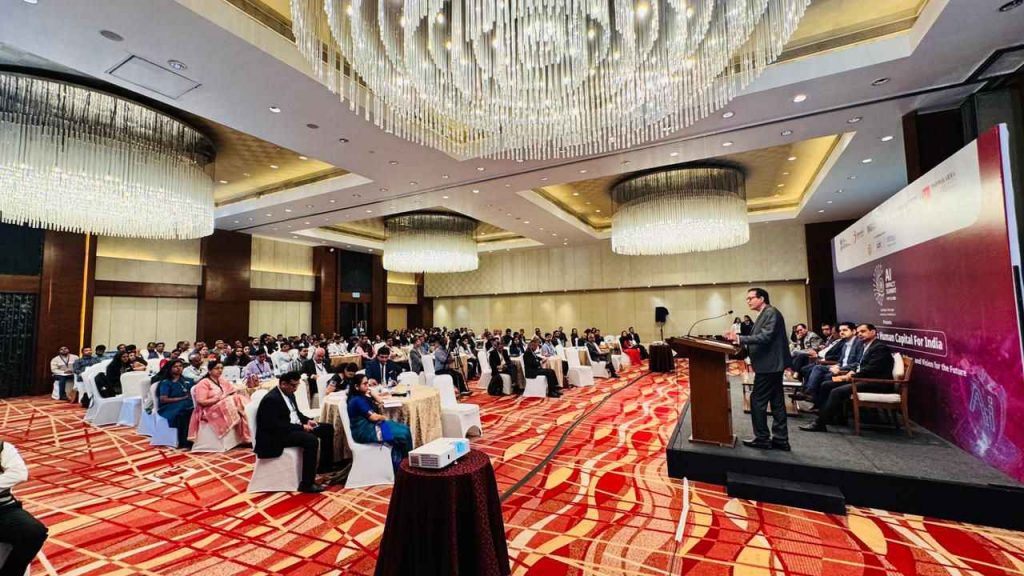
Kondhwa, December 16,2025: At a time when Artificial Intelligence (AI) is rapidly reshaping economies, workplaces and education systems, Vishwakarma University (VU) organised an AI Pre-Summit on “Human Capital in the AI Era” on Monday. The day-long summit, held at Hotel Hyatt Ista, Pune, was organised in collaboration with the All India Council for Technical Education (AICTE), the Ministry of Electronics and Information Technology, IndiaAI, Confederation of Indian Industry (CII) and Infosys.
The summit brought together policymakers, industry leaders, academicians, technology experts and students to deliberate on how India can strengthen its human capital to ensure inclusive, ethical and responsible adoption of AI, aligned with the national vision of Viksit Bharat 2047.
In his inaugural address, Bharat Agarwal, President, Vishwakarma University, highlighted the pivotal role of people in driving technological progress. He said that human capital attracts investment and fuels city development even when infrastructure and governance face limitations. “In the AI era, industry professionals, academicians and students are learning simultaneously, and sometimes students know more than teachers. AI is impacting every profession, including non-engineering fields. Pune continues to grow because it consistently develops talented human capital,” he noted.
Delivering the keynote address, Dr. Sunil Luthra, Bureau Head and Director, Training and Learning Bureau, AICTE, underlined the national and global significance of AI-driven transformation. He announced that India will host the AI Impact Summit in February 2026, aimed at presenting a future-oriented global agenda where AI supports inclusive human development, social empowerment and sustainability. “Converting India’s demographic dividend into an AI dividend requires future-ready curricula, continuous faculty upskilling, strong industry–academia collaboration, ethical AI practices and a culture of lifelong learning,” he said.
Pravin Kulkarni, Vice President and Delivery Head, Infosys – Pune Phase II and Mumbai, stressed the need to rethink work environments in the AI age. “Embracing AI is not only about technology but about redesigning work, the workforce and the workplace. AI should amplify human potential, not replace people, by building trust, collaboration and shared value,” he said.
Drawing parallels with historical transitions, Rohit Ramanand, Senior Vice President – Engineering, FIS, compared the current AI shift to the Industrial Revolution. He observed that while some jobs will be disrupted, new roles will emerge with different skill requirements. “Organisations that invest in reskilling and higher-value work will be the real winners,” he added.
Speaking on leadership and learning, Manish Tambe, Chief Executive Officer, Dassault Systèmes Global Services, said that working with AI demands not only technical capability but also strong human skills. “Creativity, critical thinking and leadership will remain uniquely human strengths. AI is not here to take jobs, but to make jobs better,” he remarked.
Emphasising collaboration, Rajnikant Behara, Executive Director, RSB Transmissions (India) Limited, stated that Viksit Bharat cannot be achieved without close cooperation between educational institutions and industry. “AI’s real value lies in solving national challenges in areas such as healthcare, sustainability and logistics, and that requires the right human capital,” he said.
The summit featured discussions on AI strategies for Viksit Bharat, AI awareness and sectoral impact, and sustainable and ethical AI, focusing on emerging skill requirements, curriculum transformation, faculty development and lifelong learning frameworks. Speakers consistently highlighted the need for human intelligence, ethical judgement and social responsibility to complement machine intelligence.
The AI Pre-Summit reaffirmed Pune’s position as a leading hub of education, innovation and thought leadership. Vishwakarma University stated that the initiative reflects its commitment to interdisciplinary learning, innovation and societal relevance, and is expected to contribute policy-relevant insights and practical strategies for strengthening India’s human capital ecosystem in the AI era.