When Duty Clashes With Humanity, Journalists Choose The Human Side
Pune 1st September 2026: When professional duty comes face-to-face with humanity, journalists and photographers still choose to be human. This was the strong message that emerged from a discussion on the pressures, uncertainty and challenges of journalism held in the city recently. The discussion followed a special screening of filmmaker Vikram Patwardhan’s Movie- Frame, organised by Belvalkar Sanskrutik Manch in association with Ashay Film Club.
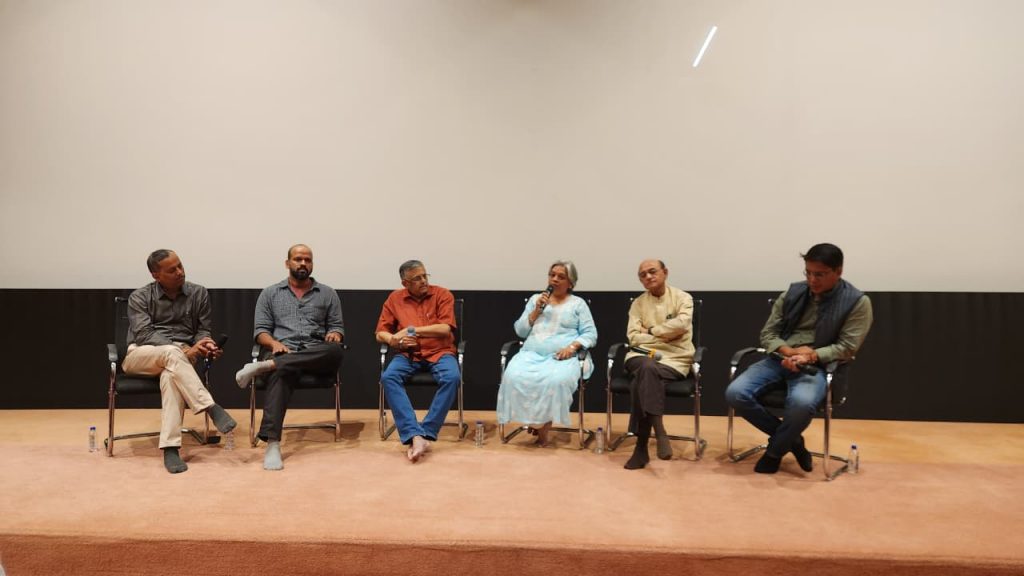
The session, titled ‘Patrakarita – Dhavpal aani Anishcitata (Journalism – Chaos and Uncertainty’), brought together senior editor Mukund Sangoram, photographer Pawan Khengare, Maharashtra Times chief correspondent Sunit Bhave, journalist Pratibha Chandran and filmmaker Vikram Patwardhan. Rajesh Damle moderated the discussion. Sameer Belvalkar of Belvalkar Cultural Forum and Satish Jakatdar of Ashay Film Club were also present.
Speaking about the demands of the profession, Sangoram said journalists and photographers have to be present at the scene of an incident, regardless of the time, place or circumstances. “Whether an incident is tragic or joyful, the journalist has to capture its essence accurately,” he said. A photograph or a news report becomes meaningful when it manages to stay with the reader, he added.
For Pratibha Chandran, years of reporting on events such as the Malin landslide, the Mandhardevi incident, the Mumbai terror attacks and elections brought her face-to-face with difficult choices. “Whenever I had to choose between professional duty and humanity, I chose humanity,” she said. She stressed that journalists must understand their professional responsibilities but also know when to step away from the role of a reporter and help a person in need. “The ability to take the right decision at the right time is extremely important,” she said.
Bhave said uncertainty, constant movement and change are part and parcel of journalism. “Something is always happening or going wrong. These are the challenges journalists deal with every day,” he said. He pointed out that the ground reality of an incident can often be understood only by reaching the spot. Journalists, he said, continue to make that effort despite the pressures involved.
Photographer Khengare, who has worked in the field for two decades, spoke about covering sensitive events at the state, national and international levels. “A photographer may not have words, but has a frame,” he said, adding that even in difficult situations, the challenge is to capture the moment with sensitivity. Recalling his experiences of covering the Malin disaster, boat accidents, fires and rescue operations, Khengare said photographers often find themselves caught between professional responsibility and human emotion.
Patwardhan, who has worked as a photographer himself, said the uncertainty and rush he experienced in journalism persist in the film industry as well. “However, when someone needs your help as a human being, other roles have to take a back seat. Helping that person should come first,” he said.