Investing in Commercial Real Estate? 5 Factors to Check Before Buying a Property
By Umesh Pawar, Founder & CEO, Dream Works Realty LLP
Pune, 29th September 2026: Over the last 14 years in real estate, after being involved in more than 1000 commercial real estate transactions, I have observed one common characteristic among serious and serial investors:
They do not buy a property simply because it looks attractive. They follow a defined decision-making process.
For investors whose primary objective is investment, passive income, long-term rental returns and capital appreciation, Commercial Real Estate (CRE) can be an effective asset class. However, successful CRE investment is not simply about finding the highest ROI.
It is about understanding price, yield, appreciation potential, deal value, liquidity and, most importantly, risk.
I believe that risk cannot always be avoided in real estate. But it can certainly be understood, calculated and managed.
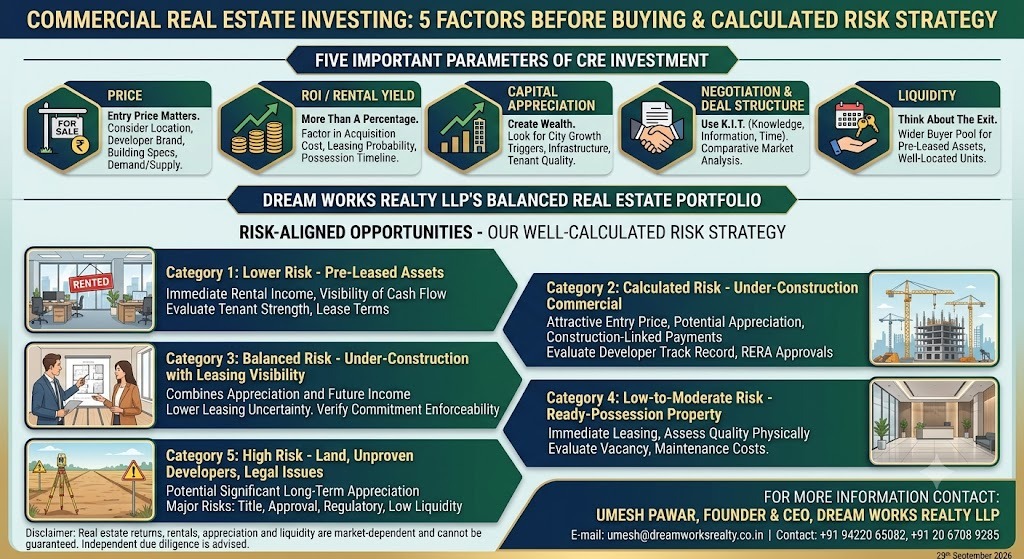
Five Important Parameters of CRE Investment
In my experience, most successful CRE investment decisions revolve around five major parameters:
1. Price
2. ROI / Rental Yield
3. Capital Appreciation
4. Negotiation & Deal Structure
5. Liquidity
Let us understand each of them.
1. PRICE — Your Entry Price Matters
One of the most important principles of real estate investment is:
Your return is influenced not only by when you sell, but also by how well you buy.
The price of a commercial property is determined by several factors.
Location
Not every property in the same city—or even in the same micro-market—commands the same price.
Main-road frontage, accessibility, floor, view, building position, surrounding development, public transport and proximity to business districts can significantly influence property values.
Developer & Project Brand
Established developers generally command a premium because of their track record, construction quality, delivery capability, property management and market reputation.
However, a premium price should always be justified by the quality of the asset and its future leasing potential.
Building Specifications
In commercial real estate, the quality of the building matters considerably.
Grade A or Grade A+ developments, efficient floor plates, adequate parking, modern elevators, power backup, security, fire compliance, good common areas and professional facility management can help attract quality occupiers.
Therefore, investors should compare not only the price per square foot but also what they are receiving for that price.
Demand & Supply
Real estate is ultimately driven by demand and supply.
When occupier demand is high and available commercial inventory is limited, both rentals and property prices generally have stronger support.
On the other hand, excessive supply in a micro-market can put pressure on rentals and increase vacancy periods.
Entry Stage
Developers normally revise prices at different stages of construction.
Investors entering at an early stage may benefit from a comparatively attractive acquisition price, provided the developer, approvals, location and project fundamentals are strong.
Early entry can create appreciation potential—but it also carries construction and execution risk.
2. ROI — Rental Return Is More Than a Percentage
Many investors begin by asking:
“What is the ROI?”
It is an important question, but ROI should never be evaluated in isolation.
Acquisition Cost
A lower acquisition cost can improve future rental yield and capital appreciation.
However, there is no single price-per-square-foot benchmark that guarantees a particular return. The right acquisition price must be evaluated against the prevailing and expected rentals of that specific micro-market.
The objective should be to identify the gap between:
Today’s acquisition cost and tomorrow’s income-generating potential.
Leasing Probability
A commercial property earns money only when it is occupied.
If a property remains vacant for six months or a year, the investor continues to bear costs such as property tax, maintenance, interest and the opportunity cost of capital.
Therefore, we prefer locations where occupier demand is deep enough that if one tenant leaves, there is a reasonable probability of another tenant entering within an acceptable period.
Occupancy probability is often more important than an attractive projected rental.
Maintenance & Occupier Experience
In many CRE leases, maintenance and operating costs may be passed on to or borne by occupiers depending on the lease structure. Even then, these costs need to remain competitive.
Modern commercial projects increasingly offer common meeting rooms, conference facilities, cafeterias, breakout areas, landscaped zones and employee amenities.
These facilities can improve the occupier experience, but they must also remain commercially sustainable.
A tenant ultimately evaluates the total cost of occupation, not merely the rent.
Possession Timeline
When investing in an under-construction property, delivery time becomes a direct component of investment return.
A substantial possession delay can postpone rental income and affect the investor’s overall IRR.
Therefore, before investing, study:
* Developer track record
* Previous project delivery
* Construction progress
* Approvals and RERA disclosures
* Financial and execution capability
Taxes and Acquisition Cost
Taxation should always be calculated as part of the investor’s total acquisition cost.
Completed ready-to-move properties sold after the applicable completion stage generally do not attract GST, although stamp duty, registration and other transaction costs remain applicable.
Under-construction commercial properties can attract GST. The applicable rate can vary depending on the nature and classification of the project. Commercial apartments in a qualifying Residential Real Estate Project can fall under a 5% structure, while commercial apartments in other real estate projects generally fall under a 12% structure. Investors should confirm the applicable tax treatment with their tax advisor before concluding a transaction.
A lower base price in an under-construction property does not automatically mean a lower acquisition cost.
Always calculate the all-inclusive cost.
3. CAPITAL APPRECIATION — Invest Where Tomorrow Is Being Built
Rental income creates cash flow.
Capital appreciation creates wealth.
Some of the important drivers of appreciation are:
City Growth Triggers
Growing employment, migration, business activity, industrial development, IT expansion and infrastructure investment can create long-term demand for real estate.
Cities and growth corridors experiencing sustained economic expansion can therefore create attractive opportunities—but the investor must identify the right micro-market within the city rather than relying only on the city name.
Infrastructure Development
Infrastructure can transform real estate values.
Some important triggers include:
* Metro connectivity
* New or widened DP roads
* Ring roads and highways
* Airports
* IT and business parks
* Industrial corridors
* Large institutional developments
* Social infrastructure
However, investors should distinguish between announced infrastructure and actually executable infrastructure.
Buy based on evidence, not only future promises.
Quality of Tenant
A strong tenant can improve the marketability of a commercial property.
Banks, multinational companies, listed companies, established corporates and recognised retail brands can make an investment more attractive to future buyers because the income stream may be perceived as more dependable.
But the tenant’s name alone is not enough.
An investor must also study:
* Lease tenure
* Lock-in period
* Escalation
* Security deposit
* Exit clauses
* Tenant financial strength
* Rental compared with market rent
Fit-Out and Property Enhancement
Commercial tenants frequently invest substantially in interiors, furniture, equipment and technology.
High-quality fit-outs can improve the usability and attractiveness of a property, although investors should remember that fit-outs may belong to the tenant depending on the lease agreement.
Therefore, fit-out value should not automatically be treated as permanent property value.
Ready Reckoner Value
Governments periodically revise Ready Reckoner or guidance values.
Increasing benchmark values can support the broader valuation environment, but market appreciation ultimately depends on actual demand, rentals, transactions, location and asset quality.
Ready Reckoner value should therefore be treated as one reference point—not the sole measure of appreciation.
4. NEGOTIATION — A Good Investment Is Often Made at the Buying Stage
A strong property at the wrong price can become an average investment.
An average opportunity purchased intelligently can sometimes become an excellent investment.
For negotiation, I use a simple principle:
K.I.T. — Knowledge, Information & Time
If you or your property advisor has:
Knowledge of the market,
Information about available opportunities, and
Time to study and negotiate,
your chances of concluding a better transaction increase significantly.
Comparative Market Analysis
Before negotiating, understand:
* Comparable transactions
* Developer inventory
* Resale inventory
* Prevailing rents
* Vacancy levels
* Recent registrations
* Competing projects
* Future supply
Negotiation backed by data is far more effective than negotiation based only on asking for a discount.
Investor Pool & Pre-Negotiated Opportunities
A buyer negotiating for one unit may have limited negotiating strength.
However, when multiple units are negotiated together—either by a single investor or a group of investors—the transaction size can create additional negotiating leverage.
This may help obtain better pricing, payment terms, preferential units or commercial terms.
Create a Win-Win Transaction
Negotiation should not always mean forcing the lowest possible price.
Developers may offer more attractive terms when buyers provide stronger payment schedules, faster decision-making or greater transaction certainty.
The most sustainable transactions are generally those in which both sides see value.
Understand the Decision-Making Structure
Negotiations can sometimes be faster when the developer has direct control over land, development, construction and sales.
In joint ventures, multiple-owner structures or projects involving several stakeholders, commercial decisions may require multiple approvals.
This does not make such projects inferior—but investors should understand the decision-making structure before expecting flexibility.
5. LIQUIDITY — Always Think About the Exit Before You Enter
Real estate is not as liquid as equity, mutual funds or fixed-income instruments.
You cannot always predict exactly when a property will sell.
Therefore, before purchasing, I ask investors to consider:
“If you need to exit this investment tomorrow, who is the next logical buyer?”
Assets that generally have a wider potential buyer pool include:
* Pre-leased commercial assets
* Well-located ground-floor retail shops
* Grade A offices
* Premium residential properties in established locations
* Legally clear NA plots near expanding city limits
This does not guarantee a three- or six-month exit.
But a property with good title, sensible pricing, strong location, rental demand and a wide buyer pool is generally better positioned for resale than a highly specialised or incorrectly priced asset.
Liquidity should be planned, not assumed.
Our Approach: The Well-Calculated Risk Strategy
At Dream Works Realty, we do not recommend the same property to every investor.
Every investor is different.
Before suggesting an opportunity, we try to understand the client’s:
* Investment objective
* Preferred location
* Age and investment horizon
* Risk appetite
* Existing real estate portfolio
* Current and future cash flow
* Expected rental income
* Capital appreciation expectations
* Ability to hold through market cycles
* Preference for pre-leased, ready-possession or under-construction properties
Based on these parameters, the objective is to balance and diversify risk instead of allocating the entire investment to a single category.
We broadly classify opportunities into five categories.
Category 1: Lower Risk — Pre-Leased / Pre-Rented Assets
These are completed commercial properties where a tenant is already occupying the premises and paying rent.
Advantages
* Immediate rental income
* Better visibility of cash flow
* Current rental yield can be calculated
* Suitable for passive-income investors
* Lower leasing uncertainty at the time of purchase
What Must Be Evaluated
* Tenant profile and financial strength
* Lease tenure
* Remaining lock-in
* Rental escalation
* Exit clauses
* Deposit
* Current rent compared with market rent
* Possibility of tenant exit
* Premium being paid for the existing lease
Suitable for: Investors prioritising regular income and relatively greater cash-flow visibility.
Category 2: Calculated Risk — Under-Construction Commercial Property
Investment is made during construction, generally at an earlier stage of the project’s price cycle.
Advantages
* Opportunity for an attractive entry price
* Potential appreciation until possession
* Construction-linked payment plans
* Potential future rental income
* Opportunity to enter emerging commercial locations early
What Must Be Evaluated
* Developer track record
* RERA and statutory approvals
* Construction progress
* Possession timeline
* Micro-market demand
* Future competing supply
* Leasing potential after completion
Suitable for: Investors with a medium- to long-term horizon who can wait for rental income.
Category 3: Balanced Risk — Under-Construction Property with Leasing Visibility
This category attempts to combine the appreciation potential of construction-stage investment with visibility of future leasing.
Advantages
* Potential construction-period appreciation
* Better visibility of future rental income
* Combination of potential capital growth and yield
* Lower leasing uncertainty than a completely speculative vacant property, where commitments are legally robust
What Must Be Evaluated
* Whether leasing is signed, committed, proposed or merely projected
* Enforceability of the agreement
* Tenant credibility
* Lease commencement conditions
* Construction-completion risk
* Developer execution capability
Suitable for: Investors seeking a combination of future income and capital appreciation.
Category 4: Low-to-Moderate Risk — Ready-Possession Commercial Property
The property is complete and available for occupation or leasing.
Advantages
* You can inspect the actual asset before buying
* No major construction-completion uncertainty
* Immediate leasing can be explored
* Prevailing rentals are easier to evaluate
* Building quality and operations can be assessed physically
What Must Be Evaluated
* Vacancy period
* Maintenance and holding costs
* Occupier demand
* Competing inventory
* Leasing brokerage and fit-out requirements
* Entry price compared with under-construction alternatives
Suitable for: Investors seeking greater asset certainty while being comfortable with some leasing risk.
Category 5: High Risk — Land, Unproven Developers & Legally Complex Opportunities
This segment can potentially generate substantial returns, but it requires deep due diligence, patience and stronger risk-bearing capacity.
Examples include:
* Open land
* Properties from relatively unproven or first-time developers
* Assets involving title disputes or legal complications
* Very early-stage opportunities where approvals are evolving
Potential Advantages
* Attractive early-stage entry
* Potential for significant long-term appreciation
* Opportunity to participate before full development of a location
* Land can become an important wealth-creation asset when location, title and development potential are strong
Major Risks
* Title risk
* Approval risk
* Regulatory changes
* Development uncertainty
* Longer investment horizon
* Little or no immediate cash flow
* Low liquidity
* Execution risk
Properties involving litigation or unclear title require particularly careful independent legal due diligence and should never be purchased merely because the apparent price is attractive.
Suitable for: Experienced investors with surplus capital, higher risk-bearing capacity and a long-term horizon.
The Right Investment Is Not Simply the One with the Highest Return
A 10% rental yield is not necessarily better than a 7% yield.
A low-priced property is not necessarily a good deal.
A famous tenant does not automatically make a property risk-free.
And an under-construction property is not automatically a high-risk investment.
Every opportunity must be evaluated in context.
At Dream Works Realty, our philosophy is to create a well-calculated real estate portfolio where risk is aligned with the investor’s age, income, cash flow, objectives, holding capacity and existing investments.
For one investor, a pre-leased office may be appropriate.
For another, an under-construction commercial property may provide the required growth potential.
For an experienced investor with surplus capital, strategically located land may have a place in the portfolio.
There is therefore no single “best property” for every investor.
There is only a property that is appropriate for that investor, at that price, at that stage of life and for that objective.
Risk Should Not Be Feared. It Should Be Calculated.
My biggest learning from more than 600 transactions is simple:
Successful real estate investing is not about avoiding every risk. It is about knowing which risks you are taking, why you are taking them and whether the potential reward justifies them.
Understand the risk.
Calculate the risk.
Diversify the risk.
And then take the right risk for the right reason.
That is what I call Well-Calculated Risk in Real Estate.
Disclaimer: Real estate returns, rentals, appreciation and liquidity are market-dependent and cannot be guaranteed. Investors should undertake independent legal, financial and tax due diligence before making any investment decision.
To Know More:
E-mail: [email protected]
Contact Details: +91 94220 65082 ; +91 20 6708 9285