Beyond the Plateau: Ahilyanagar’s Most Stunning Escapes
By Samiccha Malik
Ahilyanagar, 17th June 2026: Ahilyanagar (Ahmednagar) is Maharashtra’s largest district by area and it carries that scale in every sense. Stretching from the rain-shadow plains of the Deccan plateau in the east to the forested ridges of the Western Ghats in the west, it is a district of remarkable contrasts. Here, ancient forts built by Sultanate rulers stand alongside sacred temples that draw millions of pilgrims. A valley carved by water over millions of years sits within driving distance of a lake that glitters against a backdrop of forested hills. A village with no doors or locks on any of its homes quietly challenges everything you think you know about faith and community. And at its spiritual centre, a small town called Shirdi draws more visitors annually than almost any other religious site in India. Ahmednagar does not announce its greatness. It simply has too much of it to need to. Here are ten places in this extraordinary district that are absolutely worth your time.
1. Shirdi : Sai Baba Samadhi Mandir
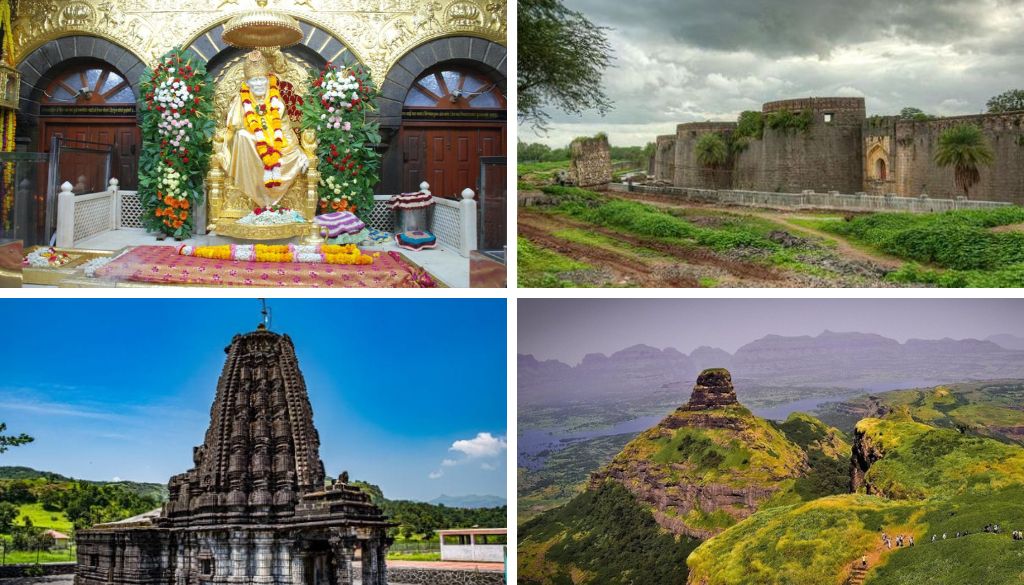
There are few places in India that carry the kind of quiet, universal spiritual power that Shirdi does. This small town in the northern part of Ahmednagar district is the home of Sai Baba the saint, mystic, and spiritual teacher who lived here from around 1858 until his passing in 1918, and whose message of love, compassion, and the unity of all faiths continues to draw millions of devotees from across the world every single year. The Samadhi Mandir, built over the place where Sai Baba was laid to rest, is a beautiful white marble structure whose interior is filled with flowers, incense, and a devotion so palpable it is almost physical. People of every faith come here Hindu, Muslim, Christian, Sikh and the atmosphere inside the temple, particularly during the aarti, is one of the most genuinely moving experiences Maharashtra has to offer.
2. Bhandardara : Arthur Lake & Wilson Dam
Tucked into the Sahyadri hills at an elevation of 750 metres, Bhandardara is one of those destinations that surprises people who come expecting a simple dam visit and leaves them wanting to return for longer. Arthur Lake the reservoir created by the Wilson Dam on the Pravara River is a wide, serene expanse of water ringed by forested hills that turns absolutely spectacular on monsoon mornings when mist sits low over the surface. The Wilson Dam itself, built in 1910, is an engineering landmark one of the earliest masonry dams in India and when the gates open in the rainy season, the water thundering through the spillway is a dramatic sight. Bhandardara is also the starting point for treks to Ratangad and Kalsubai, the highest peak in Maharashtra.
3. Sandhan Valley
There are places in Maharashtra that feel genuinely other-worldly, and Sandhan Valley is at the top of that list. Known locally as the Valley of Shadow, this narrow gorge cut into the basalt rock of the Sahyadris near Bhandardara is one of the most dramatic trekking experiences in the state. The walls of the valley rise sheer on both sides, sometimes narrowing to just a few metres apart, with the sky visible only as a thin ribbon of light far above. The trek involves wading through pools of clear water, crossing rock faces, and navigating sections where the sun barely reaches the floor. It is demanding and requires preparation but emerging from the other end of Sandhan Valley is one of those moments that trekkers in Maharashtra talk about for years.
4. Ahmednagar Fort
The fort that gives the district its name is a monument of considerable historical weight and architectural impressiveness. Built in the late fifteenth century by Ahmad Nizam Shah, founder of the Nizam Shahi dynasty, the fort was once considered one of the most formidable fortifications in the Deccan. Its circular design unusual among Indian forts with massive rounded bastions and a deep moat, was far ahead of its time. The British used the fort as a prison for prominent Indian nationalists during the independence struggle, and it was within these walls, during his confinement in 1944, that Jawaharlal Nehru wrote The Discovery of India one of the most significant books in Indian political and cultural history. Several rooms within the fort have been converted into a museum commemorating this period, giving the site a layered historical significance that goes far beyond its architecture.
5. Shani Shingnapur
Among all the unusual and remarkable places in Ahmednagar district, Shani Shingnapur stands apart in a category entirely its own. This small village, about 35 kilometres from Ahmednagar city, is home to the famous Shani temple a shrine dedicated to Shani, the deity associated with the planet Saturn and it has been built, maintained, and lived in without a single door or lock on any structure in the entire village. No home has a door. No shop has a shutter. No building has a lock. The community’s faith in Shani’s protection is so complete and so ancient that this tradition has held for centuries, and the village has an astonishing record of security. Visiting Shani Shingnapur is an encounter with a kind of faith that is rare and deeply thought-provoking regardless of your own beliefs.
6. Kalsubai Peak
At 1,646 metres above sea level, Kalsubai is the highest peak in Maharashtra and standing at its summit, with the entire spread of the Sahyadris visible in every direction, is one of the most exhilarating experiences the state’s landscape has to offer. The trek begins from the village of Bari near Bhandardara and ascends through forest, open ridgeline, and a series of iron ladders and fixed chains bolted into the rock face for the steeper sections. The climb is challenging but manageable for reasonably fit trekkers, and the rewards at the top are considerable a small temple dedicated to the goddess Kalsubai, sweeping panoramic views, and the particular satisfaction of standing at the roof of Maharashtra.
7. Ratangad Fort
Rising above the forests near Bhandardara, Ratangad is one of those forts that earns its reputation through sheer scenic magnificence. The fort sits on a dramatic rocky outcrop and is surrounded on three sides by deep valleys that drop away into the forest below. The trek to reach it passes through dense woodland and alongside streams, and the fort ruins at the top including the famous Nedhe, a natural hole in the rock through which the sky is perfectly framed are both historically interesting and visually extraordinary. Ratangad is particularly popular for overnight camping, when the forest around the fort falls completely silent and the stars above the Sahyadris are extraordinary.
8. Meher Baba’s Samadhi : Meherabad
One of Ahmednagar district’s most unusual and quietly profound sites is the samadhi of Meher Baba at Meherabad, about ten kilometres south of Ahmednagar city. Meher Baba was a spiritual master born in Pune in 1894 who attracted a following that spanned continents and included people of many different backgrounds and faiths. He spent much of his life at Meherabad, maintaining a silence he observed from 1925 until his death in 1969. His tomb on the hill at Meherabad is a simple, beautifully maintained structure that draws pilgrims and visitors from around the world – Americans, Europeans, Australians, Indians creating one of the most unexpectedly international pilgrimage atmospheres in Maharashtra. The hilltop setting, with views across the Deccan plains, adds a quiet grandeur to the experience.
9. Randha Falls
Near Bhandardara, where the Pravara River tumbles over a basalt ledge into the gorge below, Randha Falls is one of the most impressive waterfalls in western Maharashtra. During the monsoon months the falls are thunderous a wide curtain of white water dropping approximately thirty metres into the gorge, with mist rising in clouds that catch the light. The viewing area above the falls offers a dramatic perspective on the drop, and the surrounding landscape of forest and river valley is deeply beautiful. Randha is at its most spectacular from July to October, after which the flow reduces but the setting remains lovely. It is accessible and rewarding one of Bhandardara’s finest natural attractions.
10. Amruteshwar Temple
Deep in the forest near Ratangad, the Amruteshwar Temple is one of the finest examples of Hemadpanthi architecture in Maharashtra and one of the most beautifully located temples in the entire district. Built in the twelfth century during the Yadava dynasty, the temple is dedicated to Lord Shiva and is remarkable for the intricacy and quality of its stone carvings – figures of gods, celestial dancers, animals, and decorative motifs covering every surface in extraordinary detail. The temple sits in a forest clearing near the Pravara River, giving it an atmosphere of timeless tranquillity that is entirely in keeping with its great age. Combining a visit here with the Ratangad trek makes for one of the finest days out that Ahmednagar district has to offer.
Best Time to Visit
October to February is Ahmednagar’s most comfortable season – cool, clear weather ideal for fort treks, pilgrimages, and sightseeing. The monsoon from June to September is when Bhandardara, Sandhan Valley, and the district’s waterfalls are at their most dramatic and most beautiful. Kalsubai and Ratangad are best attempted between October and March when the trails are dry and the views are clear. Shirdi and Shani Shingnapur receive visitors throughout the year, with major festivals drawing particularly large numbers during Dussehra and Ram Navami.
Getting There
Ahmednagar district is well connected by road to Pune, Nashik, and Aurangabad. The Ahmednagar Railway Station provides rail connectivity to major cities. Shirdi has its own airport – the Shirdi Airport offering flights from Mumbai, Delhi, Hyderabad, and other cities, making the northern part of the district particularly accessible for visitors from across India.
Ahmednagar is a district where faith runs deep, history runs wide, and nature rises to extraordinary heights – sometimes literally. From the highest peak in Maharashtra to a village with no locks on its doors, it is a place that consistently surprises, consistently moves, and consistently rewards anyone willing to look beyond the obvious.